


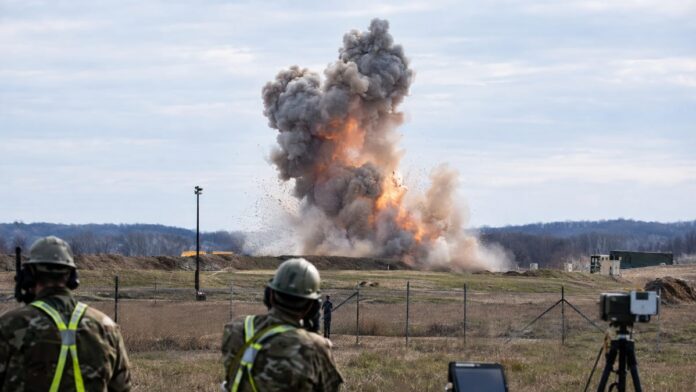
The U.S. Army on Wednesday destroyed nearly five tons of degraded lead azide at the Iowa Army Ammunition Plant in Middletown, setting off a controlled, mitigated detonation at 9 a.m. Central time after weeks of delays, a court fight and evacuation warnings across southeast Iowa.
One hour after the blast, every real-time air monitor run by the Environmental Protection Agency showed zero detection of airborne lead across the region. Federal and state officials hailed the operation as a success. Environmental groups now want a full accounting of how the stockpile reached a crisis point.
The Army’s controlled, mitigated detonation exceeded all expectations and was a HUGE success. The threat of an uncontrolled spontaneous detonation has been eliminated.
I am so proud of our SOLDIERS for their courage, training, mitigation, and precision! They put it on the line…
— Acting Secretary of the Army (@SecArmy) November 25, 2026
What the operation did
The Army Sustainment Command carried out the detonation on more than 60 barrels of lead azide, an explosive used to ignite munitions that had crystallized in storage and become too sensitive to move. Maj. Gen. Eric Shirley, who led the operation, said overhead coverage showed every barrel was destroyed. “There was no secondary explosions, there was no kickout, there was no infrastructure damage in or around our installation,” Shirley said.
Crews applied more than 3,600 gallons of aqueous foam to contain the blast, alongside earthen barriers, mister systems and water tanks set up around the site. The EPA had 300 employees and contractors on the ground and collected 1,200 air, land, dust and water samples beforehand to compare against post-blast readings.
Why it matters
The detonation ends a threat that had hung over Middletown since March, when the Army determined the material was becoming unstable. The blast was first set for Nov. 20 and slipped after the Iowa Environmental Council and the Sierra Club’s Iowa chapter, represented by Earthjustice, challenged the EPA’s emergency permit. The 8th U.S. Circuit Court of Appeals lifted its hold on Monday.
Gov. Kim Reynolds called the result “a best-case scenario for the residents of Middletown and its surrounding communities.” Agriculture Secretary Brooke Rollins said USDA has more than 1,900 employees in Iowa helping farmers, and sent Under Secretary Richard Fordyce to the state.
Daily Beltway analysis: Zero airborne lead is the best early number officials could have hoped for, but it covers only the air. Soil and water results will decide whether nearby farms and homes need cleanup.
The other side
Gov.-elect Rob Sand, a Democrat, thanked the crews but faulted the run-up. “The lead-up to the detonation should never have been so chaotic and unclear,” Sand wrote, calling for “immediate transparency” on how the situation developed.
There is obviously more testing to do that will provide certainty over time, but for now, federal officials have reported that lead dispersal should be limited, Iowans are safe, and damage to property is limited. I’m grateful to the experts on the ground who did all they could to…
— Rob Sand (@RobSandIA) November 25, 2026
The environmental groups said Iowans learned of the plan only days before the first scheduled blast. “Iowa and neighboring states deserve a full accounting of why the situation was allowed to get to the point of crisis,” said Sarah Green, executive director of the Iowa Environmental Council.
What’s next
EPA sampling of air, land and water continues, with remediation to follow if needed and real-time data posted at epa.gov/iowadata. Evacuated residents will be called once officials give the all-clear. The groups’ challenge to the EPA permit is still pending before the 8th Circuit, and the permit itself runs through Feb. 11, 2027.
Sources
- epa.gov
- governor.iowa.gov
- content.govdelivery.com
- iowapublicradio.org
- npr.org
- earthjustice.org
- cbs2iowa.com
- courtnews.org
- Original post: Acting Secretary of the Army (@SecArmy) on X, Nov 25, 2026
- Related posts reviewed for this report:
If an embedded post does not load, these links open the originals.