


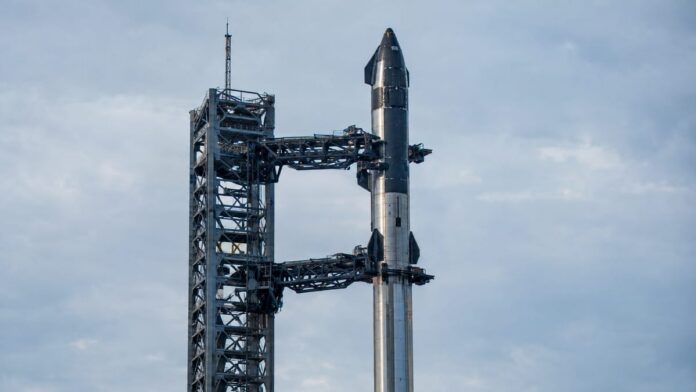
SpaceX caught the upper stage of its Starship rocket in midair for the first time on Saturday, snagging the spacecraft with the giant mechanical arms of its launch tower in South Texas after a flight of about 22 hours, the Associated Press reported.
The spacecraft completed 14 laps around Earth before descending toward its Texas launch site, Fox News said in a post on X. The capture was the first-ever catch of a Starship flying back from space, according to the AP.
SpaceX pulls off something it’s never done before, catching a massive Starship spacecraft in midair after it spends nearly an entire day orbiting Earth.
The spacecraft completes 14 laps around the planet before descending toward its Texas launch site, where giant mechanical arms… pic.twitter.com/h2GJ4lUiDS
— Fox News (@FoxNews) November 15, 2026
A first for the upper stage
The vehicle, known as Ship 42, settled into the tower’s “chopstick” arms at 4:20 p.m. Eastern, roughly 22.5 hours after Flight 15 lifted off, Space.com reported. SpaceX calls the tower “Mechazilla,” according to Space.com.
“Can you believe it?” SpaceX commentator Dan Huot shouted as the spacecraft lowered itself upright at the launch pad, the AP reported.
SpaceX had already caught its Super Heavy booster on three earlier test flights, but this was the first time the upper stage had been grabbed by the chopsticks, BBC News reported. Space.com noted the upper stage is a tougher target because it flies higher, farther and faster than the booster.
Booster catch aborted
The mission fell short of the double catch SpaceX had hoped for. The 407-foot rocket lifted off Friday afternoon from Starbase, and the plan was to grab the Super Heavy booster about six and a half minutes later, according to BBC News. Instead, the booster activated an automated abort, diverted to the ocean and exploded, the BBC reported.
Elon Musk posted on X that the booster was “slightly low on fuel,” according to the BBC. SpaceX’s Kate Tice said the booster’s engines stopped firing too soon on the way back down, the AP reported, and engineers are still investigating the cause. Wreckage remained in the Gulf of Mexico, cordoned off by buoys, according to the AP.
Satellites and reusability
After separating from the booster, the upper stage reached orbit and released 26 Starlink satellites, the AP reported. The spacecraft circled the planet about 165 miles up, according to the AP.
SpaceX officials said Saturday’s catch demonstrates the full reusability of Starship, which is intended for moon and Mars travel, the AP reported. SpaceX needs to reliably recover both parts of the rocket so that it can fly repeatedly and drastically reduce costs, according to BBC News.
Musk had said on the company’s third-quarter earnings call that “success is not guaranteed on these first flights,” The Verge reported, adding that he thought it was “more likely than not” the catch would succeed on the next flight.
Sources
- Fox News on X
- AP via NPR: SpaceX successfully catches Starship and makes history
- Space.com: SpaceX catches Starship upper stage for 1st time ever
- BBC News: SpaceX catches Starship rocket upper stage from space
- The Verge: SpaceX executes the first ‘chopstick’ catch of Starship
Sources cited
- https://www.npr.org/2026/11/14/g-s1-153786/spacex-successfully-catches-starship-and-makes-history
- https://www.space.com/space-exploration/launches-spacecraft/spacex-chopsticks-catch-starship-upper-stage-flight-14
- https://www.bbc.co.uk/news/articles/ckregdgnl0xpo
- https://www.theverge.com/science/1033930/spacex-chopstick-starship-catch
Sources
- Original post: Fox News (@FoxNews) on X, Nov 14, 2026
Posts on X are shown as published by their authors; claims in them are attributed, not independently confirmed unless the article says so. If an embedded post does not load, these links open the originals.