

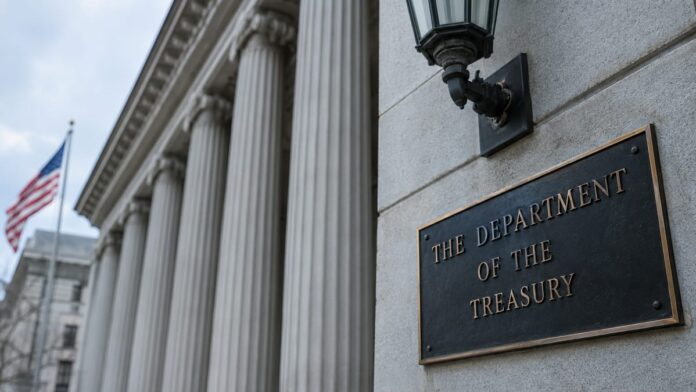
The Treasury Department’s Financial Crimes Enforcement Network on Tuesday proposed a rule that would let banks and other covered financial institutions ask for more information about the owners of business customers, including whether those owners have lawful immigration status and authorization to work in the United States.
The proposal implements Executive Order 14406, “Restoring Integrity to America’s Financial System,” which President Trump signed on May 19. It does not require banks to check every customer’s immigration status. It applies when other risk indicators or supervisory concerns warrant a closer look.
President Trump continues to safeguard American citizens, and today @FinCENnews proposal takes the next step in implementing the President’s historic Executive Order, “Restoring Integrity to America’s Financial System.” This action will strengthen customer due diligence…
— Treasury Department (@USTreasury) November 17, 2026
What the proposed rule does
The proposal would amend FinCEN’s Customer Due Diligence Rule, 31 C.F.R. 1010.230, in three ways.
First, it makes explicit that a covered institution may obtain additional information about the beneficial owners of a legal entity customer to mitigate risk or address supervisory concerns. That includes immigration status and employment authorization when relevant to assessing fraud, identity misrepresentation, sanctions evasion or other illicit financial activity.
Second, it would write into the rule FinCEN’s February exceptive relief order, FIN-2026-R001. Banks would no longer have to identify and verify a business customer’s owners every time that customer opens a new account. They would do it at the first account opening, when they learn facts that call earlier ownership information into question, and as their ongoing risk-based procedures require.
Third, it spells out the information banks must collect on each beneficial owner, including an identifying number. An Individual Taxpayer Identification Number, or ITIN, would not be an acceptable substitute for a Social Security number. FinCEN notes that the IRS issues ITINs for federal tax purposes only, and says it expects ITIN holders who are in the country legally and authorized to work to have other identification, such as a foreign passport or an alien identification card.
Why it matters
A 2016 FinCEN rulemaking required banks to identify the beneficial owners of business customers. Congress directed revisions to that rule in the Anti-Money Laundering Act of 2020.
Daily Beltway analysis: the proposal pairs a crackdown with a cleanup. It gives banks clear authority to ask hard questions when a shell company’s owners raise red flags, while dropping a paperwork requirement that made repeat business customers re-prove their ownership with every new account.
“Financial institutions are on the front lines of protecting our financial systems from criminal organizations and cartels that target law-abiding businesses and workers,” Treasury Secretary Scott Bessent said. “This proposed rule cuts unnecessary burden, gives institutions more flexibility to effectively combat risk, and strengthens our fight against financial crime.”
The banks’ response
The American Bankers Association strongly supported the earlier order ending the re-verification requirement. Its Banking Journal said the group plans to submit comments after reviewing the proposal in detail with members.
Some analysts doubted the underlying executive order when it was signed. “At first glance, we’re skeptical that the order will be highly impactful, but it could end up burdening banks with more compliance work and bureaucracy,” Ian Katz, managing director at Capital Alpha, told American Banker in May.
FinCEN itself is asking for comment on whether barring ITINs as a substitute for Social Security numbers is workable.
What’s next
Public comment is open on all parts of the proposal. Comments are due 60 days after the proposal is published in the Federal Register, under docket FINCEN-2026-0298, and can be filed at regulations.gov or by mail. FinCEN would then decide whether to issue a final rule.
Sources
- home.treasury.gov
- home.treasury.gov
- content.govdelivery.com
- bankingjournal.aba.com
- americanbanker.com
- foxnews.com
- Original post: Treasury Department (@USTreasury) on X, Nov 17, 2026
If an embedded post does not load, these links open the originals.