

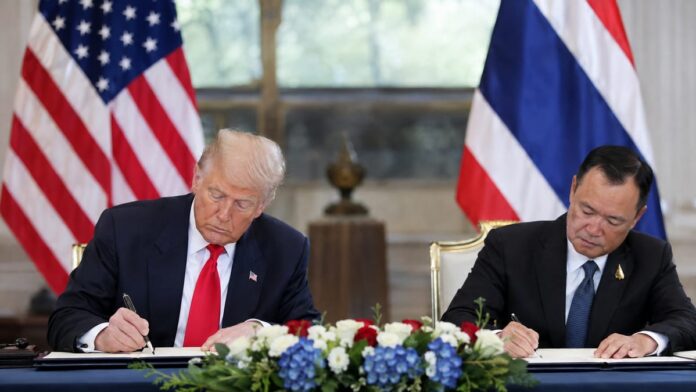
President Donald Trump and Thai Prime Minister Anutin Charnvirakul on Tuesday signed a joint statement in Manila confirming that the United States and Thailand have reached a substantial conclusion in talks on an Agreement on Reciprocal Trade.
The statement is not the trade agreement itself. Both governments will now begin the internal processes needed to prepare the deal for signature and entry into force, and no date has been set for that signing.
President Trump Participates in a U.S.-Thai Trade Deal Signing https://t.co/OwaPZp6GLA
— The White House (@WhiteHouse) November 17, 2026
What the statement and framework say
The Manila statement ties the agreement to the 1966 Treaty of Amity and Economic Relations and the 2002 Trade and Investment Framework Agreement between the two countries. It lists no terms.
Those terms come from the framework both governments announced on Oct. 26, 2025. Under it, Thailand would eliminate tariffs on about 99 percent of goods, covering U.S. industrial, food and agricultural products. The United States would keep a 19 percent reciprocal tariff on Thai goods, set under Executive Order 14257, while naming some products that could get a zero rate.
Thailand also committed to accept U.S.-built vehicles that meet federal safety and emissions standards, accept FDA approvals for medical devices and drugs, and issue import permits for U.S. fuel ethanol. Both sides agreed to finish commitments barring digital services taxes and easing foreign ownership limits for U.S. investment in Thai telecommunications.
By the numbers
- $2.6 billion a year: estimated Thai purchases of U.S. feed corn, soybean meal and distillers grains.
- $5.4 billion a year: estimated Thai purchases of U.S. LNG, crude oil and ethane.
- 80 U.S. aircraft, worth $18.8 billion.
- $84.9 billion: the U.S. goods trade deficit with Thailand from January through September 2026.
Why it matters
The trade gap the deal is meant to narrow has grown fast. The U.S. goods deficit with Thailand was $45.0 billion in 2024 and $71.7 billion in 2025. In the first nine months of 2026 it already topped all of 2025, as U.S. imports from Thailand reached $106.5 billion against $21.6 billion in exports.
Daily Beltway analysis: The Manila signing gives the White House a trade win during his Manila trip, but the binding text, and any tariff relief Bangkok wants, is still ahead. Thailand’s Commerce Ministry has said it hopes the statement improves its chances of favorable treatment on future U.S. tariff measures, including Section 301 measures on excess production capacity, The Nation reported.
Thailand’s red lines
The hardest issues are still open. U.S. requests include wider access for pork raised with the growth promoter ractopamine and removal of Thailand’s 49 percent foreign ownership cap in telecommunications.
Anutin said at the signing, “Yet there is still a little more to do. I’m confident that the agreement will be ready for us to sign real soon,” Anadolu Agency reported. Deputy Prime Minister and Commerce Minister Suphajee Suthumpun has held firm: “Thailand’s three red lines remain unchanged: sanitary and phytosanitary standards concerning pork imports containing growth promoters, security, and investment,” she said. “The US wants 100% ownership in certain sectors, such as telecommunications.”
What’s next
No date has been set to sign the final agreement. In Thailand, legal teams must settle the text before it goes to the Cabinet, which endorsed the draft joint statement on Nov. 10. Parliamentary review and a public consultation follow, and the agreement’s details are to be disclosed during that process.
Sources
- whitehouse.gov
- whitehouse.gov
- ustr.gov
- census.gov
- aa.com.tr
- nationthailand.com
- nationthailand.com
- Original post: The White House (@WhiteHouse) on X, Nov 17, 2026
If an embedded post does not load, these links open the originals.