


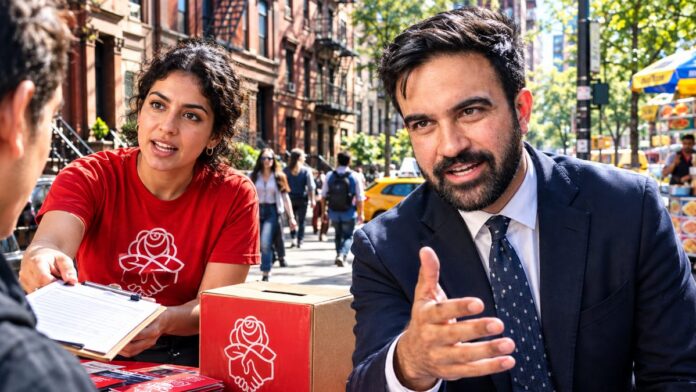
New York City Mayor Zohran Mamdani Launches Fundraising Drive for Democratic Socialists of America, Platform Seeks to Abolish Senate and Electoral College
New York City Mayor Zohran Mamdani has launched a public fundraising campaign for the Democratic Socialists of America, urging New Yorkers to commit to recurring monthly donations that he says will expand the organization’s presence in elected office across the state and beyond. In a video appeal posted this week, Mamdani framed small contributions as an investment with proven returns, citing the group’s success in placing more than a dozen democratic socialists in the state legislature, four on the city council, three in Congress, and himself in the mayor’s office.
Mamdani’s pitch ties monthly donations of five, fifteen, or fifty dollars directly to the goal of electing more socialists at every level of government. He described the DSA’s organizing work as delivering for working people at the ballot box, in workplaces, and at home, emphasizing that even a volunteer-driven organization requires funding for rent, materials, and a small paid staff whose efforts are amplified by volunteers. The mayor closed his appeal by suggesting that contributions at those levels could result in another five, fifteen, or fifty socialists holding elected office, calling it potentially the best deal in town.
NYC Mayor Mamdani is now fundraising for the Democratic Socialists of America.
The DSA’s platform calls for abolishing the Senate and Electoral College, putting the president and Supreme Court under Congress, and drafting a constitution for a “democratic socialist republic.”…
— Open Source Intel (@Osint613) November 19, 2026
The Democratic Socialists of America platform that Mamdani is now actively promoting includes sweeping proposals to abolish both the Senate and the Electoral College, two foundational elements of the American constitutional system. The platform also calls for placing the president and the Supreme Court under the direct control of Congress, effectively eliminating the separation of powers enshrined in the Constitution. Perhaps most radically, the DSA advocates drafting an entirely new constitution to establish what it describes as a democratic socialist republic.
Beyond structural changes to government, the DSA platform outlines an agenda that would fundamentally reshape American society. It calls for phasing out police and prisons, shifting major industries to public ownership, and guaranteeing housing, healthcare, and education as government-provided rights. The organization also advocates for a mandatory thirty-two-hour workweek, open borders, and blanket amnesty for all individuals in the country illegally.
Mamdani’s decision to serve as a visible fundraiser for the DSA places the mayor’s office in direct alignment with these objectives. His video message makes clear that the contributions are intended not for general civic engagement but specifically to replicate and scale the electoral successes the organization has already achieved. By framing the pitch around concrete outcomes—more socialists in office—Mamdani treats political fundraising as a mechanism for advancing institutional transformation rather than routine campaign support.
The timing of this appeal is notable. Mamdani positions himself as a mayor who governs according to the same priorities the Democratic Socialists of America have pursued at every level. The fundraising message ties directly to the group’s organizing infrastructure, presenting recurring gifts as the financial foundation for volunteer coordination and staffing that has already produced electoral victories in New York. The appeal underscores an explicit goal of expanding the organization’s influence rather than merely advocating for policy changes within existing political structures.
The DSA’s platform proposals targeting the Senate, Electoral College, and constitutional order represent a wholesale rejection of the system of checks and balances that has governed the American republic for more than two centuries. Abolishing the Senate would eliminate state-based representation, while eliminating the Electoral College would concentrate presidential election outcomes in the most populous urban centers. Subordinating the executive and judicial branches to Congress would centralize power in a single legislative body, fundamentally altering the balance of authority the framers designed to prevent tyranny.
The economic and social dimensions of the DSA agenda are equally sweeping. Public ownership of major industries would replace private enterprise with centralized government control, a hallmark of socialist economies historically associated with inefficiency and reduced innovation. Phasing out police and prisons would dismantle law enforcement and incarceration systems without clarity on what institutions would replace them or how public safety would be maintained. Guaranteeing housing, healthcare, and education as rights shifts these goods from market-driven sectors to government provision, raising questions about cost, quality, and sustainability.
The platform’s immigration provisions—open borders and amnesty—would eliminate enforcement of immigration law and legal distinctions between citizens and non-citizens. Combined with the thirty-two-hour workweek mandate, these policies represent a vision of expanded entitlements and reduced enforcement that would require unprecedented levels of taxation and government authority.
Mamdani’s public alignment with these goals through active fundraising raises questions about the role of elected officials in advancing organizational agendas that seek to replace rather than reform existing governance structures. By explicitly tying donations to the goal of electing more socialists, the mayor frames the DSA’s work as a long-term project to change not just policy but the constitutional foundations of the country.
The mayor’s appeal comes as the Democratic Socialists of America continues to gain traction in Democratic primaries and local races, particularly in urban areas like New York. The organization’s strategy focuses on building grassroots volunteer networks and electing candidates who openly identify as socialists, rather than working within traditional party structures. Mamdani’s success in winning the mayoralty of the nation’s largest city represents the most high-profile victory for the movement to date.
By publicly fundraising for the DSA and explicitly linking contributions to the goal of electing more socialists, Mamdani signals that his mayoralty is not a departure from the organization’s agenda but an extension of it. The video message treats the DSA’s platform—including its calls to abolish core constitutional institutions—as a roadmap for governance rather than a fringe position. For New Yorkers and Americans watching this movement grow, the question is whether voters understand the full scope of what they are being asked to support.
Sources
- Original post: Open Source Intel (@Osint613) on X, Nov 19, 2026
- Related posts reviewed for this report:
- Moshe Spern (@moshespern) on X, Nov 19, 2026
- Polymarket (@Polymarket) on X, Nov 19, 2026
- 🇺🇲PrConservative🇵🇷 (@pr_conservative) on X, Nov 19, 2026
Posts on X are shown as published by their authors; claims in them are attributed, not independently confirmed unless the article says so. If an embedded post does not load, these links open the originals.