


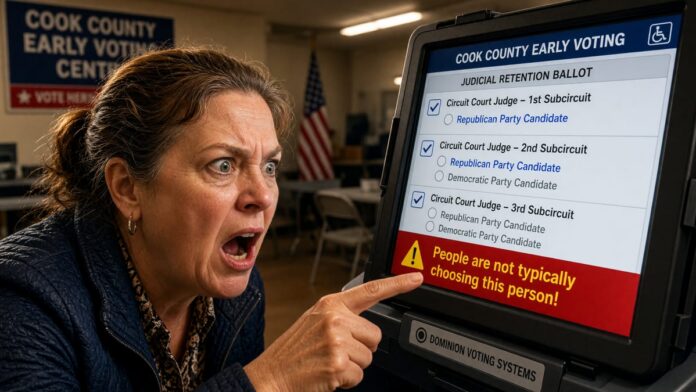
Cook County Voting Machines Flash Warning Against Republican Choices, Voter Says
A suburban Cook County voter says Dominion voting machines displayed a message discouraging her from selecting Republican judicial candidates during early voting this week, raising fresh questions about ballot interface design and election integrity in Illinois.
The woman, who lives in Streamwood within Cook County, described the incident in a video that has since circulated widely on social media. She said she went to vote early despite living in a heavily Democratic state, viewing it as her civic duty. When she reached the judicial retention section of the ballot and selected Republican judges, a notification appeared on the screen reading, “people are not typically choosing this person,” followed by an exclamation mark.
HOLY CR*P 🚨 American went to vote in Illinois, she says when selecting the conservative candidate the screen displays a message that says “people are not typically choosing this person, exclamation mark”
“I picked the Republican judges and once I selected one of the judges, I… pic.twitter.com/zmquciWwTm
— Wall Street Apes (@WallStreetApes) October 20, 2026
The message remained visible until she had selected all three Republican judicial candidates. Only then did the warning disappear. The voter questioned why a ballot would inform her that her choices were not the more popular ones, calling the feature a form of election rigging designed to influence voters by suggesting that certain candidates lack broad support.
Cook County uses Dominion Voting Systems equipment for ballot tabulation and display, according to the Illinois State Board of Elections’ official equipment log. Dominion is listed as both the equipment vendor and the support vendor for the county’s voting machines, meaning the company controls both the hardware and the software that voters interact with.
The voter argued that displaying a message about what other people are selecting introduces external pressure into a process that is supposed to remain private and free from influence. She said the notification was clearly intended to sway decisions by making Republican choices appear fringe or unusual.
Concerns about electronic voting equipment have persisted for years in Illinois, particularly in Cook County where Dominion systems handle a large portion of the state’s vote tabulation. Critics of such systems have long argued that any feature highlighting collective voter behavior or popularity undermines the neutrality of the ballot. The reported notification raises the question of whether machines should be programmed to comment on voter patterns at all.
The woman’s account aligns with broader conservative skepticism toward the use of proprietary voting systems in jurisdictions controlled by Democrats. Electronic interfaces that reference what other voters are doing, even indirectly, risk eroding confidence in the integrity of local elections, especially in down-ballot races such as judicial retention votes where name recognition is low and party affiliation is often the primary cue.
Officials in Illinois have not addressed the specific notification described by the voter. The Illinois State Board of Elections has not issued a statement explaining whether such a feature is standard, optional, or a malfunction. Cook County election authorities have also remained silent on whether the message was triggered by a threshold of selections or by some other programmatic condition.
The incident has drawn attention from conservative commentators and election integrity advocates who view it as evidence that voting machines should not be trusted to remain neutral. The voter herself said that everyone needs to share this because it is election rigging, emphasizing that any system which comments on the popularity of a candidate while a voter is making a selection is by definition designed to influence the outcome.
The dominion voting machines illinois lawsuit controversy continues to simmer as Illinois voters head to the polls. This latest report adds another data point to ongoing debates over how voting machines are programmed, who controls their software, and whether they should remain free of any messaging that references collective choices.
Conservatives have argued for years that electronic voting systems introduce vulnerabilities that paper ballots do not. The Cook County incident, if verified, would represent a new frontier in that debate: not just the question of whether machines can be hacked or miscalibrated, but whether they are designed from the outset to nudge voters away from certain candidates by invoking social proof.
The voter’s description of the notification as appearing after she selected one judge and disappearing after she selected all three suggests that the feature may be tied to a pattern recognition algorithm. If the system is programmed to flag selections that deviate from a statistical norm, that programming itself becomes a form of editorial control over the ballot.
Illinois has faced scrutiny over election administration before, particularly in Cook County where turnout patterns and ballot handling have been the subject of lawsuits and audits. The state has resisted calls for stricter voter ID laws and has been slow to adopt transparency measures that would allow independent verification of machine accuracy.
The cook county dominion ballot warnings described by the voter fit a pattern of dysfunction and mistrust that has plagued Illinois elections for decades. Whether the notification was a feature, a bug, or a deliberate attempt to discourage Republican voting remains unclear. What is clear is that any system which tells voters that their choices are unusual is a system that has abandoned neutrality.
The woman’s video has sparked renewed calls for audits of Dominion systems and for greater transparency around how ballot interfaces are designed. Without access to the source code and without independent testing, voters in Cook County and across Illinois have no way of knowing whether the machines they are using are truly neutral or whether they are programmed to favor certain outcomes.
The incident also highlights the broader problem of relying on proprietary systems in a republic where transparency and accountability are supposed to be the foundation of legitimate government. When a private company controls the software that counts votes and displays ballots, and when that company refuses to disclose how the software works, the public is asked to trust without the ability to verify.
For now, the Cook County voter’s account stands as one more piece of evidence in a growing file of concerns about electronic voting. Officials have not responded, the media has largely ignored it, and the machines remain in use.
Sources
- Original post: Wall Street Apes (@WallStreetApes) on X, Oct 20, 2026
- Related posts reviewed for this report:
- The SCIF (@TheSCIF) on X, Oct 20, 2026
- Lori Roberts (@handEchic) on X, Oct 20, 2026
- ADKWoman (@WomanAdk) on X, Oct 20, 2026
Posts on X are shown as published by their authors; claims in them are attributed, not independently confirmed unless the article says so. If an embedded post does not load, these links open the originals.