


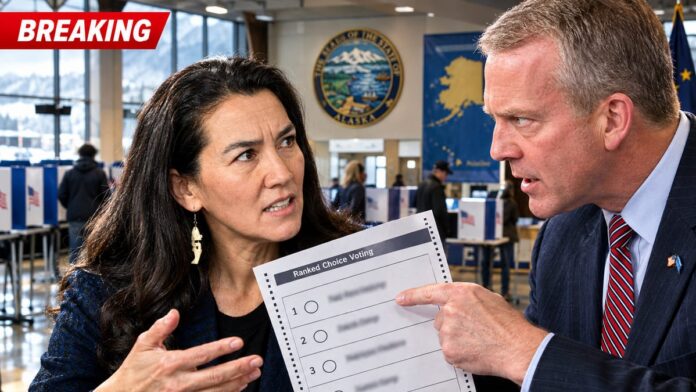
New York Times Exposes Mary Peltola Campaign’s Alleged Vote-Splitting Scheme in Alaska Senate Race
A bombshell New York Times investigation has revealed that aides to Democratic Alaska Senate candidate Mary Peltola directed campaign staff to search voter rolls for people named Dan Sullivan in an alleged scheme to exploit ranked-choice voting and siphon votes from Republican incumbent Senator Dan Sullivan.
According to the Times report, published six days before the November 3 election, a Peltola campaign staffer received explicit instructions from high-ranking campaign officials during the summer of last year to locate as many Alaska residents named Dan Sullivan as possible. The goal was clear: if the campaign or its Democratic allies could convince another Dan Sullivan to enter the race, the resulting voter confusion under Alaska’s ranked-choice voting system could cost Senator Sullivan critical votes.
🔥🚨 BREAKING — BOMBSHELL: A Democrat staffer for Senate candidate Mary Peltola was instructed by high-ranking campaign officials to search Alaska rolls for a man named “Dan Sullivan” specifically to steal votes from Sen. Dan Sullivan, according to the New York Times.
In the… pic.twitter.com/8DMIYmU1fD
— The Patriot Oasis™ (@ThePatriotOasis) October 28, 2026
The plan appears to have succeeded. Two candidates named Dan Sullivan now appear on Alaska’s Senate ballot.
The Times based its investigation on interviews with twelve people, dozens of text messages, and internal campaign documents. The reporting directly contradicts weeks of Democratic denials. Before the Times story broke, Democrats had dismissed Republican concerns about ballot manipulation as conspiracy theory, particularly after President Trump’s Justice Department filed a lawsuit challenging irregularities in Alaska’s election administration.
The Peltola campaign has denied recruiting the second Dan Sullivan candidate. But the evidence trail documented by the Times, combined with the circumstances surrounding the second candidate, has Republicans convinced the scheme is real.
The second Dan Sullivan — identified in some reports as Dan J. Sullivan to distinguish him from the incumbent senator — shares an identical surname with the Republican he is allegedly helping to defeat. He has a documented voting history as a Democrat. He has never been publicly associated with the Republican Party. And when asked directly about allegations that his candidacy exists solely to split votes, he did not deny it.
In a brief email exchange with Fox News correspondent Matt Finn, the second Sullivan defended his campaign as legitimate but offered a telling response when confronted with the fraud allegations. Asked what he would say to critics who believe he is running only to take votes from Senator Sullivan, Dan J. Sullivan wrote that every candidate in the race is trying to get as many votes as possible and that Alaskans are struggling after twelve years under the incumbent senator’s tenure. He portrayed his campaign as advocating for change.
He did not deny the scheme.
President Trump, who has campaigned for Senator Sullivan in Alaska and sent Vice President JD Vance to the state as well, told reporters two weeks ago that his administration was investigating the matter. Trump said he believes the Dan J. Sullivan campaign is a hoax and that the candidate has nothing to do with politics. On Wednesday, after the Times report was published, Trump went further, saying Mary Peltola should not be allowed to remain on the ballot and should face legal and political consequences for what she has done.
The alleged scheme exploited a unique vulnerability in Alaska’s election system. Unlike traditional ballots that separate candidates by party affiliation, Alaska’s ranked-choice voting format allows multiple candidates to appear on the same ballot without mandatory party designation. Voters rank their preferences, and if no candidate wins a majority in the first round, the lowest vote-getter is eliminated and their votes are redistributed based on second-choice rankings.
This format created the conditions that made the alleged plot viable. Two Dan Sullivans can appear on the same ballot with no clear party label to distinguish them. Voters unfamiliar with the candidates could easily split their support between the two, inadvertently helping the Democrat.
Ranked-choice voting has been controversial in Alaska since voters narrowly approved it in a 2020 ballot measure funded heavily by outside liberal groups. Republicans have argued the system is designed to disadvantage conservative candidates in a state that has historically leaned Republican. This scandal appears to validate those concerns.
Fox News correspondent Matt Finn, who has reported from Alaska twice in the past month and plans to return to the state, said Republicans on the ground are not even entertaining the possibility that the second Dan Sullivan campaign is legitimate. They are talking about it as if it is a known fraud, Finn reported, pointing to the identical name, the Democratic voting history, the lack of any Republican affiliation, and now the Times reporting that corroborates the recruitment effort.
A lawsuit has already been filed over the ballot irregularities, and evidence is now headed to court. Every ballot cast under the circumstances created by the alleged scheme is now under scrutiny.
The timing of the Times investigation — published less than a week before Election Day — has raised questions about why the paper held the story until the final days of the campaign. Some conservative observers believe the delay was designed to minimize the fallout for Peltola and Senate Democrats. Others believe the Times was forced to publish after the Justice Department lawsuit and Trump’s public statements made the allegations impossible to ignore.
Either way, the damage is done. The scheme is now public, the evidence is documented, and Alaska voters are heading to the polls knowing that Democratic operatives allegedly gamed the system to manipulate the outcome of a United States Senate race.
This is not a hypothetical concern about election integrity. This is a documented effort, reported by the New York Times, to exploit a vulnerable election system and deceive voters in a race that could determine control of the Senate.
The republic’s election systems are built on the assumption that candidates and campaigns operate in good faith. When that assumption breaks down, when operatives actively recruit fake candidates to split votes and confuse the electorate, the system itself is under attack.
Alaska voters will render their verdict on November 3. The courts will render theirs in the months ahead. But the precedent is already set: ranked-choice voting, sold to the public as a reform, has been exposed as a tool for exactly the kind of manipulation its proponents claimed it would prevent.
Sources
- Original post: The Patriot Oasis™ (@ThePatriotOasis) on X
- Related posts reviewed for this report:
- Eric Daugherty (@EricLDaugh) on X, Oct 28, 2026
- Eric Daugherty (@EricLDaugh) on X, Oct 28, 2026
- Nick Sortor (@nicksortor) on X, Oct 28, 2026
Posts on X are shown as published by their authors; claims in them are attributed, not independently confirmed unless the article says so. If an embedded post does not load, these links open the originals.