


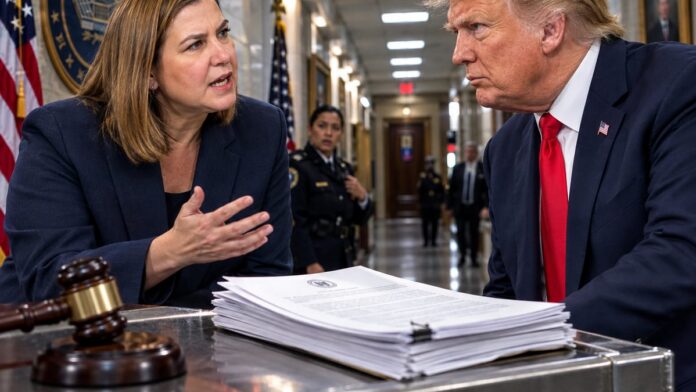
Michigan Senator Elissa Slotkin Deflects Criticism With Gender Card After Deterrence Comments Resurface
Michigan Democratic Senator Elissa Slotkin is attempting to reframe criticism of her controversial remarks about Trump administration officials by claiming the backlash stems from her gender rather than the substance of her statements.
In a recently surfaced video, Slotkin responded to mounting criticism by suggesting that being a woman who calls out what she characterizes as corruption particularly irritates the Trump administration. The senator referenced past interactions she described as gendered attacks, including mentions of the Second Amendment.
🚨 NOW: Sen. Elissa Slotkin is acting UNHINGED after she got caught red-handed planning political persecutions of conservatives, saying we ONLY criticize her because she's a WOMAN 🤡
"There's something about being a woman…that REALLY gets under their skin."
She's the one who… pic.twitter.com/wrgvqVLG7Y
— Eric Daugherty (@EricLDaugh) October 19, 2026
The comments come as Slotkin faces renewed scrutiny over statements she made at a University of Chicago event, where she openly discussed wanting to create a deterrence message for young professionals considering work in Republican administrations. President Trump previously called Slotkin a lowlife over those remarks, which suggested that prosecutions of Trump administration officials should serve as a warning to discourage college graduates from pursuing careers in future conservative administrations.
In the new video, Slotkin frames her comments as directed at people who might be asked to follow what she calls illegal requests from the Trump administration. She specifically referenced Pentagon contracts and companies with Trump Jr. on their boards, claiming that White House advisers might pressure government employees to sign contracts that would put those employees in legal jeopardy.
Slotkin emphasized that while the Supreme Court has granted the president significant immunity, individuals who carry out allegedly illegal acts on behalf of the president do not share that protection. The senator presented this framing as a warning to potential Trump administration employees rather than an admission of planned political prosecutions.
From a conservative perspective, Slotkin’s pivot to gender represents a transparent attempt to avoid accountability for statements that many viewed as an explicit admission of weaponizing government investigations for political purposes. The senator’s original University of Chicago remarks were widely interpreted as acknowledging that Democrats intend to use the threat of prosecution as a tool to cripple Republican administrations by making it professionally dangerous for talented young people to serve.
The invocation of gender as a shield against criticism follows a well-worn pattern among Democratic officials who face backlash for controversial policy positions or statements. Rather than defending the substance of her remarks about deterring young conservatives from public service, Slotkin has chosen to suggest that critics are motivated by sexism rather than legitimate concerns about the weaponization of government power.
Slotkin’s claims about Pentagon contracts and Trump Jr. board memberships appear designed to provide retroactive justification for her deterrence comments, but they raise more questions than they answer. The senator provided no specific evidence of improper contracts or illegal directives, instead offering hypothetical scenarios about what might happen. This vague framing allows her to make serious allegations about corruption while avoiding the burden of proving specific wrongdoing.
The legal distinction Slotkin draws between presidential immunity and the liability of subordinates is technically accurate but reveals the strategy behind her original comments. By highlighting that lower-level officials can be prosecuted while the president enjoys greater protection, Slotkin essentially confirmed that Democrats intend to target staff members as a way of punishing and deterring Republican administrations. This admission validates conservative concerns that investigations are being used as political weapons rather than legitimate accountability measures.
Slotkin’s response also fails to address the fundamental problem with her University of Chicago remarks: she openly stated that the goal of investigations should be to deter people from serving in future administrations. That is not the purpose of legitimate oversight or criminal investigation. The goal of law enforcement and congressional investigations should be to uncover wrongdoing and hold individuals accountable for specific illegal acts, not to create a chilling effect that prevents qualified people from entering public service.
The senator’s attempt to recast criticism as gendered rather than substantive will likely fail to convince anyone who heard her original comments or understands the broader pattern of Democratic officials threatening investigations against Trump administration personnel. The issue is not that Slotkin is a woman calling out alleged corruption. The issue is that she admitted the investigations are intended to serve a political purpose beyond accountability.
For Michigan voters who elected Slotkin to represent them in the Senate, these comments raise serious questions about whether their senator views her role as conducting legitimate oversight or engaging in political warfare designed to handicap opposing administrations. The use of government power to intimidate potential employees of a future administration represents exactly the kind of weaponization that undermines public trust in institutions.
Slotkin’s defense also ignores the reality that Republicans have faced years of investigations, special counsels, and prosecutions that many conservatives view as politically motivated. The Russia collusion investigation, the first impeachment, and various state and local prosecutions of Trump and his associates have created a perception among many Americans that Democrats are willing to abuse government power to punish political opponents. Slotkin’s comments at the University of Chicago appeared to confirm that perception, and her gender-based deflection does nothing to dispel it.
The senator’s reference to companies with Trump Jr. on their boards suggests she may be preparing to make specific allegations about improper contracts or influence peddling. If Slotkin has evidence of actual wrongdoing, she should present it through proper channels rather than making vague insinuations. If she does not have such evidence, then her comments amount to unfounded accusations designed to smear the administration and justify future investigations regardless of their merit.
Ultimately, Slotkin’s attempt to reframe legitimate criticism as sexism reveals the weakness of her position. When the substance of your statements cannot be defended, attacking the motives of critics becomes the only remaining strategy. Michigan voters and the American people deserve better than senators who openly discuss using government power to deter young people from public service and then hide behind identity politics when called out for it.
Sources
- Original post: Eric Daugherty (@EricLDaugh) on X, Oct 19, 2026
- Related posts reviewed for this report:
- John John (@the17thletter__) on X, Oct 19, 2026
- charlie ward (@charliewwg1wga) on X, Oct 19, 2026
- Adrian cole (@AdriancoleQ) on X, Oct 19, 2026
Posts on X are shown as published by their authors; claims in them are attributed, not independently confirmed unless the article says so. If an embedded post does not load, these links open the originals.