

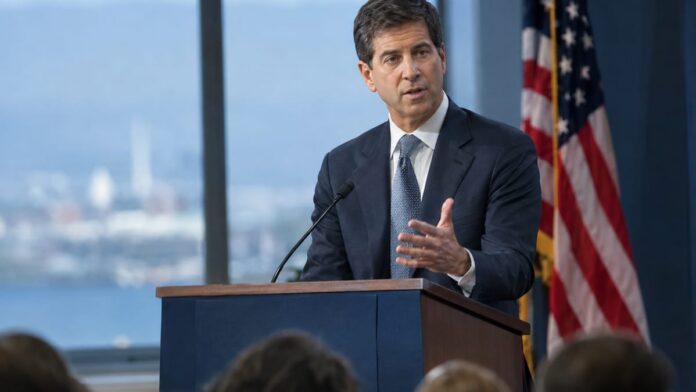
The Federal Reserve’s staff has begun modeling how “super intelligence” could reshape the U.S. economy, including a scenario in which the AI boom disappoints, stock valuations fall and unemployment rises, Chairman Kevin Warsh said Monday.
Warsh opened the first conference of the Fed’s Productivity and Jobs Task Force in San Francisco, hosted by the Board and the Federal Reserve Bank of San Francisco. It was his first visit to a Reserve Bank as chairman. The task force is one of five the Fed announced in June to examine areas central to monetary policy.
Chairman Warsh delivers opening remarks at the Federal Reserve’s Productivity and Jobs Task Force Conference hosted by the @sffed: https://t.co/653Te8WxKW
Watch live: https://t.co/XfMMNMV3Pc
Learn more about Chairman Warsh: https://t.co/b8iRmcgq1q
— Federal Reserve (@federalreserve) November 16, 2026
What the Fed is modeling
Board staff are applying stylized, model-based frameworks to a range of outcomes over the next several years. The speech described three of them, and the Fed labeled all three as illustrative scenarios rather than forecasts:
- Broad gains: productivity rises, the gains are shared across workers and the owners of capital, real GDP growth runs persistently above its long-run average, and the U.S. stays close to full employment.
- Job disruption: growth still runs above average, but automation and labor market frictions push the jobless rate above levels consistent with full employment.
- A bust: after heavy capital investment and stock market gains, expected returns turn down, equity valuations fall, the economy slows and unemployment rises more sharply. The economy eventually recovers, but without the productivity gains.
The prepared remarks did not discuss interest rates or the December policy meeting. The speech also flagged security risks, including threats to critical infrastructure and the chance that adversaries race to deploy the technology to harm the U.S. economy.
Why it matters
“Our responsibility is to recognize that the widespread adoption of this technology will have significant impact on the economy, with important implications for monetary policy down the road,” Warsh said. He framed the stakes in terms of national power, asking, “can you be a superpower without super intelligence?” He added: “Humans are the designers and the builders, and humans must be the deciders.”
Daily Beltway analysis: A Fed chair walking through a stock-bust scenario in public is unusual. It signals the central bank is planning for the AI trade to go wrong, not just betting on the upside, and that productivity claims will have to show up in the data before they shape rate decisions.
The day’s agenda put tech executives alongside economists. Panels featured Palo Alto Networks CEO Nikesh Arora, Stripe CEO Patrick Collison and Affirm CEO Max Levchin, followed by Brookings President Cecilia Rouse and Stanford President Jonathan Levin. The closing fireside chat paired Marc Andreessen of Andreessen Horowitz with former Commerce Secretary Gina Raimondo.
The other side
International Monetary Fund Managing Director Kristalina Georgieva warned the same day that the world is leaning too hard on AI. “We have a world economy that is standing on one leg on the AI leg. If this leg wobbles, that can lead to financial stability troubles,” she told CNBC, according to Anadolu Agency. She said circular financing among AI companies has grown to slightly more than $1 trillion, about two-thirds of it debt-funded, but called recent market swings “orderly.” “We have to be watchful,” she said.
What’s next
The Federal Open Market Committee meets Dec. 8-9. That meeting includes a new Summary of Economic Projections, the first since Monday’s conference on technology, productivity and jobs.
Sources
- federalreserve.gov
- federalreserve.gov
- frbsf.org
- aa.com.tr
- Original post: Federal Reserve (@federalreserve) on X, Nov 16, 2026
If an embedded post does not load, these links open the originals.