


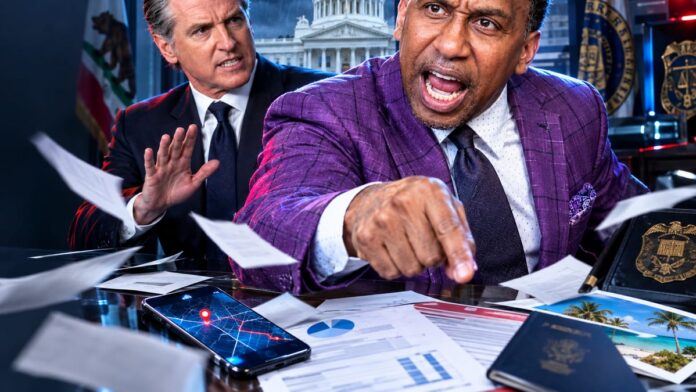
California Tracks Phones to Hit High Earners with Extra Taxes, Stephen A. Smith Reveals
Stephen A. Smith revealed during a recent conversation that California tax authorities use cell phone records to track the location of high earners and enforce additional tax days under the state’s jock tax system. The sports commentator explained that his estate planners warned him to leave California every weekend to avoid being pinged and hit with more taxable days — advice he thought was a joke until he saw his own returns.
Smith recounted the moment his planners laid out the reality. He was preparing to spend extended time in Los Angeles for NBA Countdown production when they told him staying over the weekend would allow the state to track his phone activity. Any call made or received while in California would count as a taxable day, adding to his burden under a system that already layered state, county, and city taxes on top of federal obligations.
Stephen A. Smith says he was warned by his estate planners to leave California every weekend because the government would TRACK his phone calls, then uses that data to collect MORE taxes.
He thought they were kidding. Then he got his tax returns. They weren’t.
What’s happening… pic.twitter.com/ZIEYrH45R7
— The Vigilant Fox 🦊 (@VigilantFox) September 9, 2026
He dismissed the warning as absurd. Then he reviewed his filings and realized they were dead serious.
The jock tax applies to athletes and entertainers based on days worked or physically present in the state, with income from those periods subject to California’s rates. Smith’s experience shows the mechanism has evolved beyond traditional records. Tax collectors now pull cell phone data to prove presence, turning every phone call into potential evidence of a taxable day.
California’s state income tax currently sits near 13.6 percent. Governor Gavin Newsom had proposed pushing it to 16.8 percent. Add Los Angeles city and county levies, and high earners face a compounding structure that Smith described as unbearable. He eventually moved to Florida, joining a growing list of figures fleeing the tax environment.
Smith referenced Shaquille O’Neal’s experience as another example. O’Neal signed a 20 million dollar contract with the Lakers. After federal and state taxes, his take-home dropped to 10.9 million. The jock tax then took another 4 million, leaving him with roughly 7 million — two-thirds gone to taxes.
The aggressive collection methods have drawn criticism as California’s rates climbed under recent leadership. Smith’s account highlights the practical consequences for individuals whose work requires travel and communication across state lines. The state does not rely on self-reporting alone. It uses digital tracking to build cases and collect revenue.
Smith said he later approached Newsom directly, telling the governor he looked presidential in his blue suits but would not be getting his vote because of the tax policies driving residents out.
The exodus is measurable. High-profile athletes, entertainers, and business figures have relocated to states like Florida and Texas, where income tax does not exist. California’s approach — tracking phone records to enforce tax days — represents a level of surveillance and enforcement that many view as overreach.
Smith’s planners were explicit: leave the state on weekends or expect to pay for the privilege of taking a phone call. He thought they were exaggerating. His tax returns proved otherwise.
The jock tax is not a new concept, but its enforcement has become more sophisticated. Authorities now have tools to verify presence with precision, turning cell towers and call logs into audit trails. For someone like Smith, whose schedule involves constant communication and travel, the system creates a tax liability that compounds with every day spent in the state.
California officials justify the approach as a way to ensure non-residents pay their fair share for income earned within state borders. Critics argue it amounts to punitive taxation enabled by invasive tracking, penalizing success and driving wealth to other jurisdictions.
Smith made his choice. He packed up and left for Florida, where his phone calls do not generate tax bills and his estate planners do not have to map out weekend escape routes to avoid state surveillance.
The bigger question is how many others will follow — and whether California leadership will adjust policies before the talent and revenue drain becomes irreversible.