


Maura Healey Declares Every Massachusetts Birth Triggers State Home Assessment
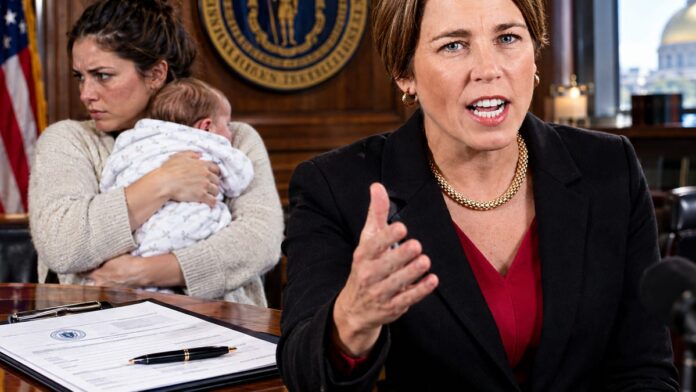
Massachusetts Governor Maura Healey has announced a universal home visit program that places a government-approved health care provider inside the residence of every family with a newborn. The visits will occur within days or weeks of delivery and will include an assessment to determine whether the family requires additional state support and resources. The program applies statewide without exception, regardless of whether a family requests assistance or demonstrates any need.
The announcement expands state presence into the most private moment of family life. Officials frame the measure as a connection to services, yet the mandatory structure raises immediate concerns about the line between government assistance and intrusion. Home assessments conducted by state-designated providers open the door to subjective judgments on household conditions, parenting choices, and even personal beliefs visible within the home.
Massachusetts is taking nanny state to the next level…
Gov. Maura Healey says every new mother in MA will soon get a "home visit" from a "health care provider" to "make an assessment?"
Is this a good idea? pic.twitter.com/AIm6OmDLX3
— Howie Carr (@HowieCarrShow) September 18, 2026
Critics warn that programs marketed with benign language about support often evolve into broader monitoring. The Massachusetts policy arrives amid ongoing national debates over parental rights and the reach of government agencies into child-rearing decisions. The prospect of a provider evaluating a home for unspecified needs invites questions about what criteria define adequacy and who sets those standards. Items visible in a living space—religious symbols, political materials, or lifestyle choices—could factor into an assessment process with no clear boundaries.
The policy fits a pattern of increased government oversight in Democratic-led states that extends into daily family decisions. Rather than allowing new parents to navigate early challenges with their own support networks or private resources, Massachusetts positions the state as the first responder inside the home. This shift aligns with efforts to normalize routine state contact with families under the banner of health and wellness initiatives.
Conservative observers see the measure as another step toward a surveillance-oriented approach to parenting. Once officials gain routine access to households, the criteria for what constitutes a need can broaden over time. Assessments initially described as supportive could influence custody decisions, resource allocation, or compliance expectations based on prevailing state views. The emphasis on assessment rather than voluntary outreach underscores the compulsory element that distinguishes this from traditional community support programs.
Families in Massachusetts now face the reality that the arrival of a newborn triggers an official state presence in their residence. The policy does not limit visits to high-risk cases or families who request help. It applies universally. This universal reach amplifies concerns that the program functions less as targeted aid and more as a mechanism for ongoing state visibility into private homes.
The announcement reflects a broader trend in certain states where government programs prioritize institutional involvement over individual autonomy. New parents seeking to raise their children according to their own values may find themselves subject to evaluations that carry implicit expectations about household norms. Without clear boundaries on what constitutes an appropriate assessment, the visits carry the risk of subjective enforcement that could disadvantage households holding traditional or dissenting perspectives.
Governor Healey’s record includes support for legislation that expanded abortion access through full term. Critics note the contradiction between a governor who championed that measure now positioning the state as the arbiter of newborn welfare inside family homes. The juxtaposition raises questions about the consistency of priorities and the selective application of state authority over life and family decisions.
The Massachusetts program sets a precedent that other states may follow. Once a universal home visit model is established in one jurisdiction, the framework becomes available for replication elsewhere. The normalization of state-mandated assessments in private residences shifts the baseline for what families can expect regarding government involvement in early child-rearing.
Parental rights advocates argue that the policy undermines the presumption that families are capable of caring for their children without state intervention. The default assumption shifts from trust in parents to a requirement that every household prove adequacy under state evaluation. This reversal places families in a defensive posture from the moment of birth.
The program also raises practical questions about implementation. Who trains the providers conducting these assessments? What guidelines govern their evaluations? What recourse do families have if they disagree with a provider’s conclusions? The announcement provided few details on these critical points, leaving families with more questions than answers about what to expect when a state-designated worker arrives at their door.
The Massachusetts universal home visit policy represents a fundamental shift in the relationship between families and government. It moves the state from a resource available upon request to an entity with default access to private homes at a moment of vulnerability. Whether other states adopt similar measures will depend in part on how families in Massachusetts respond and whether the program remains limited to its stated purpose or expands over time into broader oversight.