

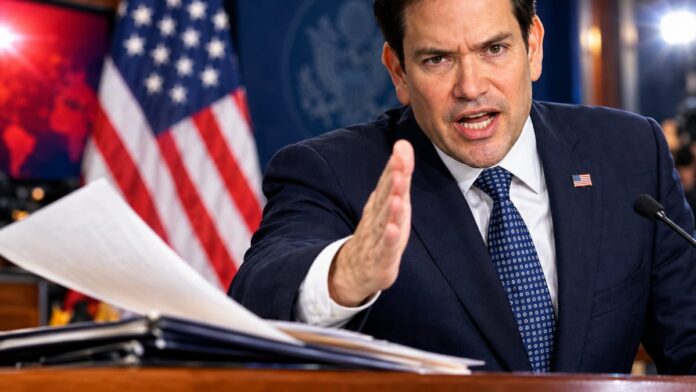
Secretary of State Marco Rubio delivered a sharp warning to Iranian leaders during a State Department briefing, declaring that Tehran fundamentally misunderstands the American constitutional system and is betting on a political outcome that will not save the regime from accountability.
Rubio explained that Iran appears convinced Democrats will win November’s midterm elections and thereby constrain President Trump’s ability to take decisive action against the regime’s nuclear ambitions. That calculation, Rubio said, rests on a dangerous illusion.
The secretary’s remarks came in response to questions about whether Iran expects a shift in United States policy following the midterms. Rubio made clear that the regime’s strategy of waiting out the current administration reflects a profound ignorance of how executive power functions in the republic.
.@SecRubio: "The Iranians misread our system. I think the Iranian are under this illusion that Democrats are going to win in November and the president will no longer be able to do things against them. I just don't think they understand our system very well…" pic.twitter.com/FTgVLWC5h7
— CSPAN (@cspan) September 23, 2026
While Congress holds significant legislative authority, Rubio noted, the president retains extraordinary constitutional and statutory powers as commander in chief when national security is at stake. Those powers include the ability to impose sanctions and authorize military force regardless of which party controls the House or Senate.
Rubio served fourteen years in Congress and said he understands both the strength and the limitations of the legislative branch. On matters of national defense and foreign threats, he emphasized, the executive branch operates with sweeping authority that midterm results cannot eliminate.
The secretary pointed out that Iran has lived under a nearly fifty-year international consensus that it must never acquire a nuclear weapon. Yet administration after administration has failed to enforce that red line with lasting effect. The current president, Rubio said, has made stopping Iran’s nuclear program a non-negotiable priority that transcends partisan politics.
Concrete steps are now underway to address the threat, Rubio confirmed, and those measures come at a cost. He acknowledged the economic and diplomatic consequences of confronting Tehran but argued that the price of inaction would prove far higher for future generations.
Rubio contrasted Iran’s confusion with the clearer understanding demonstrated by other nations that grasp the enduring strength of presidential authority in foreign policy. The regime’s bet on a midterm rescue, he suggested, is built on wishful thinking rather than constitutional reality.
The secretary’s comments signal that the administration has no intention of easing pressure on Iran regardless of electoral outcomes. The powers Trump wields to counter the nuclear threat remain intact whether Republicans or Democrats control Congress.
Rubio’s warning also underscores a broader pattern of adversaries misreading American resolve and the structure of the republic’s government. Iran’s leadership appears to believe that domestic political shifts will force a change in course, a miscalculation that could prove costly for the regime.
The administration has made prevention of an Iranian nuclear weapon its top Middle East priority. Rubio indicated that this objective stands apart from the usual partisan battles and reflects a commitment shared across decades of American foreign policy, even if previous leaders lacked the will to act decisively.
By stressing the constitutional authority of the executive branch, Rubio sent a message not only to Iran but to other adversaries watching the American political calendar. The power to defend national security does not hinge on midterm vote counts or congressional majorities.
The secretary’s remarks also served as a reminder to domestic audiences that the presidency carries unique responsibilities in confronting foreign threats. Those responsibilities do not expire or diminish based on shifts in legislative control.
Rubio closed by making clear that the current administration intends to follow through on its commitment to prevent Iran from obtaining nuclear weapons. The regime’s strategy of delay and political calculation, he suggested, will not alter that trajectory.
For Americans watching the midterm landscape, Rubio’s comments clarify that the administration’s Iran policy remains a presidential prerogative grounded in constitutional authority. Whatever happens in November, the executive branch retains the tools and the resolve to act.