
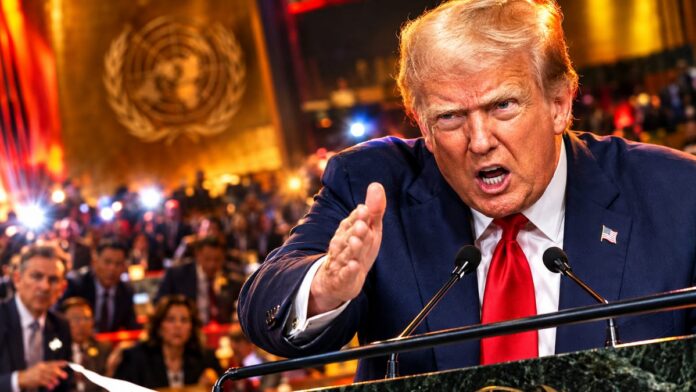
President Donald Trump just told the United Nations that Iran has two options: accept a deal that lets them rebuild their country, or face total military destruction with no chance of survival. He said it in front of Iran’s own delegation sitting in the room. The choice is binary, the timeline is short, and the decision rests entirely with him. Trump made clear that Iranian leadership is making a massive miscalculation if they think American midterm elections will change his calculus. What Tehran does not understand could determine whether the Islamic Republic exists a year from now. This footage captured the moment Trump laid out the ultimatum with Iran watching every word.
The President framed the decision in the starkest possible terms during his UN address. He described weighing whether to permit a diplomatic path that could transform Iran into a prosperous regional power, or to drive the regime into oblivion with no chance of recovery. The language left no ambiguity about the military option remaining on the table.
🚨 BREAKING: President Trump tells the UN he has a "BIG DECISION TO MAKE" on Iran on blowing them to smithereens, or striking a deal…Iran's delegation is watching him
"They're waiting to see how I do in the midterms. WHAT THEY DON'T REALIZE IS I'M NOT RUNNING!"
"Will a deal… pic.twitter.com/wzBOZM9vTS
— Eric Daugherty (@EricLDaugh) September 22, 2026
Trump said he expects a deal to materialize shortly after the upcoming midterm elections. He noted that Iranian leadership appears to be calculating their strategy around American domestic politics, waiting to see how Republicans perform in November before making their move. The President made clear that assumption is a fundamental miscalculation.
Trump reminded the assembly that he is not on the ballot in the midterms. He pointed to his landslide victory in the previous presidential election and emphasized he will remain in office for two and a half more years regardless of the midterm outcome. The Republican Party is running in November, and while he will campaign for GOP candidates, his own political future is not at stake.
More importantly, Trump stated that electoral considerations play no role whatsoever in his Iran policy. He said he gives no credence to the election when it comes to dealing with the Iranian regime, and that domestic political cycles do not enter his thinking on the matter. The only consideration that matters, according to the President, is ensuring Iran never acquires a nuclear weapon.
This position directly counters any Iranian strategy to exploit perceived American political weakness by timing provocations or negotiations around election schedules. By publicly severing the link between his Iran policy and the midterm results, Trump removes any incentive for the regime to delay or test American resolve based on the political calendar.
The administration has maintained a maximum pressure campaign against Iran since withdrawing from the previous nuclear agreement. That deal, negotiated during the prior administration, provided sanctions relief in exchange for temporary limits on Iran’s nuclear program. Critics argued the agreement merely delayed Iran’s path to a bomb while funding the regime’s regional aggression and support for proxy forces.
Trump’s withdrawal from that framework reimposed economic sanctions designed to force Iran back to the negotiating table for a more comprehensive agreement. The current standoff centers on whether Iran will accept stricter terms that permanently block its nuclear weapons capability, or whether the regime will continue to resist until it faces the military consequences Trump outlined at the UN.
The President’s remarks represent a high-stakes gamble that direct language and credible military threat will compel Iranian leadership to negotiate seriously rather than continue stalling. By publicly presenting the choice in such binary terms, Trump increases pressure on the regime while signaling to allies and adversaries alike that American patience has limits.
Conservative foreign policy experts generally support this approach, arguing that clarity and strength prevent miscalculation better than diplomatic ambiguity. The framework Trump laid out follows a pattern of demanding concrete results from adversaries rather than accepting symbolic gestures or process-oriented agreements that leave threats unresolved.
The timing of Trump’s UN speech, with midterms approaching and Iran’s delegation watching, underscores the administration’s refusal to let foreign adversaries weaponize American electoral politics. The message to Tehran is clear: the decision on Iran’s future rests with the President, not with voters in November, and that decision will be made based on national security imperatives rather than political calculations.
Whether Iran accepts a deal or faces the military option Trump described, the President has now publicly committed to resolving the nuclear threat one way or another. The regime can no longer count on running out the clock or exploiting American political transitions to avoid a reckoning.