


Austin ICE Bodycam Footage Exposes False Attorney Claims After Shooting of Illegal Immigrant
Newly released police bodycam footage from an ICE enforcement operation in Austin has exposed a glaring contradiction between what actually happened after agents shot an illegal immigrant and what his attorney told the public. The video shows officers carefully helping Wilber Rafael Garces Perez out of his vehicle and providing immediate medical attention, directly refuting claims that he was violently pulled from the car.
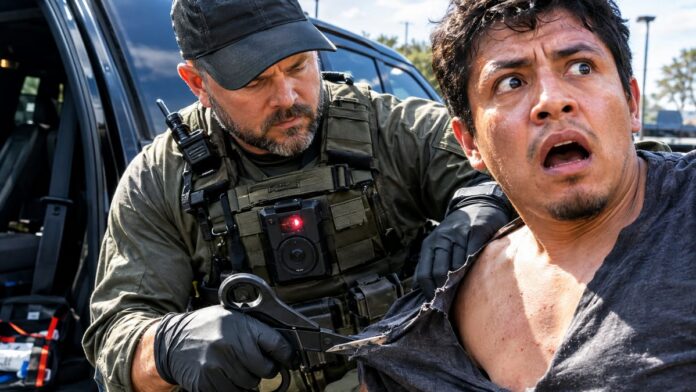
The footage captures the moments immediately following the shooting during an attempted arrest. An officer is heard confirming Garces Perez is under arrest, then directing another to retrieve trauma shears and cut away his shirt for treatment. The audio is clear: “All right, phone. Thank you. All right. Is he under arrest? Yeah. Okay. Get your shears out and put his shirt off. All right, come here.” The sequence shows Garces Perez being assisted from the vehicle, handcuffed, and seated on the ground while officers prepare to render aid.
Newly released police bodycam appears to contradict claims about how an illegal immigrant was treated after an ICE-involved shooting in Austin.
Wilber Rafael Garces Perez's attorney claimed he was pulled from the car after being shot during an attempted arrest after being shot.… pic.twitter.com/yhTdsw0t0j
— Fox News (@FoxNews) September 23, 2026
Garces Perez, a Venezuelan national in the country illegally, was the target of the enforcement action that resulted in the shooting. His attorney’s public statements painted a starkly different picture, describing rough handling and aggressive extraction immediately after the gunfire. That narrative fueled protests and clashes with law enforcement across Austin in the days following the incident.
The bodycam recording tells a different story. Officers follow standard post-shooting protocols, prioritizing medical response and securing the scene. There is no evidence of the violent extraction the attorney described. The video shows deliberate, methodical actions consistent with training for incidents involving use of force.
The discrepancy matters because the attorney’s version became the foundation for public outrage. Demonstrations erupted in North Austin and downtown, with protesters demanding accountability and an end to ICE operations in the city. Local officials amplified the anger, with one city leader warning that federal enforcement presence could lead to more shootings and urging ICE to leave Austin entirely.
The bodycam footage undercuts that entire narrative. It reveals that the initial description of events, the one that drove media coverage and political reaction, was false. Officers did not drag Garces Perez from the vehicle. They helped him out, secured him, and began cutting his clothing for medical access. The video provides a clear timeline that aligns with routine tactical and medical response, not with the story his defense team sold to the press.
This is not the first time bodycam evidence has contradicted inflammatory claims following an ICE operation. The pattern is familiar: an enforcement action occurs, an attorney or activist makes explosive allegations, protests follow, and only later does video evidence surface showing a far less dramatic reality. By then, the damage is done. The false narrative has already shaped public perception and political response.
The Austin incident also highlights the speed with which unverified claims spread in the hours after high-profile enforcement actions. Social media amplifies the most extreme versions of events, and elected officials often repeat those versions without waiting for evidence. The bodycam footage was not released immediately, giving the attorney’s narrative days to circulate unchallenged.
Garces Perez remains in custody following the shooting. ICE has not disclosed the specific charges or immigration violations that prompted the operation, but the enforcement action was clearly planned and involved multiple officers. The shooting itself is under investigation, a standard procedure for any discharge of a firearm during an arrest.
The protests in Austin have continued even after the bodycam release, though the focus has shifted. Demonstrators now emphasize opposition to ICE operations in general rather than the specific treatment of Garces Perez. City officials have not retracted their earlier statements condemning the incident, despite the video evidence contradicting the claims they amplified.
The case adds to the growing tension between sanctuary jurisdictions and federal immigration enforcement. Austin has long positioned itself as a welcoming city for immigrants, and local leaders have repeatedly criticized ICE operations within city limits. The bodycam footage complicates that posture by showing that federal agents followed protocol while the defense narrative did not.
For ICE, the video is a vindication. Officers acted professionally under high-stress circumstances, and the recording proves it. For the attorney and activists who repeated his claims, the footage is an embarrassment. They built a protest movement on a version of events that bodycam evidence has now debunked.
The broader implication is clear: in an era of instant outrage and viral narratives, video evidence remains the most reliable arbiter of truth. The Austin bodycam footage did not merely clarify a disputed detail. It exposed a deliberate misrepresentation of what occurred, one that had real consequences for public safety and law enforcement operations.
Protests that erupt based on false claims do not simply disappear when the truth emerges. They leave behind damaged relationships between communities and law enforcement, increased risk to officers, and eroded trust in institutions. The Austin incident is a textbook example of that dynamic.
The bodycam footage is now public record. Anyone can watch it and compare it to the attorney’s description. The contrast is stark. Officers assisted Garces Perez out of the vehicle. They did not pull him. They cut his shirt for medical treatment. They followed procedure. The attorney’s version was fiction, and the video proves it.