
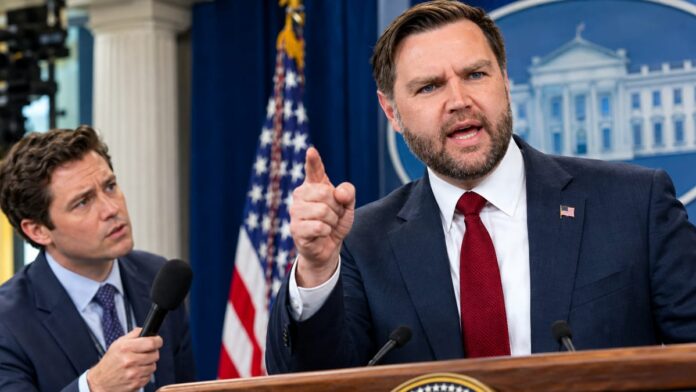
Vice President JD Vance shattered the narrative surrounding Politico’s loss of White House access during a pointed exchange that exposed the difference between press freedom and taxpayer-funded privilege.
Vance made clear that no outlet has been banned from covering the administration. Politico retains full ability to publish articles, attend public events, and exercise First Amendment rights. What changed is the removal of special accommodations that placed the outlet inside the White House complex with dedicated office space and enhanced proximity to officials.
The distinction matters because critics framed the decision as censorship when it functions as accountability. Vance stated that Politico will continue writing articles and misrepresenting administration actions, but it no longer operates from a taxpayer-funded office within the building. The move followed years of coverage that independent Harvard analysis measured as negative in 92 to 98 percent of stories about President Trump.
🚨 BOOM! JD VANCE JUST MIC DROPPED THE ENTIRE FAKE NEWS:
"People say we 'banned Politico' [from The White House]? POLITICO will STILL write their crazy articles, and misrepresent what we say and do."
"It's not a ban, it's a REFUSAL to grant SPECIAL ACCESS to people who are…
— Eric Daugherty (@EricLDaugh) September 22, 2026
That level of one-sided reporting crosses from journalism into propaganda, Vance argued. When an outlet functions as a reliable partisan messaging arm rather than an honest news organization, the administration has no obligation to subsidize that work with special access to the people’s house.
Vance emphasized that an honest press serves a necessary democratic function. Citizens need sources they can turn to for information that at least attempts to reflect reality rather than advance a predetermined narrative. The problem arises when major outlets abandon that standard entirely, producing coverage so uniformly negative that it reveals bias beyond any reasonable journalistic norm.
The Harvard study Vance cited offers hard evidence of that pattern. When nearly every story about a president tilts negative regardless of policy outcomes, economic data, or international developments, the outlet has ceased operating as a news organization. It functions instead as opposition research dressed up as reporting.
Vance noted that most Americans exercise their First Amendment rights from outside the White House grounds. Reporters from hundreds of outlets cover the administration without dedicated offices, special briefings, or insider proximity. Those arrangements were never constitutional requirements. They developed as courtesies extended to organizations the executive branch believed operated in good faith.
When that good faith disappears, the courtesy ends. Politico can still file Freedom of Information Act requests, attend public speeches, interview sources, and publish anything it chooses. It simply does so without the insider advantages it once enjoyed.
What appears to drive the outrage is not the loss of access but the loss of monopoly. For decades a small group of outlets controlled the mechanics of presidential coverage, shaping narratives from inside the building while operating as extensions of one political coalition. The administration is dismantling that arrangement by applying a consistent standard: fair reporting earns continued privileges, while sustained propaganda does not.
Critics invoke press freedom, but the concept cuts both ways. The administration has freedom to decide which organizations receive enhanced cooperation. No outlet possesses a constitutional right to office space, daily briefings, or routine face time with officials. Those perks exist at the discretion of the executive branch, which can withdraw them when the outlet’s work becomes indistinguishable from partisan advocacy.
Vance framed the policy as a restoration of balance. The White House belongs to the public, not to media organizations that have spent years producing coverage designed to harm rather than inform. By ending special treatment for outlets that function as propaganda arms, the administration signals that proximity and privileges must be earned through honest work rather than claimed as entitlements.
The policy does not prevent Politico from covering the president. It prevents Politico from doing so while enjoying taxpayer-funded workspace and insider accommodations. The outlet retains every constitutional protection. It loses only the extra benefits that came with an arrangement built on assumptions of fairness that the evidence no longer supports.
Vance’s explanation cuts through the false framing that dominated initial coverage. This is not a ban. It is a refusal to grant special access to organizations engaged in dishonest reporting. The distinction is not semantic. It defines the difference between press freedom and press privilege, between constitutional rights and insider perks, between journalism and propaganda dressed up as news.
The administration is simply holding outlets to a standard: report fairly or operate without special accommodations. Politico chose the latter through years of coverage that independent analysis measured as overwhelmingly one-sided. The consequence is not censorship. It is accountability.