

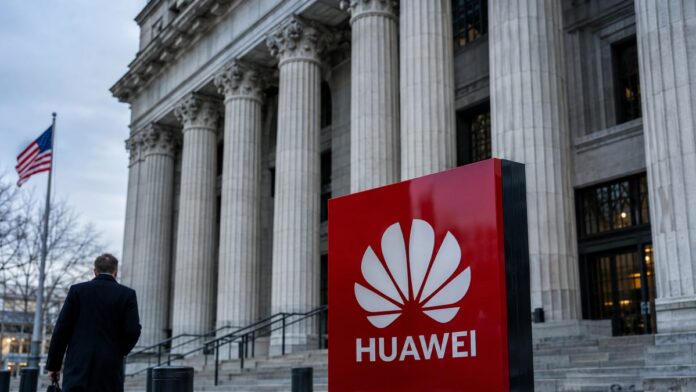
A federal jury in New York on Nov. 24 convicted Chinese telecom giant Huawei and three of its subsidiaries of stealing trade secrets from American companies, lying to banks and violating U.S. sanctions on Iran. The verdict came after a three-month trial in the Eastern District of New York.
The jury found Huawei guilty on 10 of the 12 counts it faced and acquitted it of racketeering conspiracy and obstruction of justice. The subsidiaries convicted are Huawei Device Co. Ltd., Futurewei Technologies Inc. and Huawei Device USA Inc.
Chinese Tech Giant Huawei and several of its subsidiaries have been CONVICTED of:
🔴 Sanctions Violations
🔴 Fraud
🔴 Conspiracy to Steal Trade Secrets
🔴 Money LaunderingFor decades the defendants conspired to secretly assist the Government of Iran, steal secrets from U.S.… pic.twitter.com/q4H4bzIMiV
— U.S. Department of Justice (@TheJusticeDept) November 24, 2026
What the verdict covers
The convictions include conspiracy to steal trade secrets, wire fraud, bank fraud, conspiracy to defraud the United States, violations of the International Emergency Economic Powers Act and money laundering conspiracy.
Prosecutors proved Huawei provided Iran’s government with internet backbone services, helped an Iranian intelligence component called Zaeim monitor and censor internet users, and supplied surveillance cameras used to watch protest activity. Huawei ran its Iran business under the name “Skycom” and lied to banks about it to obtain billions of U.S. dollars and access to dollar-clearing services.
The trade secret evidence included a T-Mobile touch-screen testing robot called Tappy. A Huawei employee carried part of the robot out of T-Mobile’s lab in his backpack. Huawei engineers also copied Cisco router source code and referred to Cisco by spelling its name backward, “ocsic.” A Huawei employee caught photographing Fujitsu equipment wore a badge that read “Weihua.”
NEW
Chinese Tech Giant Huawei Convicted of Sanctions Violations, Fraud, Conspiracy to Steal Trade Secrets, and Money Laundering.
Among the many examples proved at trial:
•Huawei stole proprietary information relating to a testing robot used by T-Mobile to assess the…
— Brendan Carr (@BrendanCarrFCC) November 25, 2026
“No person or company is above the law,” Attorney General Todd Blanche said. “For decades, Huawei and three of its subsidiaries conducted their business in the United States on the basis of lies and theft.”
Why it matters
The 2018 indictment came to light after the arrest of Huawei’s chief financial officer, Meng Wanzhou. The case against her was eventually dismissed, but she admitted to misleading banks about Huawei’s operations in Iran as part of a deferred prosecution agreement. The U.S. government blacklisted Huawei in 2019 over national security concerns.
Daily Beltway analysis: a jury verdict, after years of warnings from both parties about Huawei, turns those national security claims into a criminal record. It strengthens the case for keeping Huawei gear out of American networks and for pressing allies to do the same.
Huawei’s response
Huawei welcomed its acquittal on the racketeering charge, saying it “confirms that these allegations lack factual basis.” The company rejected the rest. “We believe the government’s remaining charges are equally without legal or factual merit,” Huawei said in a Nov. 25 statement. It said the five trade secret disputes prosecutors cited were civil matters resolved over the past two decades, and that it will “take all necessary legal actions to defend our rights and interests.”
What’s next
Sentencing is set for Sept. 14, 2027. The companies face criminal fines, forfeiture and restitution, and a federal judge will decide the penalties.
Sources
- justice.gov
- huawei.com
- theverge.com
- Original post: U.S. Department of Justice (@TheJusticeDept) on X, Nov 24, 2026
- Related posts reviewed for this report:
If an embedded post does not load, these links open the originals.