
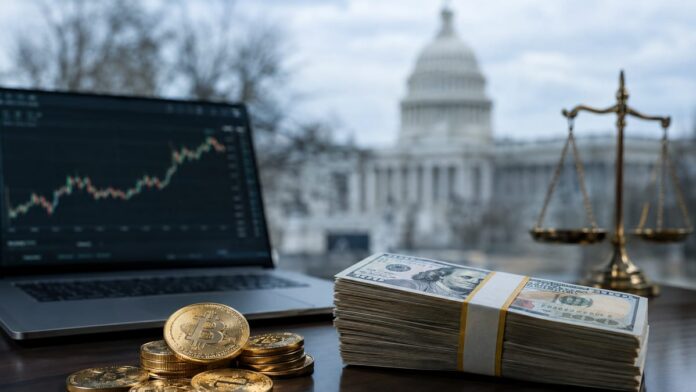
The Justice Department on Monday filed a civil claim to forfeit more than $1.1 billion in USDC, a stablecoin issued by Circle Internet Financial, that it identifies as proceeds and laundered funds from the cryptocurrency North Korean actors stole from Binance on or about Oct. 29. The case was brought in federal court in Washington by the U.S. Attorney’s Office for the District of Columbia.
The filing is one piece of a broader federal effort to help Binance recover more than $6 billion in stolen assets. Since the theft, the United States has helped freeze, seize or return more than $2.9 billion worth of cryptocurrency from multiple sources.
The Justice Department today announced actions taken to forfeit over $1.1 billion in cryptocurrency that was criminally obtained from Binance by North Korean actors in October 2026.
This is part of the greater government effort to assist Binance in recovering over $6 billion…
— U.S. Attorney DC (@USAO_DC) November 23, 2026
“Today’s action speaks to the speed and lengths that we in the U.S. government will go to stop sophisticated cybercriminals,” said U.S. Attorney Jeanine Ferris Pirro. “Whether it is a lone hacker or an enemy nation state, and wherever the criminal proceeds may go, my office and our partners will meet the moment, go toe to toe with our adversaries, and help victims of crime.”
What the forfeiture action does
The money is not newly frozen. These assets were already under a government-requested restraining order that followed the theft. Earlier this month, under court authorization, the government seized and restrained more than $1.2 billion worth of cryptocurrency stolen from Binance and took down cloud infrastructure behind FaceStealer, a North Korean social engineering scheme tied to more than $400 million in thefts.
Bankless, which reviewed the complaint, reported that the USDC sits at 36 addresses across 18 blockchains and that the complaint’s balance table adds up to about $1.17 billion. Circle told prosecutors it has no way to pull the tokens out of the blocklisted addresses, the outlet reported, and instead agreed to issue an equal amount of new “Substitute USDC” to the United States once a court grants a forfeiture order.
The FBI, the Secret Service and IRS Criminal Investigation are investigating, and Circle provided assistance. Prosecutors from the D.C. office are handling the case with the National Security Division’s National Security Cyber Section and the Criminal Division’s Computer Crime and Intellectual Property Section.
Why it matters
Daily Beltway analysis: This is a national security case as much as a crypto case. Stolen digital money is one of the ways Pyongyang pays for a regime under heavy sanctions. “North Korea depends on sophisticated laundering techniques to convert stolen cryptocurrency into funds that support the regime’s illicit activities,” said Brett Leatherman, operations director of the FBI’s Cyber Branch.
Daily Beltway analysis: The case also shows why stablecoins are a weak spot for thieves. Because an issuer like Circle can blocklist an address, the stolen USDC stayed where the hackers parked it instead of vanishing through mixers and foreign exchanges. Moving from restraint to a forfeiture claim within weeks also puts the government in line to turn frozen funds into recovered funds.
Today, my office and our partners took action to forfeit over $1.1 billion in cryptocurrency stolen from Binance by North Korean actors last month.
This brings total U.S.-assisted freezes, seizures, and recoveries to $2.9 billion as we work to reclaim all $6 billion in stolen… pic.twitter.com/eLDtTAuZPH
— Jeanine Pirro (@JudgeJeanine) November 23, 2026
What North Korea and Binance say
Pyongyang denies involvement. Kim Yo Jong, the sister of leader Kim Jong Un, called the FBI’s earlier attribution a “grave political provocation,” Anadolu reported, adding, “The U.S. assertion is an absurd rhetoric and nothing new.” Binance has said it already covered user losses with its own funds, Bankless reported, and the complaint itself asks only that the U.S. Marshal dispose of the money “according to law.”
What’s next
No forfeiture order has been entered yet. The government gets the money, through Circle’s substitute tokens, only if a federal judge in Washington grants one.
Separately, an Abu Dhabi court that granted Binance a $6.5 billion freezing order will consider asset handovers on Dec. 1, according to Bankless.
Sources
- justice.gov
- justice.gov
- bankless.com
- aa.com.tr
- Original post: U.S. Attorney DC (@USAO_DC) on X, Nov 23, 2026
- Related posts reviewed for this report:
If an embedded post does not load, these links open the originals.