
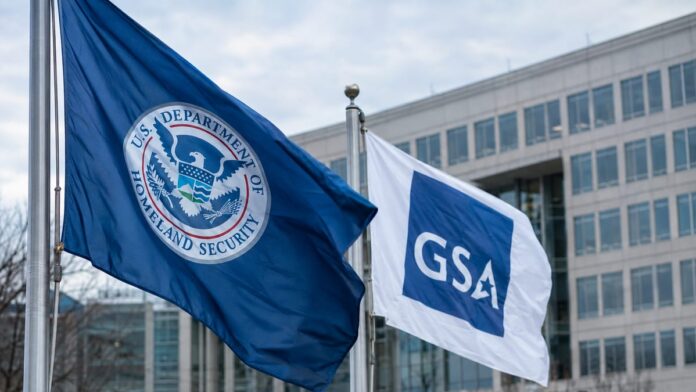
The Department of Homeland Security and the General Services Administration have put 1,579 federal contractors on notice that they may be breaking the government’s E-Verify rules, and gave them until Dec. 16 to prove otherwise. The firms hold more than $50 billion in federal contracts.
The agencies announced the effort on Thursday, Nov. 19, as part of the White House Task Force to Eliminate Fraud, which Vice President JD Vance chairs. E-Verify is the free USCIS system that checks a new hire’s Form I-9 information against federal records to confirm the worker can legally hold a job in the United States.
Today, DHS and @USGSA announced a joint effort to strengthen compliance with federal E-Verify requirements as part of the @WHFraudTF.
We notified over 1,500 federal contractors of potential noncompliance and are requiring proof of compliance within 30 days.
Taxpayer dollars…— Homeland Security (@DHSgov) November 19, 2026
What the notices do
The notices, dated Nov. 16, cite Federal Acquisition Regulation clause 52.222-54, which since 2009 has required covered federal contractors to enroll in and use E-Verify. A comparison of E-Verify records with contractor data in SAM.gov flagged three kinds of problems: firms not enrolled in E-Verify or not listed as federal contractors in their profiles, employer ID numbers that don’t match between the two systems, and firms that did not appear to have run required E-Verify checks on employees working under the contract.
Each contractor must either explain how it fixed the problem, such as enrolling or opening cases for covered workers, or send documents showing the government’s records are wrong. Firms that miss the 30-day window, or whose answers fall short, will be referred to their contracting officers. Contractors that fail the requirement or falsely claim compliance can face contract cancellation, suspension or debarment.
“American taxpayer dollars should never be used to employ illegal aliens,” said DHS Secretary Markwayne Mullin. “For too long, federal contractors have been raking in billions of dollars with too little scrutiny. That ends now.”
Why it matters
Daily Beltway analysis: the E-Verify clause has been on the books for 17 years, and this is a test of whether it actually means anything. Washington spends enormous sums with private firms, and a rule that is never checked is not much of a rule. Matching two federal databases that already exist is a cheap way to find out who is following it, and it moves worksite enforcement toward the employers who hold taxpayer money.
“Federal contractors need to make sure they are only employing individuals who may legally work,” said Scott Brady, the task force’s executive director. “It’s the law and most would agree it’s common sense.”
The other side
The notices flag potential discrepancies, not proven violations. Fox Business reported that the agencies did not identify specific instances of contractors employing unauthorized workers in the documents, and the letter itself lets firms show that a parent company or another entity handled the required checks.
Critics of E-Verify also question the system itself. “E-Verify has not proven effective at preventing the employment of undocumented immigrants,” the American Immigration Council wrote in an April analysis, adding that it “can generate errors that deny those with work authorization – including U.S. citizens and green card holders — jobs that they are qualified to fill.”
What’s next
Responses are due to E-Verify by Dec. 16, 2026. After that, GSA and DHS say they will ask contracting officers to send a letter of concern to any contractor still on the list, warning that failure to resolve the issue may lead to a referral to the E-Verify program for further action.
Sources
- dhs.gov
- gsa.gov
- e-verify.gov
- foxbusiness.com
- americanimmigrationcouncil.org
- Original post: Homeland Security (@DHSgov) on X, Nov 19, 2026
If an embedded post does not load, these links open the originals.