


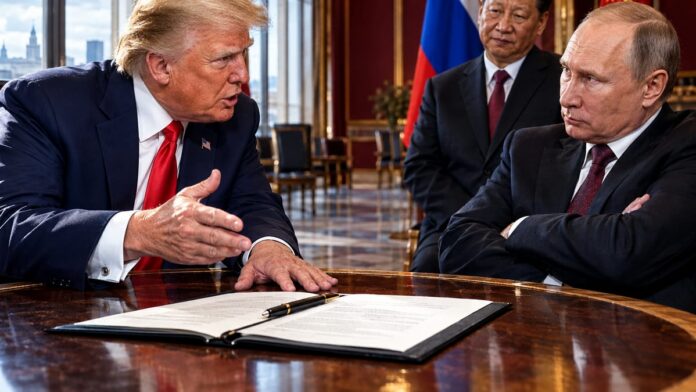
WSJ Editorial Board Dismisses Trump Nuclear Talks With China and Russia
The Wall Street Journal editorial board has taken a dismissive tone toward President Trump’s recent diplomatic outreach on nuclear issues with Russia and China. Their headline frames the effort as “Nuclear peace in our time?” and answers the question in the negative, arguing that neither Moscow nor Beijing has any interest in a world free of nuclear weapons despite the president’s direct appeals during his trip this past week.
Former CIA officer Dan Hoffman appeared on Fox to discuss the approach and noted the contrast with previous administrations. Hoffman stated that the Russians and Chinese do not want a world without nukes, despite President Trump’s entreaties there this past week. He added that the president favors a top-down method built on personal relationships with the leaders of those countries.
🚨 NOW: The Wall Street Journal editorial board is already sneering at President Trump's nuclear talks with Russia and China.
Their headline asks, "Nuclear peace in our time?" Their answer is no.
Former CIA officer Dan Hoffman told Fox that Trump is running diplomacy TOP-DOWN,… pic.twitter.com/c56NpK2Avq
— Gunther Eagleman™ (@GuntherEagleman) November 20, 2026
Hoffman explained that the president prefers an approach where he uses the personal relationships that he believes he has cultivated with these authoritarian leaders, China and Russia, to deliver a working plan for some of these issues that he thinks we can move on, like nuclear weapons. He contrasted this with past practice, where extensive lower-level work preceded any presidential meeting and produced agreements ready for signature.
The former CIA officer observed that the president may face questions about how to present the results of the trip to the American people and what concrete victories can be claimed. He stressed that the real test lies in whether American, Russian, and Chinese negotiators follow through with the detailed work required after any high-level discussion.
This top-down emphasis marks a clear departure from the bottom-up model that produced limited results in earlier years. By engaging directly with counterparts in Beijing and Moscow, the president seeks to cut through bureaucratic layers and test whether personal leverage can open paths on arms control that traditional channels have not.
The president has been vocal about his willingness to engage on nuclear issues. We reported on October 19 that Trump said he remained open to holding a trilateral summit with Russian President Vladimir Putin and Chinese President Xi Jinping focused on nuclear weapons and denuclearization, though he had not agreed to one at that time. Any gathering would center on reducing nuclear arsenals rather than the Ukraine conflict, the president stated.
First Lady Melania Trump has also weighed in on diplomatic efforts. We reported on November 5 that she delivered remarks at the White House urging Russia and Ukraine to transform a localized humanitarian ceasefire into a durable peace agreement, emphasizing the need to choose humanity over war.
The Wall Street Journal’s skepticism reflects a familiar media reluctance to credit such direct engagement. The editorial board’s negative answer to their own headline question reveals a bias against the president’s diplomatic style before any substantive negotiations have concluded. Yet the approach aligns with the president’s consistent record of prioritizing results over process.
Hoffman’s analysis on Fox highlighted the fundamental difference in method. Traditional diplomacy relied on staff-level work to produce agreements that presidents would then sign in ceremonial meetings. The president’s model inverts that sequence, using high-level personal engagement to create momentum that lower-level officials must then convert into detailed agreements.
Whether this approach succeeds depends on follow-through from negotiators on all three sides. The president’s direct appeals to Putin and Xi test whether personal relationships can overcome the structural incentives that have kept nuclear arsenals in place for decades. The Wall Street Journal editorial board has already declared the effort doomed, but the American people may prefer a president willing to try direct engagement rather than accepting diplomatic paralysis as inevitable.
The stakes are clear. Nuclear arsenals remain the greatest existential threat facing the republic. If personal diplomacy can open paths that traditional channels have not, the attempt is worth making. The president’s critics may sneer, but results will determine whether the top-down approach delivers where bottom-up incrementalism has failed.
Sources
- Original post: Gunther Eagleman™ (@GuntherEagleman) on X, Nov 20, 2026
- Related posts reviewed for this report:
- Fox News (@FoxNews) on X, Nov 19, 2026
- Eric Daugherty (@EricLDaugh) on X, Nov 19, 2026
- Commentary Eric Trump (@CommentaryEtrum) on X, Nov 19, 2026
Posts on X are shown as published by their authors; claims in them are attributed, not independently confirmed unless the article says so. If an embedded post does not load, these links open the originals.