


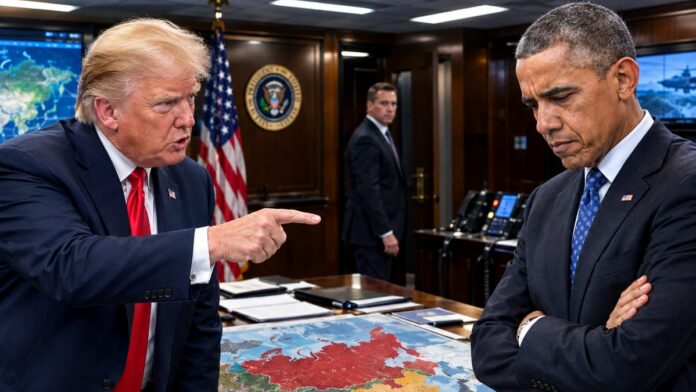
Trump Blames Obama for China Russia Alliance, Explains Why He Meets Xi and Putin Together
President Trump laid direct blame on former President Barack Obama for driving China and Russia into a strategic partnership that conventional wisdom said should never have formed, explaining during a Fox News exchange why he now meets both leaders in the same room.
Trump told Laura Ingraham’s team that the alliance between Chinese President Xi Jinping and Russian President Vladimir Putin exists because they work together on shared interests that Obama’s policies aligned. The two nations were natural rivals for decades, Trump noted, but energy policy under the previous administration changed that dynamic in ways that complicate American security.
Fox News’ Laura Ingraham: Why is it an advantage to meet with both Chinese President Xi Jinping and Russian President Vladimir Putin at the same time?
President Trump: “Because they work together. They have a relationship. The relationship was — should have never been allowed to… pic.twitter.com/dCpcc1Aqdf
— RedWave Press (@RedWavePress) November 19, 2026
The president described China’s geographic and resource constraints as the foundation of the problem. China has 1.4 billion people concentrated in a comparatively small territory. Russia spans 11 time zones and holds the largest landmass on earth. China needs energy supplies that Russia possesses in abundance. China also needs land, Trump said, and Russia has more than any nation.
Obama’s approach to energy policy brought the two powers together, Trump argued. The relationship should never have been allowed to happen, he said. It was a terrible thing. All his life, Trump recalled, strategic doctrine held that you never want Russia and China to team up. That principle was basic to politics and warfare. But Obama drove them together because of energy, Trump said, and the partnership formed as a result.
The current administration is handling the relationship differently, Trump indicated. Meeting both Xi and Putin at the same time allows the United States to address the partnership directly rather than deal with each nation separately while they coordinate behind the scenes. The president said the approach is working well.
Trump’s framing places the origin of the Russia-China alignment in the Obama years rather than attributing it to more recent developments. His comments suggest that energy dependence was the lever that moved two historic adversaries into cooperation, and that the consequences of that shift remain a central challenge for American foreign policy.
The president’s willingness to sit down with both leaders simultaneously reflects a broader strategy of direct engagement rather than isolating adversaries. Bringing competing powers into the same conversation allows for clearer communication on flashpoints and reduces the chance of miscalculation. It also signals that the United States recognizes the reality of the partnership rather than pretending it does not exist.
Trump’s critique of Obama’s legacy on this issue is consistent with his broader argument that previous administrations made strategic errors that empowered rival nations. The energy angle is specific: China needed reliable supply, Russia had it, and policy choices under Obama facilitated the connection.
The geopolitical implications are significant. A unified Russia-China bloc presents a fundamentally different challenge than two separate competitors. Coordinated action on energy, technology, military posture and economic policy makes both nations harder to counter. Trump’s argument is that the alignment was avoidable, and that it stems from decisions made during the Obama administration rather than from inevitable historical forces.
The president did not detail what specific Obama-era energy policies he believes were responsible. His focus was on the outcome: two natural enemies now working together because one had what the other desperately needed, and because American leadership at the time did not prevent the transaction.
Trump’s willingness to meet Xi and Putin together is unusual in modern diplomacy. Trilateral summits among major powers are rare, and sitting down with two nations widely viewed as adversaries in the same session invites criticism. Trump’s answer to that criticism is pragmatic: they already work together, so the United States should address them together.
The president also referenced his belief that the current approach is succeeding. He said the administration is doing real well in managing the relationship. That suggests confidence that direct engagement is producing better results than the strategies of prior administrations.
The broader question is whether the Russia-China partnership is now permanent or whether it can be disrupted. Trump’s comments imply that the alliance is rooted in practical needs rather than ideology, which suggests it could be weakened if those needs are met through other channels. But reversing a decade of deepening cooperation between two nuclear powers is a long-term challenge.
Trump’s critique of Obama on this issue is sharp and specific. He framed the alliance as a preventable mistake driven by energy policy rather than as an unavoidable evolution of great power competition. His approach now is to deal with the reality Obama created, and to do so through direct engagement rather than avoidance.
Sources
- Original post: RedWave Press (@RedWavePress) on X, Nov 18, 2026
- Related posts reviewed for this report:
- Eric Daugherty (@EricLDaugh) on X, Nov 19, 2026
- Eric Daugherty (@EricLDaugh) on X, Nov 19, 2026
- Eric Daugherty (@EricLDaugh) on X, Nov 19, 2026
Posts on X are shown as published by their authors; claims in them are attributed, not independently confirmed unless the article says so. If an embedded post does not load, these links open the originals.