

DSA Leader Refuses to Provide Cost Estimate for $49 Trillion Socialist Platform
Megan Romer, co-chair of the Democratic Socialists of America, declined repeatedly to provide a cost estimate for her organization’s policy agenda during a Fox News interview, even as she disputed a White House analysis showing the platform would cost American households $350,000 each over ten years.
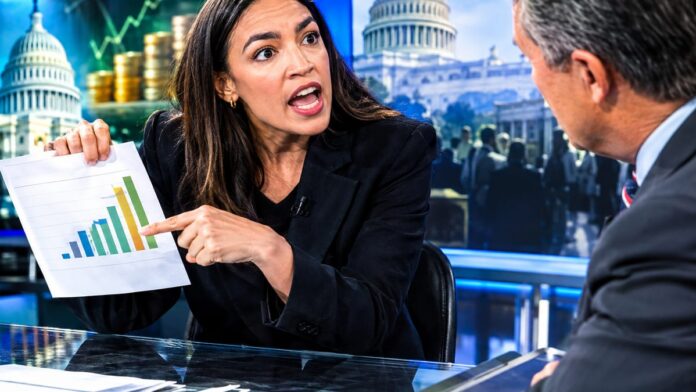
The exchange on Fox News between Romer and anchor Martha MacCallum centered on the fiscal mechanics of the DSA’s sweeping proposals, which include Medicare for All, student debt cancellation, open borders with amnesty, and abolishing Immigration and Customs Enforcement. The White House economic analysis pegged the total ten-year cost at $49 trillion.
DSA leader Megan Romer has NO answer when Fox News’s Martha MacCallum asks where the $49 TRILLION for her socialist agenda is coming from.
Romer calls the number “made-up.” Then MacCallum what HER number is, and it gets embarrassing fast.
MACCALLUM: “That’s $350,000 per… pic.twitter.com/vRlgetJzOt
— The Vigilant Fox 🦊 (@VigilantFox) November 6, 2026
When MacCallum asked directly how the DSA planned to pay for a platform costing $350,000 per household, Romer characterized the White House figure as politically motivated. She said the administration, which she acknowledged does not like the DSA very much, had managed to come up with some math that made the organization look bad.
MacCallum then cited the specific Medicare for All price tag of $47.4 trillion. Romer called that figure made up. The anchor noted the estimate came from economists and invited Romer to provide her own number for comparison. Romer suggested other estimates she had seen placed Medicare for All in the $35 to $40 trillion range, though she did not cite sources or methodology.
MacCallum then offered what appeared to be a straightforward opportunity for clarification. She asked Romer what number the DSA had calculated when adding up everything on the policy list. Romer declined to provide one. She said there was no one solid number because it depends on what pieces could be built in the meantime, framing the cost as variable based on which programs would be implemented sequentially and which existing programs would be eliminated.
Pressed again to give a basic number for the wish list, Romer called the $49 trillion figure outrageous. When asked once more what her number was, she stated the figure was ridiculous and ultimately declared she was not there to provide a solid number. She said her purpose was to talk about how Americans could collectively and democratically decide how money should be spent, who pays taxes, and what programs could be funded.
The refusal to quantify the agenda stands in stark contrast to the DSA’s willingness to articulate its financing mechanism. When MacCallum asked whether the plan involved moving money from rich people to those with less, Romer confirmed that was part of the strategy. She said the goal was to move money from the billionaire class that has profited off the labor of the working class for generations back to working people for programs that make their lives better.
The problem with that arithmetic is severe. Analysis from the Cato Institute, cited in the interview context, found that confiscating the entire net worth of the 400 wealthiest Americans—totaling $6.6 trillion—would cover only about 9 percent of the $49 trillion bill. Even adding all corporate profits to that pool would leave a shortfall of approximately $29 trillion.
The DSA’s own published estimate for a billionaire wealth tax is $3.9 trillion over ten years. Against a $49 trillion agenda, that represents less than 8 cents per dollar of total costs. The remaining 92 cents would need to come from sources Romer did not identify during the interview.
The exchange highlights a fundamental tension in the DSA’s public messaging. The organization is prepared to describe ambitious redistributive goals and to criticize existing cost analyses as biased. It is not prepared, at least in this forum, to defend a comprehensive fiscal plan or even to offer rough estimates for public scrutiny.
Romer’s refusal to engage the numbers leaves voters without a clear understanding of the trade-offs involved. A $49 trillion price tag over ten years represents nearly $5 trillion per year, an amount larger than the entire federal budget. Even if Medicare for All alone cost $35 trillion as Romer suggested—the low end of her cited range—that would still represent $3.5 trillion annually, more than the current combined spending on Social Security and Medicare.
The interview also touched on implementation challenges. MacCallum noted that countries with single-payer healthcare systems often experience long wait times and lower levels of care. Romer responded by pivoting to the affordability crisis, saying Democrats had followed Democratic Socialists in talking about cost of living and that she hoped they would work together to address it with programs offering immediate relief.
That pivot away from financing specifics and toward general economic concerns mirrors a broader pattern in progressive policy advocacy. Ambitious proposals are framed in terms of moral imperatives and social justice rather than fiscal constraints. When pressed on the math, advocates often deflect to critiques of military spending or corporate profits without demonstrating that redirecting those funds would cover the proposed new programs.
The defense budget for fiscal year 2024 is approximately $961 billion, as MacCallum noted during the interview. Even if that entire sum were redirected to domestic programs—a politically impossible scenario—it would cover less than 20 percent of the DSA’s annual agenda under the White House estimate, or roughly 27 percent under Romer’s suggested Medicare for All range.
The refusal to provide cost estimates also complicates democratic deliberation. Voters cannot make informed choices about policy trade-offs without understanding the scale of resources required and the sources from which those resources would be drawn. By declining to offer her own numbers while simultaneously rejecting the estimates of others, Romer left the fiscal foundation of the DSA platform unexplained.
The interview aired as the DSA continues to build influence within Democratic Party politics, particularly among younger voters and in urban congressional districts. Several members of Congress, including Representatives Alexandria Ocasio-Cortez and Rashida Tlaib, have aligned themselves with DSA principles or maintained membership in the organization.
Whether the DSA’s approach to fiscal transparency will prove politically sustainable remains an open question. Voters attracted to the moral vision of universal healthcare and debt relief may be willing to overlook the absence of detailed cost projections. Others, particularly those concerned about national debt and tax burdens, will likely demand greater specificity before supporting policies with price tags measured in tens of trillions of dollars.
What is clear from the Fox News exchange is that the DSA’s public representatives are not yet prepared to defend their agenda in terms of fiscal arithmetic. Whether that reflects a strategic communications choice or a genuine absence of internal cost modeling, the result is the same: a platform whose scale vastly exceeds its articulated means of payment.
Sources
- Original post: The Vigilant Fox 🦊 (@VigilantFox) on X, Nov 6, 2026
- Related posts reviewed for this report:
- RNC Research (@RNCResearch) on X, Jul 26, 2026
- RNC Research (@RNCResearch) on X, Nov 4, 2026
- Western Lensman (@WesternLensman) on X, Aug 7, 2026
Posts on X are shown as published by their authors; claims in them are attributed, not independently confirmed unless the article says so. If an embedded post does not load, these links open the originals.