
DOJ Opens Criminal Probe Into Supreme Court Dobbs Leak
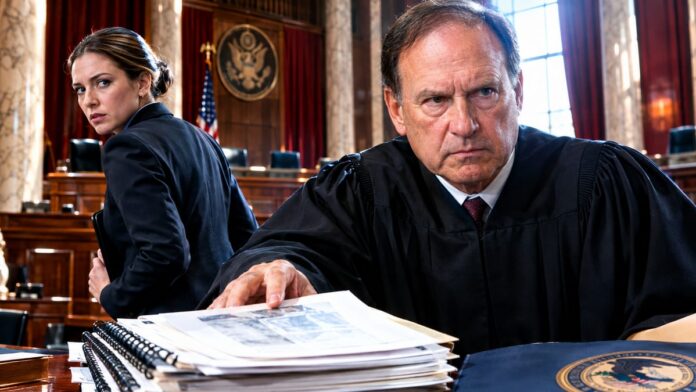
The Justice Department has opened a criminal investigation into the 2022 leak of the Supreme Court’s draft Dobbs decision, escalating a case that has remained unsolved for nearly five years and marking a significant shift in the effort to identify who disclosed one of the most consequential opinions in modern American history.
The investigation is being conducted out of the U.S. Attorney’s office. When contacted for comment, the Justice Department declined to confirm the existence of the probe, citing standard policy against discussing ongoing investigations. That silence, however, has not stopped the story from breaking through — and it is a story that raises serious questions about accountability, institutional integrity, and whether the federal government is finally willing to treat the Dobbs leak as the crime it was.
🔥🚨 BREAKING — HERE WE GO! The DOJ has just opened a criminal investigation into the leak of the Dobbs decision that overturned Roe v. Wade.
Justice Sam Alito recently said he has an opinion on who did it.
He added that the evidence available at the time was not strong enough… pic.twitter.com/4zp0modT15
— The Patriot Oasis™ (@ThePatriotOasis) November 5, 2026
The leak first appeared in Politico in May 2022, weeks before the Court officially released its decision overturning Roe v. Wade and ending the constitutional right to abortion that had stood for nearly half a century. The disclosure of a draft opinion was an extraordinary breach of the Court’s internal confidentiality, a violation that compromised the justices’ deliberative process and exposed them to immediate threats. The leak did not just embarrass the institution — it weaponized the Court’s internal workings and turned a pending decision into a political flashpoint before the justices had even finished their work.
In the immediate aftermath, Chief Justice John Roberts announced that the Marshal of the Supreme Court would conduct an internal investigation. That probe, conducted privately within the Court’s own offices, yielded nothing. No leaker was identified. No one was held accountable. The investigation went cold, and the case sat unresolved for years while the person responsible for one of the most damaging breaches in Supreme Court history walked free.
Justice Samuel Alito, who authored the Dobbs majority opinion, has said he has an opinion on who leaked the draft. According to available reporting, Alito determined that the evidence available at the time was not strong enough to name the person publicly or through official channels. That statement is telling — it suggests Alito has a suspect in mind but that the proof required to make an accusation stick was not there when the Marshal’s office conducted its review.
The criminal investigation changes the equation. Federal prosecutors have tools the Marshal’s office does not: subpoena power, grand jury authority, and the ability to compel testimony under oath. The U.S. Attorney’s office can pursue leads, demand records, and apply pressure in ways that an internal Supreme Court review cannot. Whether those tools will succeed where the Marshal’s investigation failed is an open question, but the decision to open a criminal case signals that someone in the Justice Department believes there is enough to pursue.
The consequences of the leak were immediate and severe. The premature disclosure of the Court’s draft reasoning triggered major threats against the justices before the decision was even announced. Security concerns escalated. The Court’s ability to function as a deliberative body was compromised. The leak turned the justices into targets and the Court itself into a symbol of political warfare rather than judicial independence.
Conservative critics have long argued that the leak was not just a breach of protocol but an attempt to intimidate the Court, to mobilize political opposition, and to pressure the justices into changing their votes before the decision became final. The fact that the leaker was never identified has fueled suspicion that the internal investigation was either incompetent or deliberately restrained. The decision to open a criminal probe suggests that those suspicions may have been justified.
Nearly five years have passed since the draft opinion first appeared in Politico. The identity of the leaker remains unknown. The criminal investigation is ongoing, and the Justice Department has provided no public timeline for resolution. But the fact that the case is now in the hands of federal prosecutors means the stakes have changed. This is no longer just an internal Supreme Court matter. It is a federal criminal case, and if the leaker is identified, they will face prosecution.
The leak of the Dobbs decision was not just a scandal — it was an attack on the independence of the judiciary and the integrity of the Supreme Court. The criminal investigation is long overdue, and the American people deserve to know who was responsible and whether they will be held accountable.
Sources
- Original post: The Patriot Oasis™ (@ThePatriotOasis) on X, Nov 5, 2026
- Related posts reviewed for this report:
- Nick Sortor (@nicksortor) on X, Nov 5, 2026
- American Nightmare 🇺🇸 (@thewakeninq) on X, Nov 5, 2026
- Eric Daugherty (@EricLDaugh) on X, Nov 5, 2026
Posts on X are shown as published by their authors; claims in them are attributed, not independently confirmed unless the article says so. If an embedded post does not load, these links open the originals.