


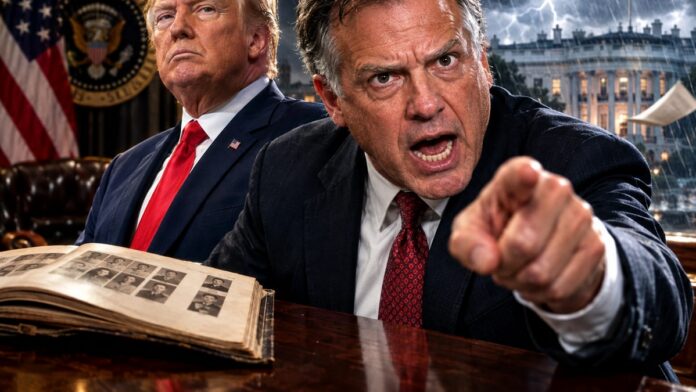
CNN Reports Peter Ticktin Trump Military School Connection in Latest Election Scare
CNN revived familiar alarmist claims that President Trump is being pushed by fringe outside advisors to declare martial law ahead of November elections, drawing from a recent Atlantic Magazine story. The report centers on attorney Peter Ticktin, described as a longtime acquaintance of the President from their military school days at New York Military Academy.
The piece ties Ticktin to convicted election denier Tina Peters and references older comments from the President on podcasts and radio appearances about federal oversight of elections. The White House already addressed the speculation directly, stating that figures like Ticktin and Peters hold no role in shaping election policy.
CNN reports Trump is so worried about Democrats winning the election that his "outside advisors" are telling him to declare martial law.
Scary shit and we need to be ready. pic.twitter.com/RrK5qvPh7H
— Mike Nellis (@MikeNellis) September 25, 2026
This clarification undercuts the narrative that informal suggestions from non-official circles represent any serious plan or directive from the administration. No actions consistent with martial law declarations have been taken or announced.
The Atlantic article claims Ticktin told the magazine that Trump could decide to declare martial law on or around election day. Ticktin serves as attorney for Tina Peters, whose sentence was commuted by Colorado Governor Jared Polis. Peters met with President Trump at the White House after her prison time was commuted.
CNN also highlighted past remarks from President Trump about election administration, including calls for greater federal involvement in certain states and references to national security considerations. Those statements predate the current cycle and align with longstanding Republican priorities on preventing irregularities.
Many voters share concerns about election integrity after documented issues in prior elections. President Trump’s remarks have consistently focused on securing the voting process rather than any extraordinary measures.
Media outlets like CNN amplify selective excerpts to portray routine discussions about election safeguards as threats to democracy. The current report follows this approach by linking unrelated past events, such as 2020 legal disputes, to present-day speculation without evidence of active implementation.
The Atlantic piece references a December 2020 meeting where attorney Sidney Powell and General Michael Flynn discussed seizing voting machines in key states. Then Attorney General Bill Barr told the President he could not take that action. In January 2026, President Trump told the New York Times he regrets not having seized the machines.
CNN also noted that in February the Office of the Director of National Intelligence under then Director Tulsi Gabbard said it obtained electronic voting machines seized from Puerto Rico to look for security vulnerabilities. In July, the FBI assigned analysts to examine ballots and election materials seized from Fulton County, Georgia.
To date, no evidence of large-scale vote rigging or foreign interference has been found as a result of any of these measures. The White House made clear that outside figures play no role in election policy.
Conservative observers note that such coverage serves to distract from the administration’s actual record on border security, economic growth, and reducing federal overreach. The President’s focus stays on delivering for voters through proven governance.
The pattern of recycled media hype around martial law speculation reveals the bias of outlets with clear partisan leanings. Voters recognize the difference between serious policy discussion and sensationalized fear mongering designed to influence election outcomes.
With the election approaching, the emphasis remains on policies that deliver results for American families rather than entertaining hypothetical scenarios pushed by hostile media. The republic functions best when citizens evaluate actions rather than speculation.
The White House statement confirming that Ticktin and Peters have no policy role should end the story. Instead, CNN chose to amplify unverified claims and link them to past unrelated events to create a narrative of looming authoritarian action.
This represents a pattern of coverage where routine discussions about election integrity are twisted into existential threats. Voters see through the manipulation and understand that securing elections is a legitimate government function, not a prelude to dictatorship.
The facts remain clear: no martial law has been declared, no plans have been announced, and the White House has explicitly rejected the premise of the CNN story. Everything else is recycled fear mongering from outlets desperate to shape the narrative ahead of November.