


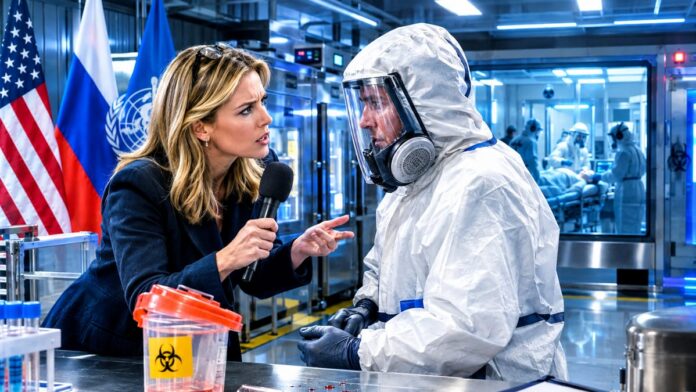
U.S. Escalates Demands as Russia Remains Silent on Second Suspected Severe Pneumonia Case at Irkutsk Lab
The United States has escalated diplomatic pressure on Russia following reports of a possible second case of severe pneumonia of undetermined cause linked to the Irkutsk Anti-Plague Research Institute. The State Department has issued a formal demarche to Russia’s foreign ministry, signaling the urgency with which Washington is demanding transparency about a pathogen that has now potentially affected two employees at the specialized biological research facility.
Fox News correspondent Gillian Turner reported that the World Health Organization is actively investigating the cause of the severe pneumonia, the specific pathogen behind public health measures, and media accounts of a second employee affected by pneumonia of undetermined cause. The development marks a significant escalation from an initial incident at the Irkutsk facility that has already triggered quarantine measures and drawn international concern.
NEWS: A possible second person in Russia has been reported with pneumonia of unknown cause, tied to the same Irkutsk Anti-Plague Research Institute scare.
Fox News’ Gillian Turner: “Overnight, the World Health Organization says they are probing, ‘the cause of the severe… pic.twitter.com/usPscsXtVq
— RedWave Press (@RedWavePress) October 7, 2026
The State Department’s use of a demarche represents a direct diplomatic request for information, a step taken when standard channels have failed to produce answers. A Kremlin spokesperson responded by dismissing reports as largely false information, stating he did not have such information and suggesting the media was overstating the situation. Russian authorities have not provided sufficient details about the pathogen, the circumstances of exposure, or the status of the reported second case.
The U.S. Embassy in Moscow took the unusual step of issuing a health alert in connection with the situation, noting that the U.S. government has limited ability to help U.S. citizens in Russia, especially outside of Moscow. The alert reflects heightened concern about an unidentified biological agent at a facility designed to handle some of the world’s most dangerous pathogens.
Turner reported this marks the sixth day of direct contact between the State Department and the Russian government regarding the matter, with officials still awaiting a formal response from the foreign ministry. The lack of cooperation has prompted Washington to ratchet up pressure through formal diplomatic channels.
Neighboring countries sharing borders with Russia have responded by implementing enhanced sanitary and quarantine controls. Mongolia, Kazakhstan, and Uzbekistan have all taken steps to monitor potential cross-border health threats in the absence of clear information from Moscow about what pathogen may be involved and whether containment measures are adequate.
The original incident involved a female lab technician at the Irkutsk Anti-Plague Institute who died from what officials described as pneumonia of undetermined origin. The facility specializes in research on plague and other dangerous infectious diseases. The emergence of a possible second case raises questions about containment protocols at the institute and whether the pathogen responsible has been properly identified.
The World Health Organization’s involvement underscores the international dimension of the threat. When a specialized biological research facility experiences unexplained severe respiratory illness among staff, the potential for a broader outbreak or accidental release becomes a matter of global health security. The WHO is seeking information about the specific pathogen, how public health measures were determined, and whether additional cases exist beyond those reported in media accounts.
Russia’s refusal to provide detailed information fits a pattern of opacity around sensitive facilities and potential security incidents. The Irkutsk Anti-Plague Research Institute handles live samples of Yersinia pestis, the bacterium that causes plague, along with other dangerous pathogens. Any breach of containment protocols or unexplained illness among staff handling such materials warrants immediate disclosure and international cooperation.
The State Department’s decision to issue a health alert through the U.S. Embassy in Moscow indicates officials believe American citizens in Russia face a credible risk. The alert’s acknowledgment of limited U.S. government ability to assist citizens outside Moscow reflects the deteriorated state of bilateral relations and the practical constraints on consular operations in Russia.
For neighboring nations, the lack of transparency from Moscow presents a direct threat. Enhanced border controls and quarantine measures are blunt instruments when the specific pathogen and transmission vectors remain unknown. Kazakhstan, Mongolia, and Uzbekistan are taking precautions based on incomplete information because Russian authorities have not shared the data that would allow for targeted, effective response.
The demarche represents a formal demand for answers that Moscow can no longer ignore through deflection or dismissal. When the State Department elevates a request to this level, it signals that normal diplomatic channels have been exhausted and that Washington views the matter as urgent enough to warrant direct, official intervention.
The situation highlights the risks inherent in operating high-containment biological research facilities without adequate transparency. When incidents occur at such facilities, the international community has a legitimate interest in understanding the nature of the pathogen, the circumstances of exposure, and the measures being taken to prevent further cases. Russia’s refusal to engage openly with these questions undermines global health security and increases the risk that what may have begun as a localized laboratory incident could develop into a broader public health crisis.
The World Health Organization, the U.S. State Department, and neighboring nations are now all demanding information that Russia should have provided immediately. Every day of delay increases uncertainty, hampers effective response planning, and raises questions about what Moscow is attempting to conceal.
Sources
- Original post: RedWave Press (@RedWavePress) on X, Oct 7, 2026
- Related posts reviewed for this report:
- 🔥🗞The Informant (@theinformant_x) on X, Oct 6, 2026
- Shafek Koreshe (@shafeKoreshe) on X, Oct 7, 2026
- Global Strategy (@World_At_War_6) on X, Oct 7, 2026
Posts on X are shown as published by their authors; claims in them are attributed, not independently confirmed unless the article says so. If an embedded post does not load, these links open the originals.