


U.S. Army Demonstrates Loitering Drone Swarm Launch from Unmanned Ground Vehicle in Germany
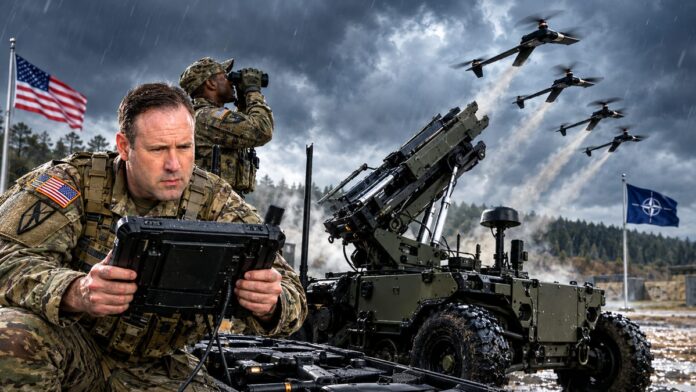
American forces recently conducted a demonstration in Germany showcasing the deployment of 18 loitering munitions from a single unmanned ground vehicle during a military exercise. The remotely operated platform released the kamikaze drones without placing personnel directly in the line of fire, illustrating a shift toward ground-based systems that can deliver multiple strikes while keeping troops at a safer distance.
The exercise took place on a German training range where the unmanned ground vehicle positioned itself and launched the swarm in rapid sequence. Each drone functions as a loitering munition, capable of circling an area before engaging a target. The video of the launch shows the vehicle deploying all 18 munitions from a compact launcher, emphasizing precision and volume of fire delivered through automated means rather than traditional manned approaches.
🇺🇸🇩🇪 U.S. MILITARY UNLEASHES DRONE SWARM during an exercise in Germany!
American forces launched 18 kamikaze drones from a single unmanned ground vehicle, demonstrating a new approach to battlefield warfare.
Instead of exposing soldiers to enemy fire, the remotely operated…
— Mario Nawfal (@MarioNawfal) November 17, 2026
This approach relies on the unmanned vehicle to carry and launch the munitions, allowing operators to control the operation from a remote location. The exercise highlighted how such systems can multiply firepower from one platform, reducing the need for soldiers to advance under potential enemy observation or attack. By launching multiple munitions from a ground-based carrier, forces can achieve coordinated effects that previously required larger teams or exposed assets.
The demonstration aligns with broader efforts to integrate unmanned technologies into tactical operations. This method prioritizes force protection while maintaining offensive capability in contested environments. The setup allows operators to position the vehicle, initiate the launch sequence, and direct the swarm without exposing personnel to direct fire or observation by adversaries.
Such capabilities reflect ongoing advancements in how American military units conduct exercises to prepare for modern battlefield conditions. The focus remains on effective, technology-driven solutions that enhance operational flexibility without unnecessary exposure of forces. The test in Germany points to a practical evolution in warfare tactics, where unmanned systems handle initial exposure and delivery of ordnance.
The loitering munitions themselves are designed to remain airborne for extended periods, surveilling an area and striking targets as they are identified. The ground vehicle serves as a mobile launcher that can reposition quickly and deploy large numbers of these weapons on demand. This reduces the logistical footprint and personnel risk associated with traditional artillery or manned aircraft delivering similar effects.
The exercise demonstrated the ability to rapidly scale strikes from a compact launcher. The platform can be transported to a forward position, deploy its munitions, and withdraw before enemy forces can effectively respond. This speed and automation represent a significant shift in how the U.S. military is preparing for future conflicts where rapid, distributed strikes from unmanned platforms may become standard.
Overall, the test underscores the military’s commitment to leveraging unmanned systems to reduce risk to American personnel while maintaining or increasing combat effectiveness. The 18-drone swarm launch from a single vehicle shows how technology is reshaping battlefield tactics and force structure for the challenges ahead.
Sources
- Original post: Mario Nawfal (@MarioNawfal) on X, Nov 17, 2026
- Related posts reviewed for this report:
- RT (@RT_com) on X, Nov 17, 2026
- Toronto Post (@torontopost11) on X, Nov 17, 2026
- 笑脸男人 (@lfx160219) on X, Nov 17, 2026
Posts on X are shown as published by their authors; claims in them are attributed, not independently confirmed unless the article says so. If an embedded post does not load, these links open the originals.