


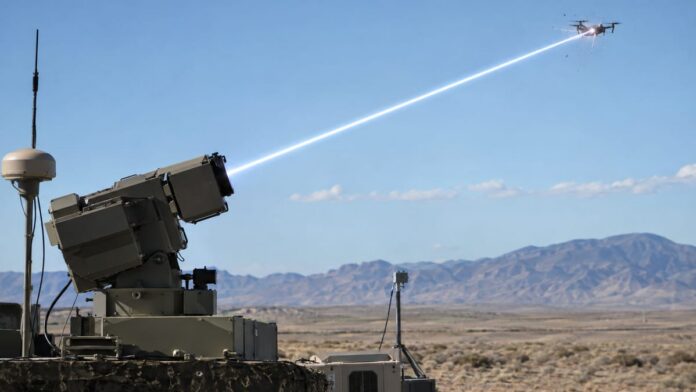
The Department of War on Monday picked seven industry teams to bring high-energy laser weapons to Dugway Proving Ground in Utah for a live-fire counter-drone “shoot-off,” with live-fire engagements set to begin by mid-December.
The teams were chosen from 13 technical white papers by the department’s Office of Research and Engineering and Joint Interagency Task Force 401, the Army-led office that buys counter-drone technology. The goal is speed: lasers that perform well could move straight to a purchase order.
What the shoot-off does
The seven teams and systems advancing to Phase II of the Directed Energy Counter-Unmanned Aerial Systems evaluation are:
- Allen Control Systems: BULLFROG HEL
- Aurelius Systems: ARCHIMEDES
- AeroVironment (BlueHalo): LOCUST X1
- Kord Technologies: FIREFLY
- Lockheed Martin (IPG): Crossbow system
- Thor Dynamics: LASER ARMOR HEL system
- Yrikka: TALOS drone-based HEL system
Through November, vendors must finish laser safety certifications and command-and-control integration. Before firing, each system must arrive at Dugway for a week of technical safety reviews, communications checks and range readiness testing. The systems will then engage representative drone targets, with evaluators assessing tracking and defeat capabilities both above and below the horizon. The department did not name the six teams that were cut.
“We’re trying to structure the shoot-off in such a way that systems that perform effectively or successfully can immediately result in a purchase order that allows us to start building the production lines to get these systems into the field,” said Army Brig. Gen. Matthew Ross, director of JIATF 401.
Why it matters
Drone swarms are cheap to launch, and answering them with missiles or other projectiles is costly. Lasers and other non-kinetic weapons promise a lower cost per shot. Emil Michael, under secretary of war for research and engineering, called scaled directed energy “one of the Department’s six critical technology areas” and said the goal is “a low cost per shot defense capability” with “deep magazine systems.”
The money is already moving. In September, the Army awarded AeroVironment a nearly $500 million contract to move its Enduring-High Energy Laser system from prototype into production, DefenseScoop reported.
Daily Beltway analysis: tying a test directly to a purchase order is the point. For years the Pentagon has shown off lasers knocking drones out of the sky, then failed to buy them in numbers. A shoot-off that ends in contracts is a direct attempt to break that cycle.
The skeptics’ case
The Government Accountability Office has warned that demonstrations alone don’t get lasers to troops. In an April 2023 report, GAO found that the department spends about $1 billion a year on directed energy weapons and has built high-energy lasers that “successfully shot down drones in demonstrations,” but “has had trouble getting these technologies out of the lab and into the field.”
GAO pointed to the “valley of death” between the Pentagon’s developers and its buyers, and recommended that the Navy and Air Force sign transition agreements for their programs. As of August 2025, GAO said it had not received the Navy’s documentation.
What’s next
- November 2026: vendors complete laser safety certifications and command-and-control integration.
- By mid-December 2026: live-fire engagements against drone targets begin at Dugway Proving Ground.