

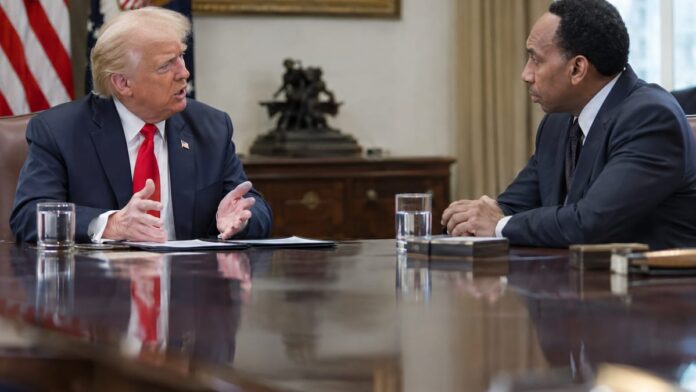
President Trump sat down with sports commentator Stephen A. Smith in the White House Roosevelt Room on Thursday, Nov. 12, and used much of the nearly 50-minute interview to make his case to Black Americans, reading from a list of his administration’s actions.
The centerpiece was money for historically Black colleges and universities. Trump told Smith he “saved the historically Black colleges and universities,” pointing to more than $612 million in one-time federal funding over two years. Smith pushed back with figures from the Obama and Biden years, and the exchange has drawn attention since the interview aired on his “Straight Shooter” YouTube show.
President Donald J. Trump sits down with @stephenasmith breaking down the administration's accomplishments for Black Americans.
WATCH ⬇️ pic.twitter.com/jv49GxnDSq
— The White House (@WhiteHouse) November 14, 2026
What the HBCU funding is
The Education Department announced a one-time investment of more than $174 million for HBCUs on Sept. 22, 2026. Education Secretary Linda McMahon unveiled it at the White House Initiative on HBCUs Summit at the White House complex. Combined with last year’s one-time boost, HBCUs received a cumulative $612 million above the level approved by Congress in fiscal years 2025 and 2026. Tribally controlled colleges received more than $61 million in the same round.
That summit is itself a product of Executive Order 14283, which Trump signed on April 23, 2025. It houses the White House Initiative on HBCUs in the Executive Office of the President, creates a President’s Board of Advisors on HBCUs and calls for an annual White House Summit on HBCUs.
The money comes on top of what Congress appropriates. This year’s HBCU share was drawn from a grant program for Hispanic-serving institutions focused on STEM fields. The department canceled grants for most minority-serving institutions last year, arguing that programs requiring a set share of students from one racial or ethnic group are unconstitutionally discriminatory.
Trump also listed the First Step Act, the 2018 criminal justice law, and his pardon of Alice Marie Johnson, whom he later named the administration’s pardon czar. He cited permanent Opportunity Zones, no federal tax on qualifying overtime pay, Trump Accounts for newborns and Medicaid coverage for sickle cell gene therapies.
Why it matters
Daily Beltway analysis: the HBCU numbers are the administration’s strongest concrete pitch to Black voters, and the president chose a sports and culture host, not a cable news anchor, to deliver it. It is a bet that results, not rhetoric, can win back ground.
The timing raised the stakes. The interview came just over a week after the Nov. 3 midterms handed Democrats control of both chambers of Congress. EEW Magazine, citing the AP Voter Poll, reported that about 9 in 10 Black voters backed Democratic House candidates, erasing much of what Trump gained with Black men in 2024.
The White House is still pushing the message. It shared a clip of the sit-down on Nov. 14 under the caption “breaking down the administration’s accomplishments for Black Americans.”
The other side
Smith did not let the claim pass. He credited Trump for the First Step Act but argued past administrations gave far more to the schools, saying Joe Biden “did over $17 billion when you take everything into account.” The Biden White House’s own tally from May 2024 was more than $16 billion across fiscal years 2021 through 2024, a figure that bundles pandemic relief, debt relief and student aid, so it does not compare directly with one-time grants.
Trump did not budge. “I got them financed and I got them more than they wanted. Barack Obama did nothing for them and Biden did nothing for them,” he said.
I sat down with President Donald Trump in the Roosevelt Room and asked him to answer for the GOP’s midterm losses. We got into the conflict with Iran, what tariffs mean for your wallet, and where he stands on funding for HBCUs.
Watch my EXCLUSIVE Straight Shooter interview on…
— Stephen A Smith (@stephenasmith) November 12, 2026
What’s next
The funding fight now moves to a new Congress. Lawmakers previously blocked the department from defunding the minority-serving programs outright, and the department has said it urged Congress to fix the constitutional issues it cited. Democrats take control of both chambers when the new Congress is sworn in this January, and the source of future HBCU money will be part of that budget debate.
Sources
- whitehouse.gov
- youtube.com
- uncf.org
- deseret.com
- clutchpoints.com
- eewmagazineonline.com
- insidehighered.com
- Original post: The White House (@WhiteHouse) on X, Nov 14, 2026
- Related posts reviewed for this report:
If an embedded post does not load, these links open the originals.