


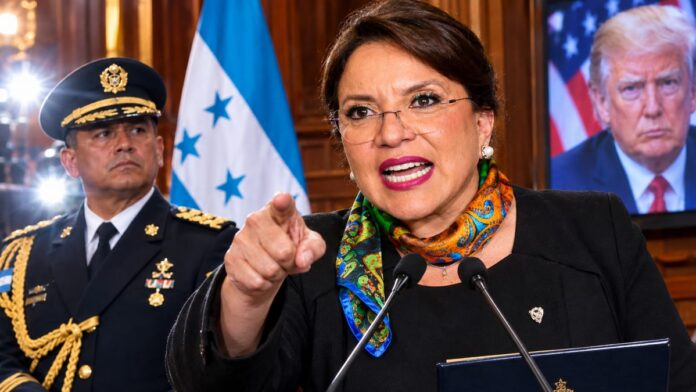
Honduras President Threatens To Expel U.S. Military Over Trump Honduras Deportations
Honduran President Xiomara Castro delivered a direct challenge to the United States on the eve of stricter immigration enforcement under President Trump. In a public address, she warned that mass removals of Hondurans present illegally would force her country to reconsider its military cooperation arrangements with Washington.
Castro stated that her government hopes the new U.S. administration remains open to constructive dialogue and does not resort to unnecessary reprisals against Honduran migrants amid an attitude of mass expulsion. She added that Honduras would have to consider changes to its cooperation policies with the United States, particularly in the military sphere, noting that American forces have maintained bases on Honduran soil for decades without payment and that those bases would lose their reason for existence if deportations proceed.
🚨HOLY SHT: President Xiomara Castro has issued Trump a warning that if Hondurans here illegally are sent back, she'll ask the U.S. Navy to leave
Raise your hand ✋️ if you think Trump should freeze all U.S Aid to Honduras if she refuses to accept the return of her own citizen pic.twitter.com/6BHA5xjMqC
— QUANTUM GUARD ™️ (@QuantumGuard17) September 28, 2026
The remarks amount to an explicit threat to expel U.S. military presence from Honduran territory in response to standard immigration enforcement. Such statements test the limits of bilateral relations at a moment when the Trump administration has signaled a return to prioritizing American border security and the removal of individuals who entered the country unlawfully.
Castro’s position links continued access to U.S. military facilities with acceptance of Honduran nationals deported for violating American law. This approach inverts the normal expectations of sovereign cooperation, where a nation is responsible for its own citizens regardless of U.S. immigration decisions. The suggestion that long-standing military arrangements could be revoked over deportations introduces unnecessary friction into a relationship that has historically included security cooperation without cost to Honduras.
Conservative observers note that threats of this nature invite a proportionate response. Freezing U.S. assistance to Honduras would align with the principle that foreign aid should not subsidize governments issuing ultimatums against American sovereignty. Honduras has benefited from decades of U.S. support in various forms, yet Castro’s comments frame routine law enforcement as hostile action requiring retaliation.
The episode underscores a broader pattern in which certain foreign leaders attempt to leverage U.S. domestic policy for leverage on unrelated matters. President Trump has consistently maintained that immigration enforcement is a core responsibility of any sovereign nation and that external pressure will not alter that course. Castro’s warning places Honduras in the position of choosing between continued cooperation and the consequences of politicizing military basing rights.
No evidence suggests the United States has sought to harm Honduran citizens through deportation policy. The removals target individuals who have violated U.S. immigration statutes, a category that includes citizens of many nations. Linking those removals to the sudden withdrawal of military access reveals a willingness to escalate a routine administrative matter into a strategic dispute.
The coming weeks will test whether such declarations produce the intended deterrent effect or simply accelerate decisions already under consideration regarding aid and security assistance. Honduras retains the right to manage its own territory, but the United States retains the right to enforce its borders without external veto. Castro’s statement has clarified the stakes for both sides.
The threat carries additional weight given Honduras’s geographic position and its role in regional security cooperation. U.S. military facilities in Honduras have supported counter-narcotics operations, humanitarian missions, and rapid-response capabilities across Central America for decades. Castro’s willingness to jeopardize that arrangement over deportations signals a significant shift in how she views the bilateral relationship.
For the Trump administration, the question is whether to treat Castro’s remarks as a negotiating tactic or as a red line that demands immediate consequences. Freezing aid would send a clear message that threats do not produce concessions. Maintaining the current posture would signal that U.S. policy is not subject to external demands tied to unrelated matters.
The broader issue remains: nations that refuse to accept the return of their own citizens create the conditions for this kind of standoff. If Honduras will not take back individuals removed for violating U.S. law, the leverage shifts entirely to the United States. Castro has now made that leverage explicit by threatening to revoke military access in exchange for halting deportations.
The republic’s immigration laws exist to protect American sovereignty and security. They apply equally to all nations. Castro’s attempt to exempt Honduran nationals from those laws through threats reveals a fundamental misunderstanding of how the Trump administration approaches foreign policy. Pressure tactics do not produce policy changes. They produce consequences.