


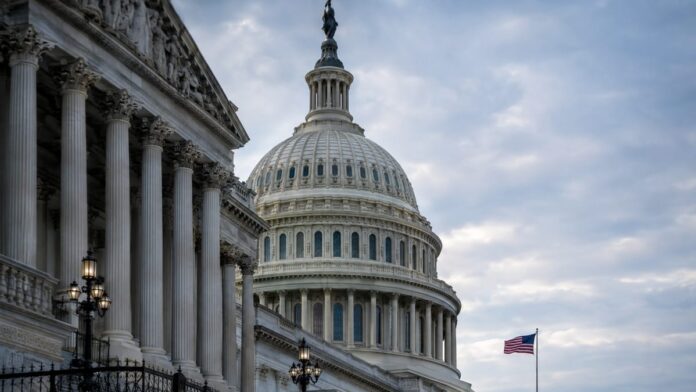
The full U.S. Court of Appeals for the Fifth Circuit ruled 9-8 on Friday that the House violated the Constitution’s Quorum Clause when it counted absent members as present by proxy to pass the $1.7 trillion Consolidated Appropriations Act of 2023. The decision in Texas v. Blanche affirms a lower-court order barring the federal government from enforcing the Pregnant Workers Fairness Act against Texas.
When the House passed the bill on Dec. 23, 2022, the vote was 225-201, with one member voting present and four not voting. Of those votes, 226 were cast by proxy, so less than a majority of the House was physically in the chamber.
Rep. Roy is pleased to see a court find proxy voting practices violate constitutional rules.
Rep. Roy was proud to file an amicus brief with his colleagues in 2022 raising these same issues.https://t.co/S9sVo9Qm3G https://t.co/XBg0mGDdSz
— Rep. Chip Roy Press Office (@RepChipRoy) November 21, 2026
What the ruling does
Judge Cory Wilson’s majority opinion was joined by Chief Judge Elrod and Judges Jones, Smith, Willett, Ho, Duncan, Engelhardt and Oldham. The court held that the enrolled-bill rule, which treats a signed bill as conclusive proof it passed, does not block review because no facts about the vote are in dispute.
On the merits, the majority wrote that the Clause’s “text, context, original understanding, and unbroken historical application all indicate that Members of Congress must be present for quorum purposes.” It added: “‘Proxy presence’ does not count.” The proxy system dated to House Resolution 965, adopted in May 2020 during the pandemic, and was renewed for the 117th Congress.
The relief is narrow. The judgment affirms only the district court’s injunction, which bars enforcement of the PWFA, and only against Texas. Texas did not ask the courts to undo the rest of the spending law.
The full court had vacated a 2025 panel ruling that went the other way and found the proxy vote valid.
Why it matters
Rep. Chip Roy of Texas raised the problem on the floor the day of the vote, noting that a physical quorum was not present and reserving the right to object. The Speaker pro tempore, then-Rep. G.K. Butterfield, answered that proxies counted toward the quorum under House Resolution 8.
Daily Beltway analysis: the ruling gives conservatives who fought pandemic-era proxy voting a constitutional win and puts a marker down for any future push to let members vote from home. The opinion limits relief to one state and one provision, but its reasoning about the House vote applies to the whole bill, which leaves room for new challenges to other parts of the package. That’s our read.
The dissent and critics
Judge James Graves wrote the main dissent, joined by six colleagues, arguing the majority added a “physical presence” requirement the Constitution does not contain. “There is no explanation offered to explain why, if the entirety of the statute was unconstitutionally passed, this court’s judgment should be limited only to one small sliver of the multi-trillion dollar bill,” he wrote. Judge Haynes dissented separately in a footnote.
The advocacy group A Better Balance, which backs the PWFA, said the ruling invalidated the law in Texas, Louisiana and Mississippi. The majority opinion says its judgment covers only Texas.
🚨 BREAKING: The 5th Circuit just invalidated the Pregnant Workers Fairness Act in Texas, Louisiana, and Mississippi.
These states are home to 20 million women, who should never have to choose between a healthy pregnancy and keeping their job.
Today the court failed them.
— A Better Balance (@ABetterBalance) November 21, 2026
What’s next
The judgment was entered Nov. 20. Under Supreme Court Rule 13, the federal government has 90 days, until Feb. 18, 2027, to ask the Supreme Court to review it.
Sources
- ca5.uscourts.gov
- law.cornell.edu
- reason.com
- news.bloomberglaw.com
- Original post: Rep. Chip Roy Press Office (@RepChipRoy) on X, Nov 21, 2026
- Related posts reviewed for this report:
If an embedded post does not load, these links open the originals.