


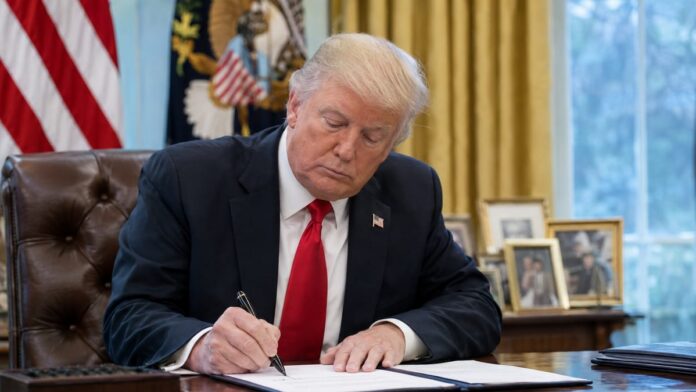
President Trump on Friday signed the Common Cents Act, H.R. 10167, into law, ending production of the penny for general circulation and setting federal rules for rounding cash purchases to the nearest nickel when exact change isn’t available.
The law writes into statute a phaseout the administration started on its own. Over the past 10 years, the cost of making one penny rose from 1.3 cents to 3.69 cents, and the U.S. Mint projects $56 million a year in material savings from stopping production. Existing pennies remain legal tender.
Today, November 20, 2026, President Donald J. Trump signed into law:
H.R. 10167, the “Common Cents Act,” which directs the Department of the Treasury to stop production of the penny except for collector needs; provides rounding guidance for cash transactions; allows the nickel…
— Rapid Response 47 (@RapidResponse47) November 21, 2026
What the law does
The act directs Treasury to stop producing pennies except for collectors, provides rounding guidance for cash transactions, lets the nickel be made of cheaper materials, and sets procedures Treasury must follow before discontinuing any coin for general circulation. Rounding applies only to cash; checks, credit cards and other noncash payments are not subject to it. Treasury must also give Congress 60 days’ notice before dropping any circulating coin, the American Bankers Association’s Banking Journal reported. Under the act, a $10.02 cash total can round down to $10 and a $10.04 total can round up to $10.05, CBS News reported, noting that before the law businesses could be sued for failing to give exact change, even when rounding in a customer’s favor.
Rep. Lisa McClain of Michigan, chair of the House Republican Conference, led the bill in the House. It passed the House on Sept. 14 and the Senate on Sept. 28. She marked the signing on X:
My Common Cents Act is now law! Washington was spending nearly four cents to make every one-cent penny. Not anymore. That’s what common sense, and Common Cents, looks like. pic.twitter.com/y0S2gBfiwh
— Chairwoman Lisa McClain (@RepLisaMcClain) November 20, 2026
Why it matters
Retailers have been handling cash without clear federal rules since penny production ended, and some rounded only in customers’ favor at their own expense, according to NACS, the convenience-store trade group. “Retailers have been looking for federal guidance on processing cash transactions since penny production ended,” said Brennan Duckett, NACS’ director of regulatory and policy.
Daily Beltway analysis: the dollar amounts are small, but the law settles a constitutional loose end. The president first ordered the penny halted in February 2025, and the committee’s minority at the time called that a policy declaration made outside his authority, since the Constitution gives Congress the power to coin money. Congress has now passed the phaseout itself, which ends that argument.
The critics’ case
In the committee’s 2025 report on an earlier version, H.R. 3074, eight Democrats led by Ranking Member Maxine Waters filed minority views opposing it. They warned of a “rounding” tax on cash users, “as businesses may round transactions to the disadvantage of consumers,” which they said would fall hardest on older Americans and low-income people. They also noted that, by the Mint’s figures, each nickel costs 13.8 cents to make, warned that a new nickel composition could disable vending machines, and listed opposition from the National Automatic Merchandising Association and the National Federation of the Blind. A Waters amendment to pause the phaseout for three years was not adopted.
What’s next
Neither the White House nor the committee announced implementation dates with the Nov. 20 signing. Any future move to stop minting another circulating coin, including the nickel, would start with that 60-day notice to Congress.
Sources
- whitehouse.gov
- financialservices.house.gov
- home.treasury.gov
- govinfo.gov
- abillaminute.com
- convenience.org
- cbsnews.com
- bankingjournal.aba.com
- Original post: Rapid Response 47 (@RapidResponse47) on X, Nov 20, 2026
- Related posts reviewed for this report:
If an embedded post does not load, these links open the originals.