


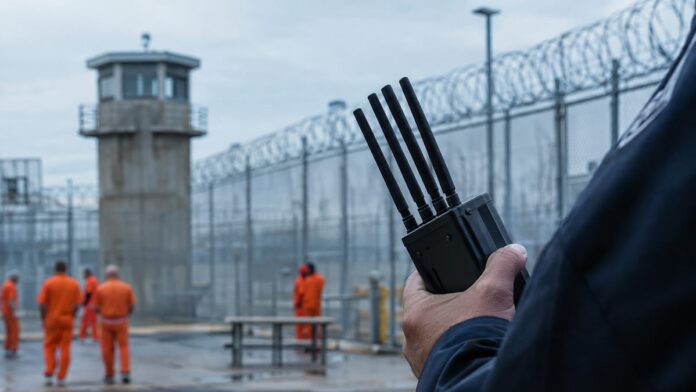
The Federal Communications Commission on Thursday, Nov. 19, cleared state and local prisons and jails to jam contraband cellphones for the first time. The order (FCC 26-80) makes jamming an optional tool that correctional facilities can seek, subject to FCC licensing, testing and technical limits.
Chairman Brendan Carr and Commissioner Olivia Trusty approved it. Commissioner Anna Gomez approved in part and dissented in part. The FCC cited a 2024 study that found prison authorities recovered more than 25,000 cellphones in one year, with two facilities each reporting more than 6,000.
ADOPTED ✅
No bars behind bars.
The FCC voted today to allow state and local prisons to jam contraband cellphones for the first time ever.
These devices are being used by inmates to order hits, run drug operations, traffic women and children, and unleash mayhem on our… pic.twitter.com/BzNAwCNXyW
— Brendan Carr (@BrendanCarrFCC) November 19, 2026
What the order does
Jamming may happen only inside a Commission-authorized “jamming containment area” where cellphone use is already barred by federal, state or local law or by prison rules, and it must not cause harmful interference outside that area. A facility first has to test its system under an experimental license to show the signal stays contained, then test again at the prison after the license is granted and before operations begin.
Nearby communities get advance notice of on-site testing and notice before deployment. Gomez’s statement lists other safeguards: wireless carriers can join initial testing, carriers and public safety agencies can attend the final test, the surrounding community gets at least 20 days’ notice before jamming starts, and equipment must shut down automatically if it is removed from the authorized area. A companion Further Notice of Proposed Rulemaking seeks comment on closing loopholes that may let contraband phones keep operating.
Why it matters
Daily Beltway analysis: this reverses a long-standing federal bar on non-federal jamming, and it hands corrections officials a tool they have been asking for. Carr’s statement points to cases in which inmates used smuggled phones to run a sextortion scheme aimed at military members and veterans in South Carolina and to plot an escape in Idaho in which three officers were shot and two civilians were murdered.
“Today, we are finally authorizing state and local prisons and jails to use targeted jamming against contraband cell phones for the first time,” Carr said. “No facility will be required to do it.”
Contraband cellphones threaten everyone from law-abiding Arkansans to law enforcement officers.
Great move by @FCC and @BrendanCarrFCC.
Congress should pass my Cellphone Jamming Reform Act to codify this decision into law. https://t.co/G5SPlVZBlC— Tom Cotton (@SenTomCotton) November 19, 2026
The dissent
Gomez said she supports stopping contraband phones but warned of unintended consequences. “For the last 90 years, the Federal Communications Commission (FCC, Commission) has prohibited jamming by non-federal actors and even prohibited jamming equipment to be introduced into the American market,” she wrote. “I want to make sure that we don’t harm public safety in the name of helping public safety.”
Her partial dissent concerned inmate calling services. She wanted the order to state that jamming costs are not necessary to provide phone and video calls to incarcerated people, which matters when the FCC sets those rates.
What’s next
No facility can jam until it applies, wins FCC approval and passes both rounds of testing, and the further notice opens a public comment round; the FCC’s release did not list dates for either. Sen. Tom Cotton, R-Ark., wants Congress to pass his Cellphone Jamming Reform Act to write the decision into law. No vote on that bill has been scheduled.
Sources
- docs.fcc.gov
- docs.fcc.gov
- docs.fcc.gov
- docs.fcc.gov
- Original post: Brendan Carr (@BrendanCarrFCC) on X, Nov 19, 2026
- Related posts reviewed for this report:
If an embedded post does not load, these links open the originals.