

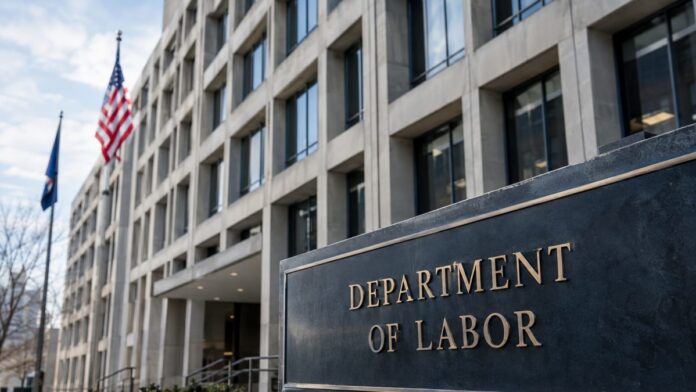
The Labor Department on Thursday finalized a rule that rescinds the 2024 standard for deciding who is an employee and who is an independent contractor under the Fair Labor Standards Act. The replacement is a streamlined test substantially similar to the framework the department adopted in 2021, during President Trump’s first term.
Labor Secretary Keith Sonderling and Wage and Hour Division Administrator Andrew Rogers announced the rule at the department’s Frances Perkins Building headquarters. It takes effect 60 days after publication in the Federal Register and also covers the Family and Medical Leave Act and the Migrant and Seasonal Agricultural Worker Protection Act.
Today, I’m proud to announce @USDOL has FINALIZED our new INDEPENDENT CONTRACTOR RULE.
This Administration is boldly taking the final step toward ENDING UNCERTAINTY by establishing CLEAR and EASY-TO-UNDERSTAND criteria for determining who is an EMPLOYEE and who is an INDEPENDENT… pic.twitter.com/0hxdQeGXqt
— Secretary Keith Sonderling (@Sonderling47) November 19, 2026
What the rule does
The rule applies an “economic reality” test that asks whether a worker is in business for himself or herself or is economically dependent on an employer for work. Two core factors carry the analysis: the nature and degree of control over the work, and the worker’s opportunity for profit or loss based on initiative or investment.
Three other factors can help decide close cases: the amount of skill the work requires, the permanence of the working relationship, and whether the work is part of an integrated unit of production. What the worker and company actually do counts more than what a contract says is possible. The rule does not change classification under other federal laws, including the Internal Revenue Code, and does not preempt state or local laws.
By the numbers
- 2 core factors, plus 3 secondary factors
- 14 fact-specific examples, including new ones for farm labor contractors, digital platform workers and truck drivers
- About 16,500 public comments during a 60-day comment period after the Feb. 27, 2026, proposal
- 60 days from Federal Register publication to take effect
Why it matters
Daily Beltway analysis: The rule ends, for now, a classification standard that has flipped with each recent administration, from the 2021 rule in Trump’s first term to the 2024 rule adopted under President Biden and back again. For small firms without compliance staff, a test built on two questions is easier to apply before a working relationship starts. It does not override stricter state laws, including the ABC test used in California, so employers there still face a tougher standard.
“The new Independent Contractor final rule establishes clear, predictable, and easy-to-understand criteria for determining who is an employee and who is an independent contractor – allowing millions of Americans to take advantage of new opportunities in President Trump’s booming economy,” Sonderling said. Small-business owners backed it, with the National Federation of Independent Business saying the rule “will lower the risk of worker misclassification, giving predictability to employers and reducing financial penalties placed on well-meaning small businesses for misclassifications.”
#NFIB sent a statement in support of the U.S. DOL final rule on the classification of independent contractors, which was announced today.
The 2026 rule will lower the risk of worker misclassification, giving predictability to employers and reducing financial penalties placed on… pic.twitter.com/yLveRDpaS7
— NFIB (@NFIB) November 19, 2026
The other side
Worker advocates fought the proposal. The National Employment Law Project, which filed comments opposing it April 28, argued that the approach is contrary to the language of the three laws and to Supreme Court and circuit court precedent. The group said the proposal “elevates and narrowly defines two ‘core’ factors in ways that will broaden who is considered an independent contractor excluded from FLSA, FMLA, and MSPA protections.”
What’s next
The rule takes effect 60 days after it appears in the Federal Register; it had not been published there as of Friday morning. Workers and employers with questions can call the Wage and Hour Division’s helpline at 866-487-9243.
Sources
- dol.gov
- dol.gov
- federalregister.gov
- shrm.org
- nelp.org
- Original post: Secretary Keith Sonderling (@Sonderling47) on X, Nov 19, 2026
- Related posts reviewed for this report:
If an embedded post does not load, these links open the originals.