


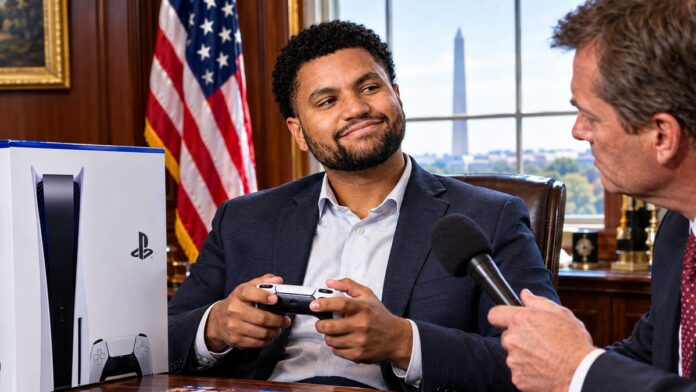
Rep Maxwell Frost Just Bought A PlayStation 5 To Play Grand Theft Auto — And Told Critics To Chill Out
Democratic Representative Maxwell Frost disclosed plans to purchase a PlayStation 5 for the sole purpose of playing Grand Theft Auto, a video game centered on criminal activity that includes the shooting of police officers and other violent acts. In a recorded exchange that surfaced online, the Florida congressman described the purchase as necessary to catch up on experiences denied to him during his youth, when his parents restricted access to the title.
Frost stated directly in the conversation, admitting he would buy the console for one game. When questioned about the game’s content and whether it promotes violence, he dismissed the concern outright. Parents should decide what content their children consume, he argued, noting he had instead played Simpsons Hit and Run during his own childhood, which he called a child-friendly alternative.
Rep. Maxwell Frost tells me he’s buying a Playstation 5 to play “one f**king game” — saying America is the only country with Grand Theft Auto and a gun violence issue pic.twitter.com/sjRTqniu47 https://t.co/xdeR7f5N5B
— Jacob Wasserman (@jacob_wass) November 18, 2026
The congressman extended his remarks to address broader concerns about video games and violence. He claimed that every country has access to these games and movies, but the United States is the only one with a real firearm violence problem. Frost contrasted the global availability of Grand Theft Auto V with what he described as America’s unique position, asserting that firearms availability — not entertainment — explains the difference in outcomes. He maintained that decisions about such games rest with parents rather than broader restrictions.
Frost’s comments came during a discussion that referenced Republican Representative Tim Burchett’s view that parents allowing children to play the game bear responsibility for any resulting effects. The Florida Democrat rejected any direct link between the game and real-world violence outside the American context, insisting the distinction lies in access to firearms rather than exposure to simulated crime and killing.
The remarks reflect a common line of argument from some lawmakers who downplay the role of violent entertainment in shaping behavior while focusing attention exclusively on firearms policy. Frost positioned the issue as one of parental choice and national differences in weapons availability, without addressing repeated findings from multiple studies on the potential desensitizing impact of repeated exposure to simulated violence in interactive media.
His own admission of buying the console specifically for the game underscores a personal interest that some may view as inconsistent with calls to treat firearm violence as a uniquely American problem detached from cultural influences. The game in question centers on theft, assault, police shootings, and organized crime as core gameplay mechanics. Players advance by committing crimes, evading law enforcement, and accumulating wealth through illegal activity.
Frost’s defense of the title as equivalent to a movie or song sidesteps the interactive nature of video games, where players actively control characters committing violent acts rather than passively observing them. The distinction between consuming violent content and participating in simulated violence has been the subject of ongoing research and debate, particularly regarding desensitization effects on younger audiences.
The congressman’s casual dismissal of concerns — telling critics to chill out — may resonate with younger constituents who view gaming as mainstream entertainment. It also invites scrutiny from those who question whether elected officials should model the consumption of content that glorifies criminal behavior, particularly when those same officials advocate for stricter laws in other areas of public life.
Frost’s claim that Grand Theft Auto exists in many countries without producing similar violence outcomes is accurate in part but incomplete. Studies examining cross-national differences in violence have identified multiple factors beyond firearms availability, including enforcement of age ratings, parenting practices, mental health infrastructure, and cultural attitudes toward authority. The congressman’s framing reduces a complex issue to a single variable.
The timing of Frost’s comments is notable given ongoing debates in Congress over content moderation, age-appropriate entertainment, and corporate responsibility for the material companies market to minors. While the congressman framed his position as one of parental autonomy, critics may argue that lawmakers have a broader responsibility to consider the cumulative cultural impact of entertainment that normalizes criminal violence.
Frost’s reference to making up for lost time suggests a personal motivation beyond policy consideration. The purchase decision, delivered with profanity in the recorded exchange, reflects a casual approach to content that includes police killings and organized crime as entertainment. Whether voters view that as relatable or inappropriate will likely depend on their own views regarding the role of media violence in shaping societal norms.
The exchange leaves unanswered questions about where Frost believes the line should be drawn on violent content, if anywhere, and whether he supports any age restrictions or labeling requirements for games that simulate criminal activity. His emphasis on parental choice implies opposition to government-imposed content restrictions, but he did not address whether he supports existing industry rating systems or believes they should be strengthened.
The story is a reminder that lawmakers often hold positions on cultural issues that are shaped as much by personal preferences as by policy analysis. Frost’s willingness to state his intention publicly and defend the game on camera suggests confidence that his constituents will support his stance. It also ensures the exchange will be revisited whenever debates over media violence and societal harm return to the national conversation.
Sources
- Original post: Jacob Wasserman (@jacob_wass) on X, Nov 18, 2026
- Related posts reviewed for this report:
- Maxwell Alejandro Frost (@MaxwellFrostFL) on X, Nov 18, 2026
- Jen (@tavmcknythews) on X, Nov 18, 2026
- Jen (@tavmcknythews) on X, Nov 18, 2026
Posts on X are shown as published by their authors; claims in them are attributed, not independently confirmed unless the article says so. If an embedded post does not load, these links open the originals.