


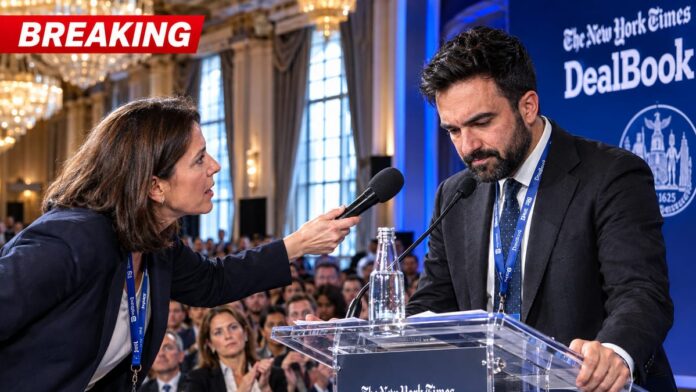
New York City Mayor Zohran Mamdani stood before a packed DealBook conference audience and refused to commemorate the October 7, 2023 t*rrorists attacks without immediately pivoting to Israeli actions in Gaza. The exchange at the New York Times event laid bare a pattern that has drawn sharp criticism from Jewish leaders and residents who expected their mayor to honor the victims of that day without political hedging.
A questioner pressed Mamdani directly. Would he ever consider sending one message on October 7 acknowledging the horror of the attacks, then waiting until October 8 to address his concerns about Israel’s response? The question drew applause from the room. Mamdani visibly hesitated, then doubled down on his refusal to separate the two.
Mamdani framed October 7 as both a horrific war crime and a day that has been used as justification for what followed. He argued that when the Israeli government is conducting a genocide of Palestinians, the defense given will reference October 7 no matter what day it is asked about. His conclusion: it is important to mourn the totality of its impact on any day.
Wow. @NYCMayor just moments ago at the NY Times DealBook conference was asked why can't Jews have just one day to mark October 7 without him mixing it up—as he did this year—into a discussion about Gaza. The audience broke into applause at the question. And Mamdani seemed as… pic.twitter.com/tQG9prA0Ck
— Gerald Posner (@geraldposner) November 18, 2026
The mayor described his approach as a politics of universality. When asked why he supports Palestinian freedom or rights, he speaks about extending the same values to everyone. That framing allows him to avoid isolating the brutality of October 7 as a standalone atrocrity. It folds the massacre into a broader narrative that immediately shifts focus to Israeli conduct.
The positioning stands in stark contrast to remarks Mamdani made earlier in the same interview. He expressed pride in serving as mayor of the most Jewish city in the United States, noting that much of what people love about New York ties into that legacy. He described his responsibility as rooting out antisemitism. The audience heard those words, then watched him refuse to honor October 7 victims without immediately invoking Gaza.
The contradiction was not lost on observers. Mamdani’s insistence on pairing the events reflects a consistent pattern in his public statements. He treats the October 7 massacre not as a discrete tragedy but as part of a larger narrative involving Israeli actions. This approach undercuts efforts to isolate the specific brutality of that day. It dilutes focus on the original attacks and instead folds them into arguments that equate or diminish what happened.
Such positioning aligns with rhetoric that has fueled tensions in New York City, where antisemitic incidents have risen sharply in recent years. Claims of pride in the city’s Jewish community and commitments to combat antisemitism serve as rhetorical shields. Yet they coexist with language that endorses contested characterizations of events in Gaza. The refusal to mark October 7 independently reveals a deeper prioritization. The mayor views the date primarily through the lens of later conflicts rather than its intrinsic horror.
The interview format allowed these points to surface without substantial challenge on the core assertions. Interviewer Andrew Ross Sorkin acknowledged the other side of the argument but did not push back on Mamdani’s characterization of Israeli actions as genocide. The framing went unchallenged in the moment, leaving Mamdani free to reinforce a worldview that integrates support for Palestinian causes with a universalist lens. That lens consistently dilutes focus on the initial attacks.
This dynamic has contributed to perceptions that city leadership under Mamdani struggles to address antisemitism with the clarity many expect. Political considerations tied to certain voter bases appear to shape the mayor’s public language. The result is a posture that offers verbal commitments to fighting antisemitism while simultaneously declining to honor Jewish victims of t*rrorism on their own terms.
The October 7 attacks killed over 1,200 people and saw hundreds taken hostage. The day marked the deadliest assault on Jews since the Holocaust. For many in New York’s Jewish community, the expectation that their mayor would acknowledge that day without immediate qualification is not unreasonable. Mamdani’s refusal to do so has deepened concerns about his willingness to confront antisemitism when it conflicts with his broader political priorities.
The DealBook exchange crystallized a tension that has simmered throughout Mamdani’s tenure. He presents himself as a champion of universal values and an opponent of bigotry. Yet when asked to apply those principles to the commemoration of October 7, he declines. The unwillingness to separate the massacre from subsequent geopolitical debates suggests that for Mamdani, the politics of universality applies selectively. Jewish victims of t*rrorism receive conditional empathy, contingent on the mayor’s larger narrative about Israeli actions.
That conditional empathy has real consequences. It signals to New York’s Jewish community that their pain is negotiable, subject to political framing and broader debates. It tells them that their mayor will not stand with them unequivocally, even on the anniversary of the worst attack on Jews in generations. For a city that prides itself on diversity and inclusion, that message is both troubling and revealing.
Sources
- Original post: Gerald Posner (@geraldposner) on X
- Related posts reviewed for this report:
- Brigitte Gabriel (@ACTBrigitte) on X, Nov 18, 2026
- 🇺🇦Banquo (@BanquoDyar) on X, Nov 19, 2026
- Lunar Surfer (@TheLunarSurfer) on X, Nov 18, 2026
Posts on X are shown as published by their authors; claims in them are attributed, not independently confirmed unless the article says so. If an embedded post does not load, these links open the originals.