


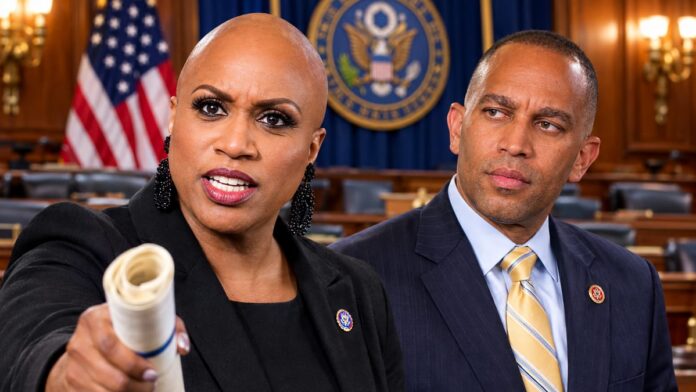
Rep. Ayanna Pressley Demands Slavery Reparations, ICE Abolition in Sweeping Progressive Vision
Rep. Ayanna Pressley has laid out a sweeping policy vision that prioritizes slavery reparations for Black Americans, the abolition of Immigration and Customs Enforcement, expanded abortion access, and a broad pathway to citizenship for illegal immigrants. The Massachusetts Democrat delivered the remarks in a public address, framing the agenda as essential for what she called reparative justice and immigrant safety while explicitly calling for the repeal of federal funding restrictions on abortion and the dismantling of an entire federal enforcement agency.
Pressley described her push for what she termed a reparative justice agenda for Black America, appealing directly to House Democratic Leader Hakeem Jeffries to embrace the effort without apology. She tied the initiative to her role as chair of the Reproductive Freedom Caucus, where she advocates for the restoration and expansion of abortion rights, including the elimination of restrictions on federal funding through repeal of the Hyde Amendment. Pressley also highlighted her district’s demographics, noting it is 40 percent foreign-born, and argued that ICE must be dismantled because it is terrorizing immigrant neighbors. She further demanded extensions of temporary protected status programs, claiming they prevent family separations and deportations that amount to a death sentence, alongside a citizenship pathway that prioritizes what she described as the humanity, dignity, and safety of people.
Rep. Pressley lays out Project 2027: slavery reparations, more abortion, amnesty, TPS expansion, and ICE abolition
So much for the "affordability agenda" pic.twitter.com/Qhi6vwbXBl
— End Wokeness (@EndWokeness) November 19, 2026
The positions directly challenge the economic focus that has dominated recent political messaging around affordability and cost-of-living concerns. Pressley’s agenda instead elevates identity-based redistribution, unrestricted reproductive policies, and immigration restructuring as central demands, sidelining broader voter priorities on household expenses and border security under the current administration. The contrast underscores a persistent divide within Democratic ranks, where progressive lawmakers continue to advance measures that expand federal involvement in racial grievance programs, abortion funding, and immigration enforcement rollbacks.
Such proposals have historically faced resistance in Republican-controlled chambers and from the White House, which has prioritized enforcement and fiscal restraint since taking office. By centering these elements, the outlined plan risks reinforcing perceptions that certain Democratic voices remain detached from practical governance on inflation, energy costs, and legal immigration reform. Pressley’s district-specific references and explicit calls for structural changes to immigration agencies signal an intent to institutionalize these shifts through legislative and caucus-driven pressure.
The emphasis on repealing longstanding funding restrictions like the Hyde Amendment and abolishing an entire federal enforcement body represents a departure from incremental policy adjustments toward more transformative demands. This approach aligns with ongoing efforts to reframe domestic priorities around equity frameworks rather than universal economic metrics. The Hyde Amendment, first enacted in 1976, prohibits the use of federal funds for most abortions and has been renewed annually with bipartisan support for decades. Pressley’s call for its repeal places her at odds with moderate Democrats and the broader electorate, which has consistently supported restrictions on taxpayer funding for abortion.
The demand to abolish ICE, the federal agency responsible for enforcement of immigration law in the interior of the United States, represents one of the most radical proposals in the current Democratic policy debate. ICE conducts investigations into human trafficking, child exploitation, narcotics smuggling, and other transnational crimes, in addition to its role in deportation proceedings. The agency employs over 20,000 personnel and operates on a budget of approximately eight billion dollars annually. Abolishing it would require either the creation of a replacement agency or the transfer of its responsibilities to other federal entities, a restructuring that would face significant legal, operational, and political hurdles.
Pressley’s reference to temporary protected status programs reflects ongoing debates over the scope and duration of protections for foreign nationals who entered the United States under emergency designations. TPS grants temporary legal status to individuals from countries facing armed conflict, environmental disasters, or other extraordinary conditions. The Trump administration has sought to wind down TPS designations for several countries, arguing that the original conditions justifying the protections have changed or no longer exist. Pressley’s demand for extensions would perpetuate the status of hundreds of thousands of individuals, many of whom have been in the United States for decades, without resolving their long-term immigration status.
The call for a pathway to citizenship that centers humanity, dignity, and safety is a reframing of longstanding Democratic proposals for comprehensive immigration reform. Critics argue that such pathways amount to amnesty for individuals who violated immigration law, undermining the legal immigration process and incentivizing future illegal crossings. The emphasis on safety and dignity, while politically appealing, sidesteps questions of enforcement, border control, and the fiscal cost of providing public services to millions of newly legalized residents.
Pressley’s appeal to Jeffries to lead on reparations without apology places the Democratic leader in a politically delicate position. Reparations proposals have gained traction among progressive activists and some lawmakers, but they remain deeply unpopular with the broader electorate and face significant opposition even within the Democratic caucus. Jeffries, who assumed his role as House Democratic Leader following Nancy Pelosi’s decision to step aside, has not publicly committed to supporting a comprehensive reparations framework. Pressley’s direct call for his leadership on the issue is an attempt to pressure him into adopting a position that could alienate moderate voters and complicate Democratic messaging ahead of future elections.
The framing of the agenda as a project for 2027 suggests an expectation that Democrats will not achieve legislative majorities in the near term and are instead positioning these demands as long-term goals to energize the party’s progressive base. The reference to 2027, however, invites comparisons to the conservative Project 2025, a policy blueprint developed by right-leaning organizations to guide a future Republican administration. By adopting similar framing, Pressley and her allies are signaling an intent to formalize their policy vision into a coherent legislative program that could be enacted if Democrats regain control of the federal government.
The contrast between Pressley’s progressive vision and the economic concerns of working-class voters highlights the ongoing tension within the Democratic coalition. While activists and progressive lawmakers prioritize issues of identity, immigration, and reproductive rights, polling consistently shows that voters across the political spectrum rank the economy, inflation, and public safety as their top concerns. Pressley’s agenda, while popular among a segment of the Democratic base, risks alienating swing voters who view the focus on reparations, ICE abolition, and expanded abortion access as disconnected from their daily struggles.
The remarks also underscore the challenge facing Democratic leadership as they attempt to unify a fractious caucus ahead of the next election cycle. Jeffries and other party leaders must balance the demands of progressive members like Pressley with the need to appeal to moderate and independent voters in competitive districts. The emphasis on transformative policy changes, rather than incremental reforms, complicates efforts to present a cohesive message on kitchen-table issues that resonate with the broader electorate.
Pressley’s public address and the policy vision it outlined represent a clear articulation of the progressive wing’s priorities and a test of Democratic leadership’s willingness to embrace or distance itself from those demands. The coming months will reveal whether Jeffries and other party leaders choose to amplify Pressley’s agenda or pursue a more moderate path in response to voter concerns about affordability, border security, and public safety.
Sources
- Original post: End Wokeness (@EndWokeness) on X, Nov 18, 2026
- Related posts reviewed for this report:
- Martin Walsh (@martinwalsh__) on X, Nov 18, 2026
- DAKKADAKKA (@DAKKADAKKA1) on X, Nov 19, 2026
- Ricardo Palomino (@TucoPalomino) on X, Nov 19, 2026
Posts on X are shown as published by their authors; claims in them are attributed, not independently confirmed unless the article says so. If an embedded post does not load, these links open the originals.