

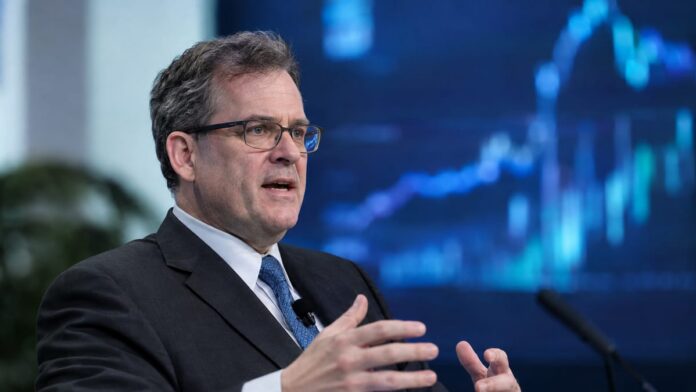
Federal Reserve Governor Michael Barr warned Monday that the debt piling up behind the artificial intelligence buildout deserves close watching, saying a sharp reversal in the AI trade could lead to “rapid deleveraging and, potentially, self-reinforcing fire sales.” Barr spoke at an AI-in-finance conference in Milan, Italy.
The speech walked through the Fed’s latest Financial Stability Report, released Friday, which this time focuses on the AI investment boom. Its biggest number: the Fed estimates the potential maximum value of AI firms’ off-balance-sheet obligations “now exceeds $3 trillion.”
Speech by Governor Barr on some potential financial stability implications of artificial intelligence: https://t.co/5WJ28iremn
Watch live: https://t.co/IIsyOn6Dkd
Learn more about Governor Barr: https://t.co/AZsNWhl2ze
— Federal Reserve (@federalreserve) November 16, 2026
What the Fed found
On-balance-sheet debt at the seven largest AI firms has grown significantly in 2026 and is expected to exceed $800 billion before year’s end. Barr compared that growth to the telecom investment cycle of the late 1990s and early 2000s. The hyperscalers have not yet passed that earlier boom, but their recent acceleration in capital spending suggests they may do so soon.
The faster-growing risk sits off the books: long-term contracts, lease commitments and residual value guarantees. That complexity “can be opaque to unsophisticated investors,” Barr warned, and opacity can make selloffs worse because “it is hard to know where risk resides.”
He also flagged “circular financing.” Hyperscalers and chipmakers hold more than $100 billion in cumulative equity investments in AI labs and cloud start-ups, which then use the money to rent or buy chips and computing power from the same firms that invested.
Why it matters
Barr was not predicting a crash. He said he is “an optimist about the long-term promise of AI,” and that, given “the still-limited amount of debt backing the current boom,” he is “less concerned about direct losses.” His worry is leverage at hedge funds and in equity strategies, much of it supplied by large dealers.
Barr also put the boom in historical terms. By one estimate he cited, the AI capital buildout could rival or even exceed the railroad boom of the 1870s, the highway buildout of the 1950s and ’60s and the fiber-optic boom of the 1990s. Most of a data center’s cost is in specialized chips that may lose value quickly as newer technology overtakes them, though lease rates for older chips appear to be holding up for now.
Daily Beltway analysis: AI spending is now large enough that a repricing would not stay on Wall Street. Losses could slow the economy two ways, through lower investment and through weaker consumer spending as household wealth falls. Barr served as the Fed’s vice chair for supervision from July 2022 to February 2025, and he has spent much of the past year on this theme. Monday’s remarks were his fourth speech devoted entirely to AI in the past year.
The administration’s case
The Trump administration is pointing to a broader, stronger economy. Treasury Secretary Scott Bessent said in remarks Treasury shared Sunday: “We are seeing a very strong acceleration across all parts of the economy.” He credited the tax bill, trade, energy and deregulatory policy, and said “all areas of the economy are strong.”
.@SecScottBessent: “We are seeing a very strong acceleration across all parts of the economy. 2025 was setting the table with the tax bill, with trade policy, with energy policy, with the deregulatory policy. And now, second half of 2026, everything is coming into place. We are… pic.twitter.com/oPsHrxf4VD
— Treasury Department (@USTreasury) November 15, 2026
What’s next
Fed Chairman Kevin Warsh is scheduled to give opening remarks Tuesday, Nov. 17, at the Fed’s Productivity and Jobs Task Force Conference in San Francisco. The Federal Open Market Committee meets Dec. 8-9, a meeting that comes with new economic projections.
Sources
- federalreserve.gov
- federalreserve.gov
- federalreserve.gov
- federalreserve.gov
- Original post: Federal Reserve (@federalreserve) on X, Nov 16, 2026
- Related posts reviewed for this report:
If an embedded post does not load, these links open the originals.