


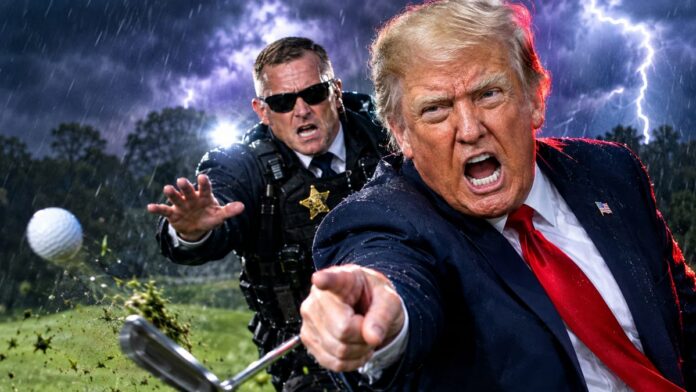
President Trump Jokes He Cannot Cheat at Golf With 250 Secret Service Agents Watching Every Swing
President Donald Trump delivered one of his signature self-aware punchlines during a recent golf outing with corporate executives, explaining that critics who accuse him of cheating on the course overlook one insurmountable obstacle: the hundreds of Secret Service agents tracking his every move.
Speaking about the round, Trump described the security presence blanketing the fairways. We had hundreds of Secret Service all over the course, he said. In fact, they said, does Trump cheat? I cannot cheat. You have 250 Secret Service agents running down. It is not that I would not cheat, but you cannot move the ball.
🚨 LMFAO! Donald Trump drops the funniest line on people claiming he cheats at golf
“It’s not that I WOULDN’T cheat. I can’t move the ball!” 😭
“I can't cheat. You have 250 secret service agents running around. It's not that I wouldn't cheat.”
Funniest president ever, the… pic.twitter.com/vQfJ5OdUmC
— Eric Daugherty (@EricLDaugh) September 12, 2026
The remark landed as both a joke and a pointed rebuttal to persistent media allegations that the president improves his lie when playing golf. Trump has faced years of unverified claims from critics and authors who suggest he bends the rules during casual rounds. The president addressed those accusations head-on with humor, framing the Secret Service detail as an all-seeing surveillance apparatus that makes any rule-breaking impossible.
Trump noted that the agents understand golf etiquette even if they do not play the game themselves. I do not know if they play or not, but they know you are not supposed to be moving the ball around, OK? he added. The comment drew laughter from those familiar with the cheating narrative, which has been a recurring theme in unflattering profiles and partisan commentary.
The president is a legitimate golfer with multiple club championships to his name and a reported low handicap. Professional golfers who have played with him, including major champions, have praised his swing and competitive nature. His courses host PGA Tour and LPGA events, and he has invested heavily in golf infrastructure across the country. The idea that he would need to cheat to perform well does not align with the skill level he has demonstrated over decades of play.
Trump also used the story to illustrate the scale of presidential protection. He recounted how one corporate executive playing in the group asked what would happen to him in the event of an emergency. The agent’s response was blunt: You are considered collateral damage. You are on your own, sir.
Trump observed that the executive did not feel too good after hearing that and was not sure if he should finish out the round, actually. The anecdote offered a glimpse into the no-nonsense approach the Secret Service takes when securing a president in public or semi-public settings. The detail does not negotiate. The mission is singular.
Trump closed by praising the professionalism of the agents assigned to him. They are amazing. Secret Service has been great and they are. They do not play games, especially since, he said, trailing off in a likely reference to the two assassination attempts he survived during the campaign and transition.
The comments reflect Trump’s habit of turning the constraints of high office into material for humor while acknowledging the gravity of the security apparatus around him. He does not shy away from the absurdity of being followed by hundreds of armed personnel during a casual round of golf. Instead, he leans into it, using the reality of presidential protection as the setup for a joke that doubles as a rebuttal to critics.
Conservative observers appreciated the moment as another example of Trump’s direct communication style. He does not engage in lawyerly denials or rehearsed talking points. He jokes about the accusation, admits he is under constant surveillance, and moves on. The approach disarms critics by refusing to treat the allegation as serious enough to merit a defensive response.
The story has circulated widely among supporters who see it as emblematic of the president’s willingness to be himself in public settings, even when the subject is minor. The media has spent years fixating on Trump’s golf habits, tallying his rounds and questioning his honesty on the course. Trump’s response is to make the surveillance state the punchline.
The remark also underscores a broader truth about the modern presidency. No president operates without a massive security footprint. Every movement is tracked, every location is secured, and every interaction is monitored. The golf course is no exception. The idea that Trump could surreptitiously move a ball under the watch of trained federal agents is logistically implausible, which is precisely the joke.
Trump’s relationship with golf has been a point of contention throughout his time in public life. Democrats and media figures criticized the number of rounds he played during his first term, often contrasting his golf schedule with his public statements about working tirelessly. Trump, for his part, has pointed out that many presidential decisions were made on the course, where he hosted foreign leaders, business executives, and members of Congress in informal settings that facilitated deal-making.
The anecdote fits within a long tradition of presidents using humor to deflect criticism. Trump’s version is characteristically blunt, with no attempt to soften the edges. He acknowledges the premise of the accusation—does Trump cheat—and dismisses it with a logistical reality check rather than a moral defense. The response is effective because it reframes the question as ridiculous on its face.
The executive’s collateral damage moment also reveals the stark divide between presidential security and everyone else. The Secret Service does not extend its protection to guests or playing partners beyond the immediate threat environment. The mission is the principal, and everyone else is secondary. That reality, delivered with deadpan honesty by the agent, left the executive rattled and Trump amused.
This story is a small window into how Trump operates. He does not take himself too seriously on minor issues, but he does not let accusations stand unchallenged either. The joke is the rebuttal. The laughter is the punctuation. And the Secret Service, ever professional, remains the unintended straight man in a comedy routine that only a president under constant watch could deliver.