


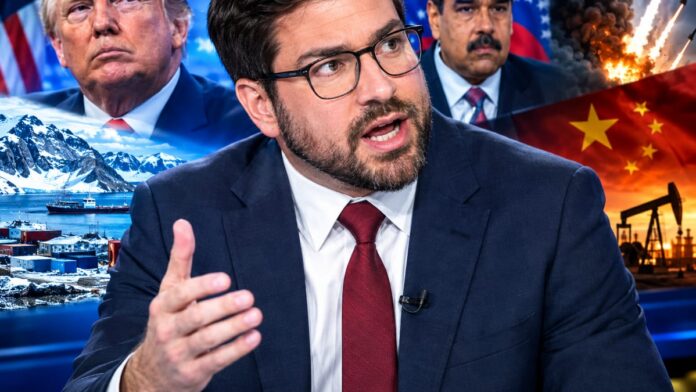
President Trump has systematically undercut Chinese strategic interests through a series of concrete moves that directly challenge Beijing’s global positioning, according to analysis delivered on CNN by commentator Jason Rantz.
The Greenland deal, actions targeting Venezuelan strongman Maduro, and the ongoing conflict in Iran collectively deliver measurable blows to China’s economy and influence. Rantz laid out the case during a CNN NewsNight panel discussion, pushing back against suggestions that Trump has softened his stance toward China. The record shows otherwise.
Rantz described the Greenland deal as a move that undercuts Chinese influence in the Arctic. The agreement came together within the past week and represents a strategic win for American interests in a region where China has sought to expand its footprint. By securing access and partnership with Denmark, the administration blocked a potential avenue for Beijing to gain leverage over critical shipping routes and natural resources. The deal is not symbolic. It is operational.
.@jasonrantz reminds the CNN NewsNight panel the recent history of Trump standing up to China: Greenland deal. Going after Maduro — “a key Chinese ally.” Iran war hitting China’s economy.
Rantz: “It’s not like he’s holding back on China any meaningful way as it comes to our… pic.twitter.com/NFUJrvDDDZ
— Steve Guest (@SteveGuest) September 25, 2026
The commentator also pointed to efforts targeting Maduro, whom he identified as a key Chinese ally. Venezuela has served as a beachhead for Beijing in Latin America, with billions in Chinese loans propping up the regime and extensive economic ties binding the two governments. Any pressure that weakens Maduro also weakens China’s strategic position in the Western Hemisphere. Rantz argued that going after Maduro is not incidental to the broader China strategy. It is central.
The war in Iran adds another layer of economic pressure on China. Iran supplies oil to China at discounted rates, and any disruption to Iranian production or export capacity hits Beijing’s energy security. Conflict in the region drives up costs and destabilizes a supply line China depends on. Rantz noted this dynamic explicitly, stating that the war impacts China’s economy in a very negative way. The connection between Middle East instability and Chinese economic vulnerability is direct.
Rantz emphasized that these actions show Trump is not holding back in any meaningful way when it comes to advancing American goals. The phrase came up repeatedly during the panel as he countered claims that the president has gone soft on China. The Greenland deal, the Maduro pressure, and the Iran conflict all serve American interests while simultaneously degrading Chinese power. That pattern is not coincidence. It is policy.
The commentator also addressed the broader negotiation style Trump employs. He described a method that builds partnerships and friendships while still delivering results against adversaries. The approach creates trust with allies even as it applies maximum pressure to opponents. Rantz argued this is not a new tactic invented by the current administration. He pointed out that the Obama administration used similar methods as far back as 2012, and critics raised the same concerns at the time. The continuity suggests that standing firm on national security priorities transcends partisan politics.
The CNN panel discussion came amid ongoing analysis of Trump administration foreign policy. The Greenland agreement has drawn significant attention because it shifts the balance of power in the Arctic at a time when China and Russia have both sought greater influence in the region. Denmark’s participation signals that European allies see value in the partnership, despite media narratives suggesting Trump alienates traditional partners.
Venezuela remains a flashpoint in the Western Hemisphere. Maduro’s regime survives in large part because of Chinese financial support. Any effort to isolate or weaken Maduro therefore strikes at Beijing’s strategic investments. The connection between regime pressure in Caracas and geopolitical outcomes in Asia is often overlooked in mainstream coverage, but it is fundamental to understanding how global influence works. Rantz made that connection explicit.
Iran’s role as a Chinese energy supplier makes Middle East conflict a China problem. Beijing cannot easily replace Iranian oil with alternative sources at comparable prices. Disruption in Iran means higher costs and supply uncertainty for China. That economic pain translates into political pressure at home and reduced capacity for foreign adventurism. The war in Iran is not just a regional issue. It is a lever that affects Chinese decision-making across multiple theaters.
The broader point Rantz advanced is that Trump’s foreign policy delivers concrete results that serve American interests while imposing real costs on adversaries. The Greenland deal secures Arctic access. The Maduro pressure weakens a Chinese proxy. The Iran conflict disrupts Chinese energy supply. These are not abstract diplomatic maneuvers. They are measurable strategic wins that shift the balance of power in favor of the republic.
Conservative analysts have long argued that American foreign policy must prioritize results over rhetoric. The actions Rantz outlined fit that framework. They advance national security goals, counter adversary influence, and strengthen alliances. Whether the media chooses to acknowledge those outcomes is irrelevant to their strategic value. The record stands on its own.
The CNN panel provided a rare instance of a conservative voice delivering unfiltered analysis on a mainstream outlet. Rantz’s points cut through the typical narrative that portrays Trump’s foreign policy as erratic or damaging. The evidence he presented shows a coherent strategy with concrete outcomes. The Greenland deal, the Maduro pressure, and the Iran conflict are not isolated events. They are part of a broader effort to counter Chinese influence and secure American interests. That effort is working.