

Gavin Newsom Rules Out 2028 Race if Kamala Harris Runs
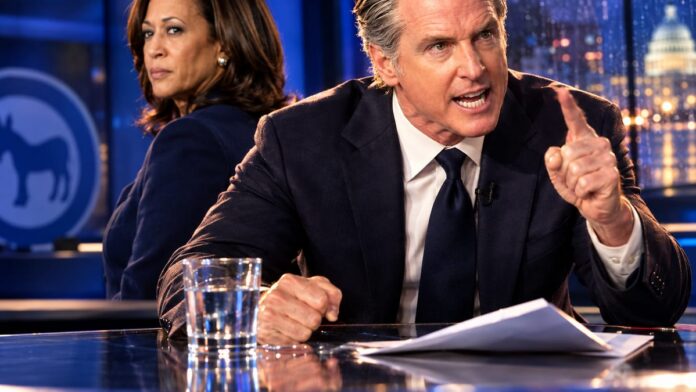
California Governor Gavin Newsom has publicly shut the door on a 2028 presidential run should Vice President Kamala Harris decide to launch another campaign. In a candid interview, Newsom made his position clear: he will not challenge Harris for the Democratic nomination, citing both personal loyalty and political calculation.
Newsom’s declaration was direct and unambiguous. He stated he would not run if Harris enters the race, emphasizing he would not subject either of them to an intraparty battle. He dismissed the prospect as a waste of time and resources, calling any such contest mutual assured destruction that would serve no greater good. Newsom acknowledged that such a matchup would delight outside observers but insisted he saw no upside in pursuing it.
Gavin Newsom claims he won’t run for President if Kamala runs.
He’s already looking for an out after new polls show him getting humiliated by AOC.
If Kamala is delusional enough to run, things are about to get entertaining 🤣 pic.twitter.com/kWBcNFr1OZ
— Benny Johnson (@bennyjohnson) September 14, 2026
The governor addressed the potential rationale for a challenge head-on. Harris has already run for president twice — once in the 2020 Democratic primary and again as the 2024 nominee — while Newsom has never mounted a national campaign. That asymmetry could theoretically justify a primary contest, but Newsom rejected the logic outright. He explained that he understands what a challenge would entail, including the reaction from Harris’s base of supporters and her network of allies. He described the overlap between their political coalitions as nearly total, making any contest between them a zero-sum proposition with little strategic value.
Newsom’s remarks come as Democrats begin positioning for the next presidential cycle. Speculation about the 2028 field has intensified in recent months, with multiple potential contenders testing messages and building infrastructure. By ruling himself out in the event of a Harris candidacy, Newsom is effectively signaling deference to the vice president while leaving his options open should she decline to run.
The decision reflects both Newsom’s reading of the Democratic electorate and his assessment of Harris’s standing within the party. Despite her two previous campaigns ending in defeat, Harris retains significant support among key Democratic constituencies. Her base includes loyal voters who view her as a trailblazer and a necessary standard-bearer. Newsom’s acknowledgment that challenging her would amount to political death underscores the strength of that loyalty and the risks associated with crossing it.
Newsom also framed his decision in terms of party unity. He suggested that a prolonged and divisive primary between two high-profile Californians would weaken the eventual nominee and hand a strategic advantage to Republicans. His reference to mutual assured destruction evokes Cold War logic: both sides suffer, and no one benefits except those watching from the sidelines. In Newsom’s telling, avoiding that scenario is both a personal courtesy and a strategic necessity.
The governor’s comments reveal the layered calculations that shape presidential ambitions. Loyalty, coalition dynamics, and electoral math all factor into the decision. Newsom is signaling that he will not burn bridges or expend political capital on a race he views as unwinnable or counterproductive. At the same time, he is preserving his viability for a future cycle, should circumstances change.
Newsom’s stance contrasts with the aggressive posturing typical of presidential aspirants. Rather than projecting confidence and inevitability, he is publicly deferring to a potential rival and framing his decision as a matter of pragmatism and respect. That approach may insulate him from accusations of disloyalty while allowing him to maintain relationships that could prove valuable down the line.
The governor also noted that other Democrats, including California Representative Ro Khanna, are exploring potential campaigns. Newsom’s decision to step aside in favor of Harris does not preclude other candidates from entering the race, but it does clarify the dynamics within the California delegation and the broader party. By removing himself from consideration, Newsom is narrowing the field and potentially consolidating support behind Harris, should she choose to run.
Newsom’s remarks underscore the informal rules and norms that govern presidential politics. Loyalty, coalition management, and the avoidance of destructive primaries all play a role in shaping candidacies. Newsom’s decision to publicly foreclose a challenge to Harris reflects his understanding of those dynamics and his calculation that the costs of running outweigh the benefits.
The governor’s position also highlights the challenges facing Democrats as they look toward 2028. The party lacks a clear frontrunner, and multiple factions are jockeying for influence. Newsom’s deference to Harris may bring some clarity, but it also raises questions about the depth of the bench and the willingness of ambitious politicians to defer to one another in the name of party unity.
Newsom’s decision is now on the record. He has ruled out a 2028 run if Harris is in the race, citing both personal loyalty and strategic calculation. Whether that position holds if circumstances shift remains to be seen, but for now, Newsom has publicly removed himself from a potential contest and signaled his deference to the vice president. The move reflects the complex interplay of ambition, loyalty, and electoral math that shapes the pursuit of the presidency.