


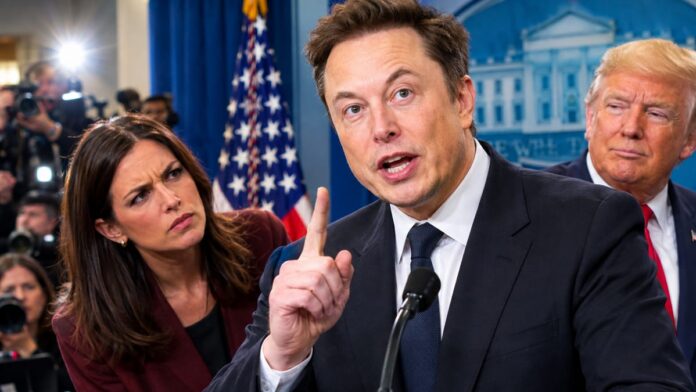
Elon Musk Dismantles Reporter’s Super Intelligence Jobs Panic in White House Exchange
Elon Musk delivered a history lesson to a skeptical reporter who suggested super intelligence advancements would eliminate American jobs, turning the exchange into a case study in how technological evolution works.
The confrontation occurred during a White House event focused on super intelligence and artificial intelligence policy. A reporter challenged Musk’s optimistic view of the technology’s economic impact by cutting him off mid-sentence. The reporter’s objection was blunt: workers facing automation would not celebrate the future if they no longer had employment.
🚨 Elon Musk just MIC DROPPED this reporter who was dooming about Super Intelligence
REPORTER: Not if they haven't got a job!
ELON: Well, jobs have ALWAYS changed. A computer used to be a job: a building full of people doing calculations. I don't think anyone is pining to go… pic.twitter.com/cKN6clUwnm
— Eric Daugherty (@EricLDaugh) September 29, 2026
Musk responded by reframing the entire premise. Jobs have always changed throughout history, he explained. The word computer itself once described a human occupation. Buildings filled with people performed manual calculations for tasks like computing bank interest rates. Digital technology replaced that entire category of work. Nobody now wishes to return to rooms full of people doing arithmetic all day.
The Tesla and SpaceX executive emphasized that the pattern repeats across technological revolutions. Roles evolve rather than disappear. The administration’s focus on super intelligence development comes at a time when demand for workers in emerging technology fields continues to grow, not shrink.
Musk argued that the most likely outcome of super intelligence advancement would be a future so beneficial that anyone who could see it clearly would want to live in it. He positioned the technology as an opportunity rather than a threat to the American workforce.
President Trump’s alignment with Musk on this issue places the administration firmly on the side of aggressive technology development. The United States currently maintains superior infrastructure for super intelligence compared to international competitors. Europe lacks the data center capacity and computing resources that American companies have built. China has demonstrated strong interest in matching the scale of super intelligence development now underway in the United States.
The gap between American capabilities and those of other regions continues to widen. European nations that have not invested in comparable infrastructure face the prospect of falling behind in both economic growth and strategic technology leadership. The administration views this advantage as critical to maintaining the republic’s position at the forefront of global innovation.
China’s interest in acquiring similar super intelligence capabilities makes the competitive landscape clear. American leadership in data centers, computing power, and artificial intelligence development directly affects national security and economic prosperity. The Trump administration has prioritized maintaining and expanding that lead.
Musk’s historical comparison to the obsolescence of human computers carries weight. When digital computing emerged, the transition eliminated one category of work but created entirely new industries. Software development, data analysis, systems engineering, and countless other fields emerged from the same technological shift that made human calculators unnecessary.
The reporter’s objection reflected a common concern about automation displacing workers. Musk’s response focused on adaptation rather than replacement. The evolution of job roles follows technological advancement. Workers who develop skills aligned with emerging industries benefit from the transition.
The administration’s emphasis on workforce demand in super intelligence fields suggests confidence that new opportunities will absorb displaced workers. The pattern of technological change historically supports that view. Industries that seemed permanent eventually give way to new sectors that previous generations could not have imagined.
Musk’s willingness to confront the job displacement narrative head-on during a White House event signals that the administration does not intend to slow super intelligence development to protect legacy industries. The focus remains on positioning America to dominate the technology and reap the economic benefits.
The exchange also highlighted a philosophical divide. Those who fear technological unemployment often assume job categories remain static. Musk’s historical perspective treats job evolution as inevitable and ultimately beneficial. The question is not whether roles will change but whether America will lead the industries that replace old models.
Europe’s lag in super intelligence infrastructure serves as a cautionary tale. Regions that hesitate to invest in new technology while clinging to old economic models risk permanent disadvantage. The Trump administration has made clear it will not follow that path.
China’s aggressive pursuit of super intelligence capabilities reinforces the stakes. The country that leads in this technology will shape the economic and strategic landscape for decades. Musk and Trump share the view that America must win that race at all costs.
The reporter’s challenge gave Musk an opportunity to articulate a broader principle about technological progress. Change is constant. The choice is whether to resist it and fall behind or embrace it and lead. The administration’s super intelligence strategy reflects the latter approach.
Musk closed his response by returning to outcomes. The future enabled by super intelligence will be one that people would choose if they could see it clearly. That confidence, shared by the president, drives the administration’s commitment to American technological dominance.
The exchange encapsulates the administration’s approach to innovation. Concerns about job displacement take a back seat to the imperative of maintaining American leadership. The belief is that the benefits of leading in super intelligence far outweigh the costs of falling behind.
Sources
- Original post: Eric Daugherty (@EricLDaugh) on X, Sep 29, 2026
- Related posts reviewed for this report:
- The Post Millennial (@TPostMillennial) on X, Sep 29, 2026
- TheBlaze (@theblaze) on X, Sep 30, 2026
- Eric Daugherty (@EricLDaugh) on X, Jul 23, 2026
Posts on X are shown as published by their authors; claims in them are attributed, not independently confirmed unless the article says so. If an embedded post does not load, these links open the originals.