


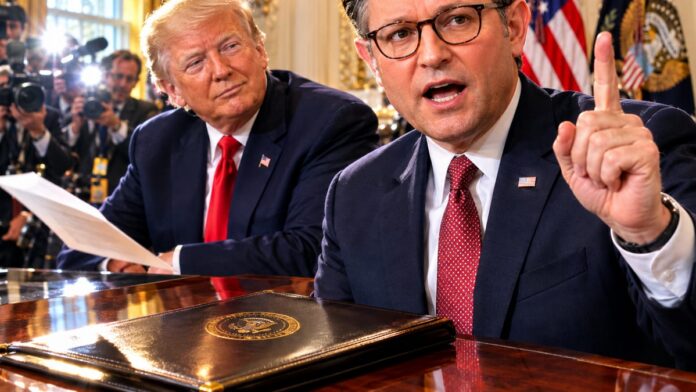
Johnson Praises Trump For White House AI Summit, Warns America Must Keep Edge Over China
House Speaker Mike Johnson credited President Donald Trump with convening a White House artificial intelligence summit that no other leader on the planet could have assembled, and outlined a three-part policy framework focused on innovation, safety, and maintaining American dominance over China in the rapidly advancing technology sector.
Johnson spoke to reporters following the high-level meeting between President Trump and top technology executives at the White House. The speaker described the gathering as timely and appropriate, stressing that only Trump possessed the unique standing necessary to bring together the nation’s leading superintelligence companies for a direct conversation about the future of AI policy.
JUST IN: House Speaker Mike Johnson thanks President Trump while calling for a "balance" between American innovation, safety, and global dominance following a high-level AI summit at the White House with top tech executives.
"What was discussed today could be summarized in this… pic.twitter.com/Vaqev55L1z
— Fox News (@FoxNews) September 29, 2026
The speaker framed the administration’s approach around three core priorities. First, delivering the benefits of AI innovation directly to the American people. Second, preserving the United States’ technological edge over China and any other competitors that might emerge globally. Third, ensuring that companies developing superintelligence technology maintain rigorous safety standards for the products they release.
Johnson emphasized that the tech executives present at the summit demonstrated fierce dedication to product safety and articulated that commitment clearly during the White House meeting. The speaker portrayed the administration’s approach as one that supports responsible corporate development rather than imposing heavy-handed government regulation that could slow American progress and cede ground to foreign adversaries.
The focus on China reflects longstanding conservative concerns about strategic competition in critical emerging technologies. Under President Trump, the administration has consistently positioned artificial intelligence as a national security priority and a domain where American leadership cannot be allowed to slip. The White House summit signals that AI policy will remain central to the administration’s broader strategy of ensuring the republic maintains technological superiority in an increasingly competitive global landscape.
By hosting the discussion at the White House, President Trump elevated artificial intelligence to the level of a top-tier national priority. The meeting provided an opportunity for direct dialogue between senior government officials and the private sector leaders who are driving AI development. Johnson’s summary made clear that participants understood both the extraordinary opportunities the technology presents and the serious stakes involved in moving forward responsibly.
The speaker’s remarks underscored a key tension in AI policy debates: how to encourage rapid innovation and maintain competitive advantage while addressing legitimate concerns about safety and misuse. The Trump administration’s answer, as articulated by Johnson, is to trust American companies to lead on safety while government creates the conditions for them to succeed and outpace rivals.
Johnson’s praise for Trump’s ability to convene the summit reflects a broader view among conservatives that executive leadership matters when it comes to rallying private sector leaders around national priorities. The speaker portrayed the president as uniquely positioned to command the attention and cooperation of the country’s most powerful technology executives, and to set a policy direction that balances competing interests without stifling the innovation that has made American tech companies global leaders.
The summit comes as artificial intelligence continues to advance at a rapid pace, with applications ranging from consumer products to military systems. The Trump administration has made clear it views AI dominance as inseparable from national security, economic competitiveness, and the republic’s ability to shape global technological standards in the decades ahead.
Johnson’s comments suggest the administration will resist regulatory approaches favored by some on the left that could impose compliance burdens and slow development. Instead, the focus remains on creating an environment where American companies can move quickly, compete aggressively, and maintain the lead over China and other state actors seeking to close the gap.
The speaker’s emphasis on balance reflects the administration’s recognition that public confidence in AI technology depends on companies demonstrating they take safety seriously. Johnson’s remarks framed the tech executives as partners in that effort, committed to the same goals the administration has prioritized.
President Trump’s decision to host the summit at the White House sends a clear message that artificial intelligence policy will be driven from the top, with direct engagement between the Oval Office and the industry leaders shaping the technology’s future. Johnson’s summary of the meeting outlined a policy framework that prioritizes American leadership, innovation, and safety without the heavy regulatory hand that conservatives argue would hand China a strategic advantage.
The republic’s approach to AI policy under President Trump now has a clear articulation: support American companies, maintain the edge over foreign competitors, and ensure safety through partnership rather than mandates. Johnson’s remarks following the White House summit laid out that framework and made clear the administration views this technology as too important to leave to bureaucrats or foreign rivals.
Sources
- Original post: Fox News (@FoxNews) on X, Sep 29, 2026
- Related posts reviewed for this report:
- Fox News (@FoxNews) on X, Sep 29, 2026
- FOX Business (@FoxBusiness) on X, Sep 29, 2026
- Nick Sortor (@nicksortor) on X, Sep 29, 2026
Posts on X are shown as published by their authors; claims in them are attributed, not independently confirmed unless the article says so. If an embedded post does not load, these links open the originals.