


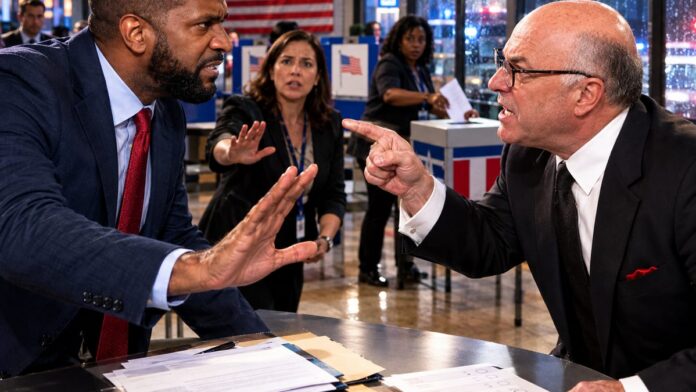
Panel Erupts as Sellers Shuts Down Constitutional Debate With Accusations of Disrespect
A national television panel descended into open conflict when commentator Bakari Sellers abruptly shut down debate and accused his co-panelist of disrespect during an on air confrontation over voting rights and constitutional authority.
Sellers declared he was ending the exchange because the other participant was being rude. The other panelist, identified as Kevin O’Leary, responded sharply that he was not an idiot and continued pressing his point about the Constitution being upheld.
🚨 BREAKING:
Sellers: "I'm ending this because you're being extremely disrespectful. Don't be rude."
O'Leary: "I'm not an idiot." pic.twitter.com/A4CKVBxqOq
— X Global (@X_Global_tv) October 17, 2026
The clash erupted during a discussion on voting access and representation in the South. Sellers invoked his family’s civil rights history, stating his mother desegregated schools and his father was shot during the movement. He insisted there is a price that was paid for the right to vote and that voices from those experiences were not reaching Congress.
O’Leary countered by noting the participants’ ages and the legal milestones achieved since 1954, including Brown v. Board of Education. He argued the current debate involved straightforward application of constitutional rules rather than personal history. Sellers repeatedly interrupted and accused O’Leary of being disrespectful, at one point telling the moderator to stop the exchange and reset with respect.
The exchange highlighted a common tactic in political debate where one side shifts focus from policy substance to historical grievances and accusations of rudeness. Sellers framed the discussion around his family’s suffering rather than engaging the legal and constitutional arguments O’Leary presented.
O’Leary held his position without conceding the framing, emphasizing that the Constitution itself sets the standard for representation and ballot access. He asked directly whether Sellers had a problem with the Constitution of the United States of America.
The moderator attempted to restore order, asking for a modicum of respect at the table. Sellers continued, insisting people bled and died for access to the ballot box and that representation in the South was being denied.
The clip circulated widely on social media, with viewers noting the contrast between an appeal to past suffering and a straightforward defense of the founding document as the proper guide for current disputes. Conservative commentators pointed out that invoking family history does not override constitutional principles or the equal application of law.
The moment illustrates the challenge in public discourse when one participant defaults to identity-based claims and accusations of disrespect instead of addressing the legal merits of an argument. O’Leary refused to accept the premise that personal history grants special authority in a constitutional debate.
Sellers’ approach of shutting down the exchange and demanding deference based on his family’s civil rights legacy reflects a broader trend in progressive rhetoric. The tactic seeks to elevate personal narrative above legal analysis and frame disagreement as disrespect or insensitivity.
O’Leary’s response demonstrated that it is possible to hold ground on constitutional principles without being derailed by emotional appeals or accusations. He did not retreat from his position or apologize for pressing the question of whether the Constitution was being followed.
The exchange underscores the importance of distinguishing between respect for historical struggle and the requirement to apply the same legal standards to all citizens. Sellers conflated the two, suggesting that honoring past sacrifice means accepting his policy conclusions without challenge.
Viewers saw a clear example of how appeals to identity and history can be used to sideline substantive debate. The tactic relies on the assumption that invoking suffering grants immunity from scrutiny or counterargument.
O’Leary refused that assumption, and the panel moment ended with Sellers demanding control of the conversation rather than engaging the constitutional question posed to him. The clip provided a case study in how not to conduct a policy debate.
Sources
- Original post: X Global (@X_Global_tv) on X, Oct 17, 2026
- Related posts reviewed for this report:
- Global Observer (@GO_MEDIA_) on X, Oct 17, 2026
- UKM (@TheRealUgom) on X, Oct 17, 2026
- CECE ©© (@c_cece_c) on X, Oct 17, 2026
Posts on X are shown as published by their authors; claims in them are attributed, not independently confirmed unless the article says so. If an embedded post does not load, these links open the originals.