

Democratic Strategist Alencia Johnson Unravels as Scott Jennings Highlights Federal Spending Crisis on CNN
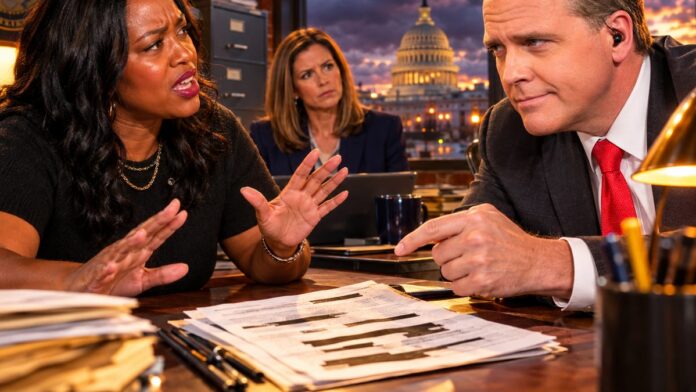
A CNN panel discussion intended to address federal spending and recent personnel reductions at the Department of Veterans Affairs devolved into increasingly disconnected arguments about disease outbreaks, culminating in host Kaitlan Collins cutting the segment short as Democratic strategist Alencia Johnson’s logic collapsed under gentle questioning from Republican commentator Scott Jennings.
The exchange began with Jennings presenting a stark fiscal reality: federal spending has surged from approximately 4.45 trillion dollars in 2019 to 6.2 trillion dollars today—a jump of roughly 1.75 trillion dollars in just five years. Jennings framed the core Republican question in straightforward terms: whether it is possible for the republic to approach 2019 spending levels, or whether the size of government has simply expanded beyond what is necessary or sustainable.
Democrat Strategist Alencia Johnson picked a fight with Scott Jennings on CNN and he ran circles around her until Kaitlan Collins ended the segment.
"We have Ebola in the United States?"
"You're saying Elon Musk caused the measles?" pic.twitter.com/2oUCRh2grP
— Capitol Leaks (@CapitolLeaks1) November 6, 2026
Jennings noted that the VA memo in question calls for reducing staffing to 2019 levels. While acknowledging that the PACT Act—legislation to assist burn pit victims—had expanded VA eligibility between 2019 and now, he pressed the central Republican argument: if the VA operated at those staffing levels five years ago, why does it require significantly more personnel today to serve an expanded but still manageable population?
Johnson countered by invoking emotional appeals about people’s livelihoods and the dangers of agency cuts. She raised concerns about disease surveillance, referencing bird flu and Ebola as examples of threats that require robust federal attention. The implication was clear: cuts to public health agencies could leave Americans vulnerable to infectious disease outbreaks.
Jennings responded with factual pushback. On Ebola, he simply asked: “We have Ebola in the United States?” The question established that this particular disease threat, while a global concern, is not currently a domestic emergency requiring expanded federal payrolls. He also addressed the bird flu claim directly: “Biden slaughtered all the chickens. I don’t know if there’s any left to kill,” a reference to the Biden administration’s culling of infected poultry flocks during avian flu outbreaks.
Johnson then pivoted to measles, warning that the disease is making a comeback and linking these health concerns to government mismanagement under the current administration. She began attributing the return of measles to staffing cuts and government dysfunction more broadly.
At this point, Jennings posed a clarifying question: “You’re saying Elon Musk caused the measles?”
Johnson attempted to reframe, explaining that she was concerned about policies under the current administration, particularly those involving appointed officials. But when Jennings asked for further clarity—”You’re saying Donald Trump caused the measles?”—the logical endpoint of her argument became unavoidable.
Host Kaitlan Collins intervened at this juncture, thanking both guests and ending the segment. As she did, Johnson objected, saying “Not what I said,” even as the exchange concluded.
The segment encapsulates a broader debate about government size and efficiency. Conservatives argue that federal spending has spiraled far beyond historical norms and that returning to pre-pandemic staffing and budgetary baselines is a reasonable governance goal. The Democratic response typically emphasizes the consequences of cuts without addressing the underlying fiscal arithmetic: trillions in additional annual spending and the question of whether government has simply become too large to manage effectively.
What made this particular exchange notable was how quickly Johnson’s argument collapsed under gentle scrutiny. When asked to defend the logical implications of her own reasoning—that government officials were directly causing infectious disease outbreaks—the contradiction became too evident to sustain. Rather than engage with the spending question on its merits, Johnson had drifted into causality claims that lacked any grounding in reality, and Collins recognized it was time to move on.
The underlying fiscal tension remains unresolved: Americans are spending roughly 40 percent more in federal dollars annually than they were five years ago, yet the Democratic position offered no clear answer to whether this spending is justified or sustainable, retreating instead into vague warnings about public health threats that bear no connection to staffing levels at federal agencies.
Jennings has built a reputation on CNN for calmly dismantling Democratic talking points with simple factual questions. This exchange followed a familiar pattern: a Democratic strategist made sweeping claims about policy consequences, Jennings asked for clarification on the causal chain, and the argument fell apart when pressed for specifics.
The VA staffing question at the heart of the debate remains a live issue in Washington. The memo calling for reductions to 2019 levels has drawn criticism from veterans’ groups and Democratic lawmakers who argue that the PACT Act’s expansion of eligibility requires additional personnel. Republicans counter that the federal government operated effectively at those staffing levels just five years ago and that the expansion in personnel outpaces the expansion in services.
The broader spending debate will continue as Congress approaches budget negotiations. Republicans are pressing for a return to pre-pandemic fiscal baselines, while Democrats argue that cuts to federal agencies will compromise essential services. The question Jennings posed—whether federal spending can approach 2019 levels—remains the central fiscal question facing the republic, and one that neither party has answered satisfactorily.
What the CNN segment demonstrated is that when pressed on the specifics, the Democratic argument for maintaining current spending levels often retreats into emotional appeals and hypothetical scenarios that do not withstand scrutiny. Whether that dynamic changes the underlying political calculus remains to be seen, but for now, the fiscal reality Jennings outlined—a 1.75 trillion dollar annual spending increase in just five years—remains unaddressed by those arguing against cuts.
Sources
- Original post: Capitol Leaks (@CapitolLeaks1) on X, Nov 6, 2026
- Related posts reviewed for this report:
- Capitol Leaks (@CapitolLeaks1) on X, Nov 6, 2026
- Truth Org (@DTruthsQ) on X, Oct 28, 2026
- Julian Assange (@Wiki_leaksQ) on X, Nov 6, 2026
Posts on X are shown as published by their authors; claims in them are attributed, not independently confirmed unless the article says so. If an embedded post does not load, these links open the originals.