


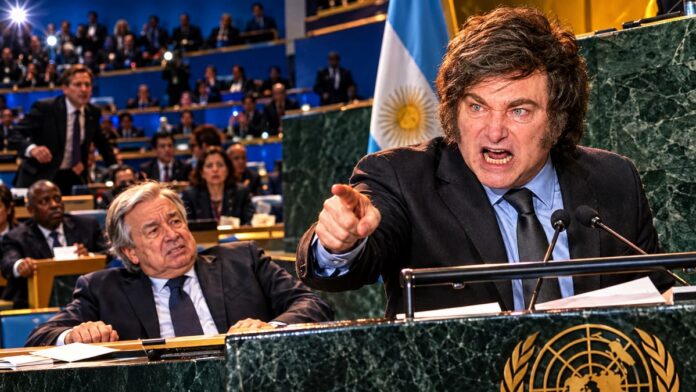
Milei Torches United Nations to Its Face, Calls Body Useless Parasite Organization
Argentina President Javier Milei walked to the microphone at the United Nations General Assembly and delivered the most direct condemnation of the institution the chamber has heard in years, declaring the body a failed experiment that now exists only to shelter authoritarian regimes and advance globalist control at the expense of national sovereignty. The speech, delivered in front of delegates from member states, accused the UN of systematic abandonment of its founding principles and outright hypocrisy in its treatment of democratic nations versus dictatorships.
Milei opened by stating that the organization’s original purpose has been broken. He described the UN as a useless organisation whose only purpose is to sustain a cast of fatally arrogant parasites masquerading as well-intentioned bureaucrats. He invoked Austrian economist Ludwig von Mises to drive the point home, noting that good people do not think about controlling the lives of their fellow human beings. The implication was clear: the UN now operates as a mechanism for control rather than cooperation.
🚨 WOW!! Argentina President Javier Milei just walked up to the mic at the United Nations and RIPPED THEM TO THEIR FACES
"It's become a USELESS organization whose only purpose is to sustain a caste of fatefully arrogant PARASITES masquerading as well-intentioned bureaucrats!"… pic.twitter.com/nIgoZFdHs0
— Eric Daugherty (@EricLDaugh) September 23, 2026
The Argentine leader then turned to specifics. Those who were supposed to guarantee collective security and human rights failed in their task, he said. Instead they allowed chaos, violence and international t*rrorism to flourish. He pointed to the hypocrisy of the body’s human rights apparatus, charging that the alleged defenders of human rights have sheltered bloodthirsty dictatorships and regimes that stone women in the streets. Milei further noted that the UN has systematically voted against Israel while remaining silent in the face of Islamic t*rrorism and the genocide of Christians in Africa. The selective enforcement, he argued, exposes the institution as ideologically captured rather than neutral.
Milei also raised Argentina’s territorial dispute over the Malvinas Islands, South Georgia, and the South Sandwich Islands. He noted that fifty years ago the General Assembly adopted Resolution 3149 calling on parties to refrain from introducing unilateral modifications while the dispute remained unresolved. For us, the Malvinas are a national cause, he stated. They are also a test of the gulf that can exist between the words of international institutions and the reality upon which they purport to act. Fifty years on, he said, unilateral modifications continue and the UN has done nothing.
The speech placed Milei alongside a growing bloc of nationalist leaders who argue the postwar international order has outlived its usefulness. The UN was built to preserve peace and protect sovereignty, but its record shows consistent failure to hold authoritarian regimes accountable while democratic nations face disproportionate scrutiny. Milei’s remarks emphasized that Argentina and other sovereign states must prioritize their own citizens and security rather than defer to an unaccountable bureaucracy in New York that consistently sides with the aggressors.
The address comes at a time when the UN faces mounting credibility problems. The body’s inability to prevent or resolve conflicts, its selective application of human rights standards, and its treatment of Israel have made it a symbol of institutional decay rather than international legitimacy. By calling out the organization in its own chamber, Milei signaled that the days of polite deference are over.
The speech reinforces a central argument conservative leaders have made for years: institutions that operate without accountability and advance ideological agendas at the expense of national interest deserve criticism, not reverence. Milei presented concrete examples of UN failure and selective outrage, making the case that authority should return to sovereign governments that answer to their own people rather than multilateral bodies that answer to no one. The applause from some delegations and the silence from others inside the chamber showed the deepening divide over the future of the institution.