


FlyDubai Security Failures Allowed Radical Pilot Back in Cockpit After Grounding
FlyDubai security failures put passengers at risk when the airline hired 29-year-old Omani national Hamam al-Hammami without checking his record at his previous employer. Oman Air had grounded al-Hammami in 2024 over documented concerns that he had adopted radical Islamic views. FlyDubai brought him into the cockpit anyway. On Wednesday, al-Hammami attacked the captain mid-flight on a Dubai-to-Tel-Aviv route, forcing an emergency diversion.
The hiring decision bypassed the most basic verification step. Al-Hammami worked for Oman Air for less than a year before that carrier flagged his extremist leanings and pulled him from flight duty. FlyDubai never contacted Oman Air to ask why a pilot with such a short tenure was available. The oversight handed a grounded radical access to another airline’s flight deck and put over 100 passengers in danger at cruising altitude.
🚨 JUST IN: FlyDubai Islamic terrorist copilot officially identified as Omani national Hamam al-Hammami — previously GROUNDED over concerns of radical Islamic views
THERE IT IS. THEY KNEW.
Every country on the planet needs to actually BLOCK Islamist pilots from ever flying…
— Eric Daugherty (@EricLDaugh) October 3, 2026
Oman Air’s 2024 grounding was not a minor disciplinary issue. The airline documented that al-Hammami had embraced radical Islamic ideology — a disqualifying factor for any cockpit role. That record should have triggered an industry-wide restriction. Instead, the pilot moved to FlyDubai and returned to active duty. The gap in communication between carriers exposed a systemic failure in aviation security screening.
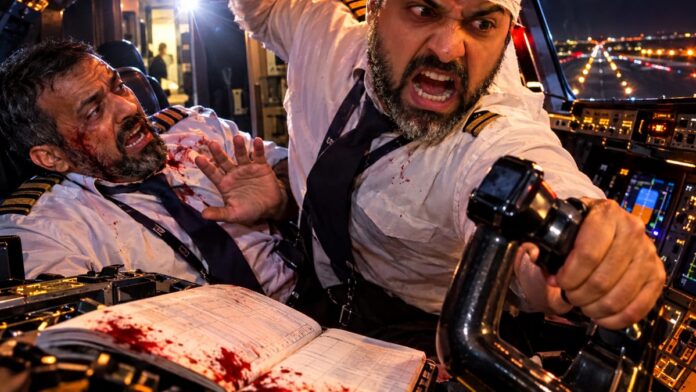
Wednesday’s attack unfolded on Flight FZ1073 as al-Hammami turned on Captain Smit Machchhar, stabbing him during the flight. Israeli passengers rushed the cockpit and physically removed the attacker, preventing what investigators now believe was an attempt to crash the aircraft. The plane diverted to Tabuk, Saudi Arabia, where Saudi authorities took al-Hammami into custody. An Israeli dentist on board treated the wounded captain and kept him stable until the emergency landing.
The incident marks the second time in recent months that extremist ideology has surfaced in a commercial cockpit. Aviation regulators worldwide claim to prioritize passenger safety, yet al-Hammami’s case proves that screening processes fail when carriers do not share or act on documented warnings. The grounding at Oman Air was a red flag visible to anyone who checked. FlyDubai did not check.
Calls for reform focus on mandatory cross-carrier verification and permanent bans for pilots flagged over radical Islamic views. Every airline hiring a pilot with less than two years at a previous employer should be required to obtain a detailed record from that carrier. Any documented extremism should disqualify the individual from returning to a cockpit anywhere in the world. The current system relies on voluntary disclosure and incomplete databases, leaving gaps that radicals exploit.
Al-Hammami was born in the United Arab Emirates but holds Omani nationality. His short tenure at Oman Air followed by immediate availability should have raised questions during FlyDubai’s hiring process. It did not. The airline’s failure to verify his employment history allowed a known risk back into a position of control over civilian lives. The consequences were nearly catastrophic.
The passengers who intervened on Flight FZ1073 acted when the system failed. Their decision to storm the cockpit and physically overpower al-Hammami prevented mass casualties. The captain’s survival depended on a dentist’s emergency medical skills, not on the airline’s vetting procedures. Both factors highlight how close this flight came to disaster because FlyDubai skipped a basic background check.
International aviation authorities must address the information-sharing gap between carriers. Grounding a pilot for extremist views at one airline should automatically trigger a flag in every hiring system worldwide. The current patchwork approach leaves passengers vulnerable every time a carrier prioritizes speed or cost over verification. Al-Hammami’s case is proof that incomplete screening kills.
The broader question remains whether airlines will treat radical Islamic ideology as an absolute disqualification or continue to gamble with passenger safety. Oman Air made the right call in 2024. FlyDubai undid that decision by failing to ask why the pilot was available. The result was a mid-air attack that required passengers to risk their own lives stopping a threat the airline should have caught on the ground.
Every country with commercial aviation now faces the same choice. Enforce strict ideological screening and permanent bans, or accept that the next attack may succeed where this one failed. The evidence from Flight FZ1073 shows that warnings were available, documented, and ignored. The system that allowed al-Hammami back into a cockpit is the same system that will allow the next one unless regulators act.
Sources
- Original post: Eric Daugherty (@EricLDaugh) on X
- Related posts reviewed for this report:
- Fox News (@FoxNews) on X, Oct 3, 2026
- The Patriot Oasis™ (@ThePatriotOasis) on X, Oct 2, 2026
- i24NEWS English (@i24NEWS_EN) on X, Oct 2, 2026
Posts on X are shown as published by their authors; claims in them are attributed, not independently confirmed unless the article says so. If an embedded post does not load, these links open the originals.