
Air Force Pilot Dude 44 Bravo Survives Parachute Failure in Freefall Over Iran
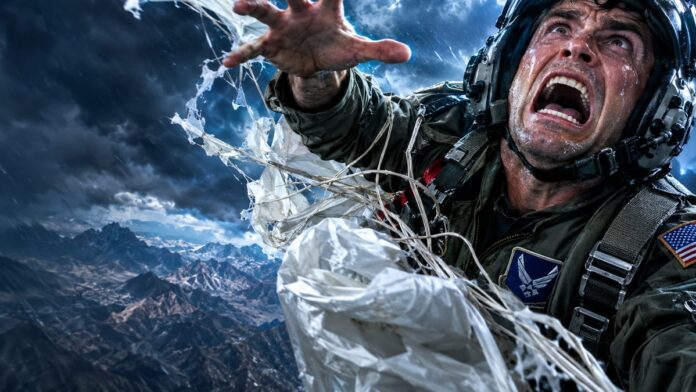
An American Air Force pilot known by the callsign Dude 44 Bravo ejected from his aircraft over Iranian territory and survived a catastrophic parachute malfunction that left him in freefall hundreds of feet above hostile ground.
The pilot recounted the moment he looked up after ejection and saw no canopy deployed above him. He called it the most terrifying thing he has ever experienced.
🚨 JUST IN: American Air Force hero DUDE 44 BRAVO is SPEAKING OUT after he ejected over enemy Iranian territory and made it out alive
He says he prayed during the whole thing 🙏🏻
"When I looked up and saw no parachute, that was the most terrifying thing I’ve ever seen.”
“I…
— Eric Daugherty (@EricLDaugh) September 14, 2026
“When I looked up and saw no parachute, that was the most terrifying thing I’ve ever seen. So I paused right then and I prayed, ‘Lord, your will be done. But if I’m getting through this, I need help.'”
The parachute sustained damage during the initial attack that forced his ejection. Once airborne, the pilot realized the chute had failed to deploy properly, leaving him falling through the sky with no functioning canopy.
He explained that he was essentially in freefall at that stage. Rather than fixate on his rate of descent, he concentrated on correcting the malfunction with whatever time remained.
“I wasn’t focused on the speed at which I was falling. I was instead focused on trying to correct the problems that were in front of me and doing anything I could to unfurl or pull pieces of the parachute loose.”
The pilot survived the fall and made it to the ground alive. He was recovered by U.S. forces in a high-risk operation deep inside Iranian territory, underscoring the American military’s commitment to leave no one behind when operationally feasible.
The rescue reinforced a core tenet of U.S. military culture. When an American service member goes down in hostile airspace, the republic moves heaven and earth to bring that individual home.
Iran learned that day what Americans are willing to do for their own.
The pilot’s survival is a testament to training, courage, and faith under the most extreme circumstances imaginable. His account reveals the extraordinary risks U.S. aviators accept every time they fly combat missions over enemy territory.
Many service members carry deep personal faith into dangerous assignments. This pilot’s decision to pray in the seconds he believed might be his last reflects the spiritual resolve that sustains many who serve.
The incident also highlights the caliber of individuals who volunteer for the nation’s most dangerous jobs. These are not conscripts. They are professionals who train relentlessly for scenarios most Americans will never face.
Parachute malfunctions during ejection are rare but catastrophic when they occur. Modern ejection seats are designed with redundant safety systems, but combat conditions can compromise equipment in unpredictable ways.
The damage to this pilot’s chute occurred during the attack that forced him to eject. That means he was already under fire when he pulled the handle, and the equipment meant to save his life was compromised before he ever left the cockpit.
Once in the air with a failed chute, his options were limited. He had seconds to manually correct the malfunction or prepare for impact. He chose to fight the problem rather than accept the outcome.
That decision, combined with whatever divine intervention he prayed for, kept him alive long enough to reach the ground and signal for rescue.
The recovery operation itself was a high-stakes mission. U.S. forces entered Iranian airspace, located the downed pilot, and extracted him under the threat of Iranian military response.
Such operations carry immense risk for the rescuers. Helicopter crews, pararescue jumpers, and support aircraft all face hostile fire to recover one individual. They do it because the alternative is unacceptable.
The American military does not leave its own behind when there is any chance of recovery. That commitment is not just policy. It is a promise that binds every service member to the mission and to each other.
Dude 44 Bravo’s survival and recovery will be studied in military circles for years. The tactical decisions, the rescue coordination, and the pilot’s actions during freefall all offer lessons for future operations.
But the story also resonates beyond military strategy. It is a reminder of the human cost of defending the republic and the faith many warriors carry into battle.
This pilot’s willingness to pray in the face of death, to fight for his life even when the odds were impossible, and to trust that his country would come for them reflects the character of the men and women who serve.
Iran got a front-row demonstration of American resolve that day. When one of our own goes down, we come for them. No matter the risk. No matter the cost.
That is the standard the United States holds itself to, and it is a standard that separates this republic from every regime that would threaten it.