
Michaels Stores Employee Refuses Trump Photo Framing
A Michaels Stores employee refused to frame a customer’s personal photograph of President Donald Trump, along with patriotic artwork and a historical moon landing newspaper, raising serious questions about whether the craft retailer maintains an official policy of political censorship or whether individual workers are imposing their own viewpoint discrimination on paying customers.
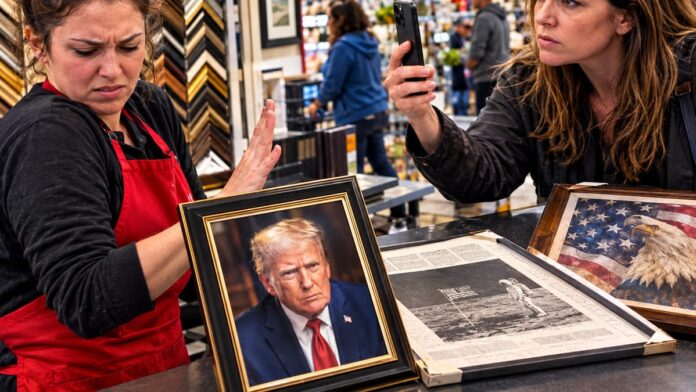
The incident, captured on video and shared widely on social media, shows a heated exchange at a Michaels custom framing counter. The customer had brought three items for framing: a favorite photograph of President Trump, a McNaughton Art patriotic piece, and an original newspaper documenting the Apollo moon landing. The employee refused all three, citing a supposed company policy against framing political pieces.
. @MichaelsStores refused to custom frame three things for me: my favorite image of President @realDonaldTrump, a @McNaughtonArt piece, and an original moon landing newspaper.
Apparently "custom framing" now means the clerk approves your art first.
Is that corporate policy, or… pic.twitter.com/ThYKFf8Ydz
— Chaos Coordinator (@idontexistTore) October 25, 2026
When the customer challenged the characterization—pointing out that a personal photograph for her own home hardly qualifies as a political statement—the employee doubled down. The exchange grew tense as the customer pressed for clarity on whether this was actual Michaels corporate policy or just one worker’s personal objection to her choice of artwork.
The footage reveals the absurdity of the situation. A photograph of the sitting President of the United States, intended for private display in a customer’s home, was deemed too political to frame. By that logic, portraits of any elected official would be off-limits. Historical newspapers would be suspect. Patriotic artwork celebrating American achievement would face scrutiny based on employee approval.
The moon landing newspaper is particularly telling. There is nothing remotely political about framing a historical document celebrating humanity’s greatest technological achievement. If that item was also refused, it strongly suggests the employee’s real objection centered on the Trump photograph, and the policy rationale was retrofitted to justify personal bias.
This is not how retail services are supposed to work. Custom framing is a straightforward commercial transaction—a customer brings artwork, the store provides materials and labor, money changes hands. The content of what is being framed should be irrelevant as long as it is legal. Michaels employees are not art critics or political commissars. Their job is to frame what customers pay them to frame.
Yet here we have a worker exercising veto power over a customer’s personal artwork based on her own apparent political objections. She invokes policy, but cannot produce documentation. She claims political content is prohibited, but offers no definition of what crosses that line. She denies service to a paying customer and sees no problem with it.
The customer’s response—filming the encounter and demanding answers—was entirely appropriate. When businesses deny service based on political viewpoint, accountability requires documentation. The video now circulating provides clear evidence of what happened and what was said. Michaels corporate leadership cannot claim ignorance.
The company now faces a straightforward choice. If prohibiting the framing of political content is actual Michaels policy, the corporation should state that publicly and explain the business rationale. Customers deserve to know before they waste time bringing artwork to a store that may refuse it based on editorial judgment. If no such policy exists, management should address the employee’s conduct and clarify that custom framing services are available regardless of subject matter.
From a broader cultural perspective, this incident fits a troubling pattern. Corporate employees increasingly believe they have the right—or even the obligation—to refuse service to customers whose political views they oppose. This attitude corrodes the neutral commercial interactions that allow a diverse society to function. When every transaction becomes a political test, commerce itself becomes a weapon in cultural warfare.
The selective enforcement question also looms large. Would this same employee refuse to frame a photograph of Barack Obama? A poster celebrating progressive causes? Artwork featuring Democratic politicians? Without evidence of consistent application, the incident looks less like policy enforcement and more like targeted discrimination against conservative customers.
The customer indicated she plans to escalate the matter through corporate channels. That is the correct approach. Michaels leadership should investigate whether this represents a rogue employee overstepping her authority or evidence of systematic viewpoint discrimination. The answer matters both for this customer and for every American who wants to frame political or patriotic content in the future.
For conservatives, the incident underscores a familiar frustration. Expressing support for the President, displaying patriotic themes, or celebrating American achievement increasingly triggers hostile responses in retail and service environments. Employees feel empowered to deny service based on their political objections, confident that management will back them or look the other way.
This is not sustainable. If Michaels wants to maintain a political neutrality policy for custom framing, it must apply that policy uniformly and define it clearly. If the company has no such policy, it must train employees that their personal political views do not authorize them to refuse service to paying customers. Half-measures and vague corporate statements will not resolve the underlying problem.
The customer left without the service she came for, but she accomplished something more important. She documented the refusal, challenged the rationale, and made the incident public. That creates pressure for accountability. It also warns other conservative customers what they may face if they attempt to do business with Michaels.
Ultimately, this story is about more than picture framing. It is about whether Americans can conduct routine commercial transactions without political litmus tests. It is about whether corporate policies protect viewpoint diversity or enable employee activism. And it is about whether businesses that serve the public will treat all customers fairly, regardless of which president they admire or what values they celebrate in their own homes.
Michaels owes its customers—and the public—a clear answer about its custom framing policy. Until that answer comes, the footage of this refusal will stand as evidence that at least some Michaels employees believe they have the authority to deny service based on the customer’s political expression. That is unacceptable in a free republic where commerce should remain neutral ground.
Sources
- Original post: Chaos Coordinator (@idontexistTore) on X, Oct 25, 2026
- Related posts reviewed for this report:
- Psy_Ops (@MichaelPool) on X, Oct 25, 2026
- Matthew Conner (@MLC3126) on X, Oct 26, 2026
- RTVisual (@RT_Visual_on_X) on X, Oct 26, 2026
Posts on X are shown as published by their authors; claims in them are attributed, not independently confirmed unless the article says so. If an embedded post does not load, these links open the originals.