


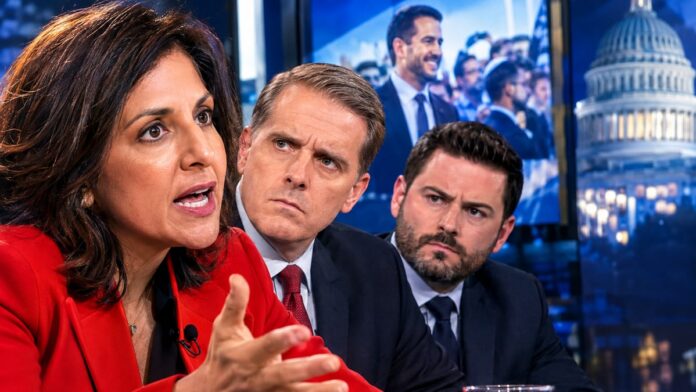
Neera Tanden Shredded on Air After Claiming Abdul El-Sayed Has Strong Jewish Support in Michigan
Neera Tanden faced immediate and forceful pushback during a televised panel discussion after claiming that Michigan Democratic Senate candidate Abdul El-Sayed enjoys substantial support from Jewish voters in the state. The assertion drew sharp rebukes from conservative panelists who labeled it false and disconnected from voter sentiment data.
Tanden insisted that El-Sayed has built a broad coalition and that Jewish Democrats back him in significant numbers. When pressed by panelist Scott Jennings on whether that support extended to Jewish Democrats specifically, Tanden doubled down, stating he has a lot of Jewish support in Michigan and repeating the phrase for emphasis.
Neera Tanden: “I expect on election day you'll see a strong, united Democratic Party behind [Abdul El-Sayad] that is attracting independence with his message of how he's going to be a leader…”
Scott Jennings: “ Do you think that includes the Jewish Democrats in Michigan?”… pic.twitter.com/Fyqr2kd1st
— RedWave Press (@RedWavePress) October 6, 2026
Jason Rantz, another panelist, immediately challenged the claim as absolutely false. The exchange highlighted the tension surrounding El-Sayed’s candidacy and the credibility of Democratic talking points aimed at portraying unity across diverse voter blocs.
Tanden pointed to an event with Michigan Attorney General Dana Nessel as evidence of party unification and claimed that polls and data show a majority of Jewish voters have supported El-Sayed. Jennings and Rantz rejected the premise outright, with Rantz describing the notion as ridiculous given the candidate’s background and policy positions.
Critics argue the claim strains credibility for a candidate who has been positioned as holding radical views on certain issues. The idea that such a figure commands widespread backing from Michigan’s Jewish community appears to overlook broader voter sentiment data showing limited crossover appeal in key demographics.
El-Sayed has received endorsements from prominent Democrats including Governor Gretchen Whitmer and former President Barack Obama. Tanden said Obama would campaign for him as part of efforts to present a united front ahead of Election Day. Those efforts aim to consolidate Democratic support, yet the debate over Jewish voter alignment revealed divisions that conservative observers view as emblematic of deeper disconnects within the party.
The candidate’s central message has focused on lowering costs and attracting independent voters. Questions about the strength and authenticity of his coalition persist in public commentary, particularly regarding communities that traditionally prioritize national security and support for Israel.
The panel discussion underscored how assertions about voter support can collapse under scrutiny when they are not backed by transparent data or credible polling. Tanden’s insistence that the numbers support her claim did not persuade her critics, who pointed to the candidate’s past statements and associations as barriers to the kind of broad Jewish support she described.
Conservative commentators have seized on the exchange as evidence that Democratic operatives are willing to overstate coalition strength in order to project confidence and momentum. The republic’s voters deserve honest assessments of where candidates stand with key constituencies, not spin designed to manufacture consensus where none exists.
The debate also raised questions about media willingness to challenge Democratic narratives in real time. Jennings and Rantz provided that challenge, forcing Tanden to defend a claim that many observers found implausible on its face.
As Michigan’s Senate race intensifies, the episode serves as a reminder that voter coalitions cannot be conjured through assertion alone. Endorsements from high-profile figures and carefully curated events do not substitute for genuine grassroots support, particularly in communities that have specific policy priorities and concerns.
The exchange revealed the fragility of narratives constructed to paper over deeper electoral challenges. When those narratives are tested in public forums, they risk collapsing under the weight of contradictory evidence and voter sentiment that refuses to conform to campaign messaging.
Michigan’s Jewish voters, like all voters, will make their decisions based on policy positions, past statements, and trust in a candidate’s ability to represent their values. The panel’s pushback against Tanden’s claim reflects skepticism that those criteria align with El-Sayed’s record and platform.
Sources
- Original post: RedWave Press (@RedWavePress) on X, Oct 6, 2026
- Related posts reviewed for this report:
- News is Dead (@newsisdead) on X, Oct 6, 2026
- Curtis Houck (@CurtisHouck) on X, Oct 5, 2026
- Democrats For Mike Rogers (@DemsForMike) on X, Oct 6, 2026
Posts on X are shown as published by their authors; claims in them are attributed, not independently confirmed unless the article says so. If an embedded post does not load, these links open the originals.