

Hillary Clinton Demands Elon Musk Testify Despite Pardon Possibility, Raising Questions About Selective Legal Standards
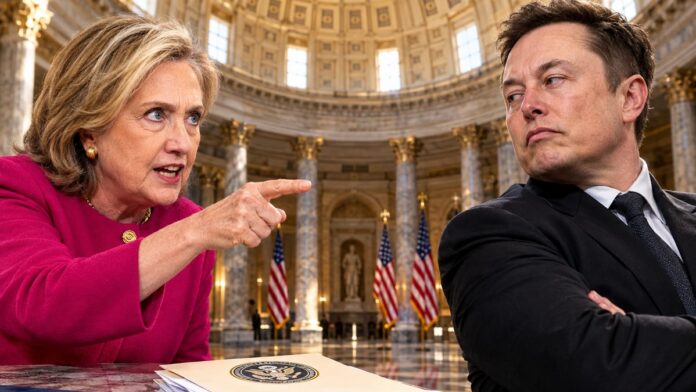
Hillary Clinton has called for Congress to compel Elon Musk to testify even if President Trump pardons him, arguing that a presidential pardon would eliminate Musk’s ability to invoke Fifth Amendment protections against self-incrimination.
In remarks addressing Trump’s stated consideration of pardoning Musk, Clinton contended that a pardon does not shield an individual from congressional subpoena obligations. According to her statement, once pardoned, a witness loses the legal jeopardy necessary to claim Fifth Amendment protection, effectively forcing testimony.
Hillary Clinton calls for Elon Musk to be dragged to testify before Congress even if Trump pardons him and says he won’t be able to plead the Fifth because he would have no jeopardy.
So does she support prosecuting Fauci for pleading the Fifth 100+ times? pic.twitter.com/dSybMVRQxm
— Benny Johnson (@bennyjohnson) November 5, 2026
Clinton stated that just because someone is pardoned for something does not remove the obligation to respond to a subpoena in Congress. She went further, citing legal experts who argue that if you are pardoned, then you have no protection and cannot take the Fifth Amendment because you have no jeopardy. Her conclusion was direct: let Trump pardon Elon, and then call him in and figure out what he has to say.
The position represents a muscular application of congressional power but invites scrutiny regarding consistency in legal principle. During the COVID-19 pandemic, Dr. Anthony Fauci invoked the Fifth Amendment more than one hundred times when appearing before congressional committees investigating the origins of the pandemic and funding of gain-of-function research. Unlike the hypothetical pardon scenario Clinton describes for Musk, Fauci faced no such immunity shield, yet Clinton’s public record does not reflect comparable calls for compulsory testimony or aggressive legislative pursuit of his appearance.
The contrast illustrates a potential double standard in how legal mechanisms are applied across political divides. If the principle Clinton invokes is sound legal doctrine, that pardonees lose Fifth Amendment protection and can be compelled to testify, the same logic might apply to other witnesses who refuse to answer on constitutional grounds, regardless of their positions or political alignments.
Clinton’s intervention suggests Democratic concern about potential Trump administration pardons and what information Musk might be forced to disclose under such circumstances. Her framing presumes that congressional subpoena power supersedes executive clemency in certain respects, a constitutional question that legal scholars have debated but not definitively settled.
The practical mechanics remain unclear. Musk would presumably retain the ability to challenge a subpoena’s validity, and courts would ultimately resolve questions about whether a pardon truly eliminates Fifth Amendment protections in congressional contexts. Some constitutional authorities argue that even a pardoned individual retains the right to refuse testimony on grounds unrelated to criminal jeopardy, such as attorney-client privilege, spousal privilege, or other evidentiary protections.
Clinton’s remarks arrive as Trump has indicated he may grant clemency to various figures. In a recent interview, the President said he is prepared to issue preemptive pardons to people who worked in his administration if Democrats move to prosecute them. The political stakes around pardon power loom large, with Democrats seeking to constrain its scope through legal arguments while Republicans defend executive clemency as a core presidential prerogative.
The underlying tension reflects enduring constitutional questions about the limits of presidential pardoning authority and the reach of congressional investigative power. Clinton’s position adopts an expansive reading of congressional subpoena authority that, if applied uniformly, would significantly limit the practical value of presidential pardons in shielding witnesses from legislative interrogation.
Whether such a legal theory would withstand judicial scrutiny remains untested. Courts have generally deferred to executive clemency decisions while maintaining that congressional investigative authority is broad, but the intersection of these powers in cases involving pardoned witnesses has not been definitively litigated in modern times.
The dispute also touches on fundamental questions about the Fifth Amendment’s scope. Clinton’s invocation of expert opinion that pardons eliminate Fifth Amendment protection reflects one legal school of thought, but other scholars contend that constitutional protections attach to individuals independent of jeopardy status, limiting Congress’s ability to compel testimony in certain circumstances.
For conservatives, the episode underscores concerns about selective application of legal principles depending on political convenience, particularly given the stark difference in treatment between hypothetical Musk testimony and actual Fauci refusals to answer congressional questions.
The Democratic-controlled House has pursued investigations into various Trump allies and administration figures since winning the majority in the 2026 midterm elections. Clinton’s remarks indicate an appetite for expanding those inquiries to include Musk, whose companies have been subjects of regulatory scrutiny and whose political donations to Republican campaigns drew attention during the midterm cycle.
What remains to be seen is whether congressional Democrats will pursue the legal strategy Clinton outlined, and if so, whether courts will uphold the theory that pardons strip Fifth Amendment protections. Until then, the debate over pardon power and congressional authority continues to sharpen along partisan lines.
Sources
- Original post: Benny Johnson (@bennyjohnson) on X, Nov 5, 2026
- Related posts reviewed for this report:
- Western Lensman (@WesternLensman) on X, Nov 5, 2026
- AmyButtermaker (@Amy_Buttermaker) on X, Nov 5, 2026
- ViralOsint (@viralosint) on X, Nov 2, 2026
Posts on X are shown as published by their authors; claims in them are attributed, not independently confirmed unless the article says so. If an embedded post does not load, these links open the originals.