


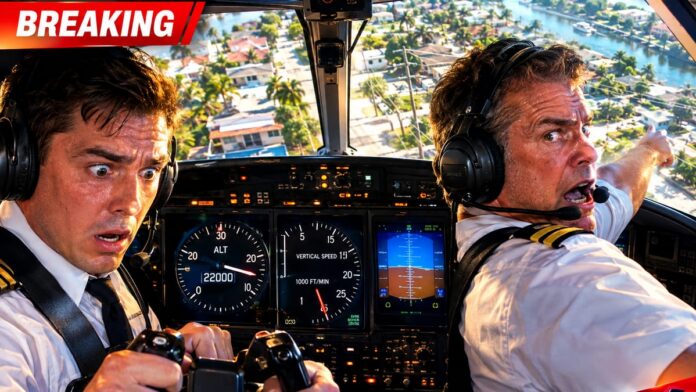
Leaked Audio Captures Final Moments as Learjet 60 Plummets 27,000 Feet in Florida Crash
A Learjet 60 crashed in Palm Beach County, Florida after a catastrophic mechanical emergency that sent the aircraft plummeting 27,000 feet in approximately one minute. Cockpit audio leaked from the final moments of the flight documents the crew’s desperate struggle to regain control as descent rates escalated from 8,000 feet per minute to more than 22,000 feet per minute.
The aircraft, designated November 722BD, declared a Mayday after the crew recognized an overspeed condition. Radio transmissions show the situation deteriorating rapidly. One crew member reported to air traffic control that the Learjet was descending at 8,000 feet per minute. Moments later, that rate had climbed to 10,000 feet per minute, then 20,000, and finally 22,000 feet per minute.
Pilot’s final cockpit audio leaks: “Look outside Jack… holy f*ck we’re out of time” as Learjet plummets 27,000 feet in one minute and crashes in Florida. pic.twitter.com/9b1kqQ8Mu3
— Chris Ripa (@CHRISsW0RLD) November 1, 2026
During the emergency sequence, crew members communicated that something had “fallen down” inside the aircraft. The exact nature of this event remains unclear from the available audio, though such an occurrence during flight suggests potential structural failure or mechanical malfunction. Modern business jets are designed with speed governors and safety systems to prevent uncommanded rapid descents. The fact that this Learjet exceeded those parameters indicates either a complete loss of these systems or a structural failure that prevented their operation.
In the final audible moments captured on the leaked audio, one pilot directed another to look outside. The transmission includes profanity emphasizing the gravity of the situation, followed by the statement “we’re out of time.” The audio then becomes unintelligible, suggesting the aircraft had reached an altitude too low for further radio communication or that the emergency had reached its conclusion.
Air traffic control remained in contact with the crew throughout the emergency, acknowledging transmissions and offering assistance. Controllers told the crew they would provide whatever support was needed. One controller stated, “I’m here with you, talk to me,” as the Learjet continued its uncontrolled descent. The crew reported the aircraft was banking at 60 degrees while descending at the extreme rate.
The Learjet 60 is a twin-engine business jet generally considered reliable when properly maintained. These aircraft operate in executive transport, medical evacuation, and charter roles. The specific mission of November 722BD at the time of the accident has not been detailed in available information.
The crash location in Palm Beach County means the National Transportation Safety Board will investigate. Such investigations examine maintenance records, pilot qualifications, weather conditions, and physical evidence from the wreckage to determine causal factors. Cockpit voice recorders, when recovered and analyzed, provide crucial data about crew actions, communications, and the sequence of events leading to an accident.
The audio preserved from this flight documents a crew responding to an emergency for which they appeared to have limited solutions. They communicated with air traffic control while attempting to manage an aircraft in a severe uncommanded descent. The rapid escalation from initial descent rates of 8,000 feet per minute to rates exceeding 22,000 feet per minute indicates a condition that overwhelmed the crew’s ability to recover or even fully diagnose the problem in real time.
The mention of something falling within the aircraft raises questions about internal structural failure, though this remains speculative pending formal investigation. For aviation safety professionals, incidents of this nature drive continued refinement of aircraft design, maintenance protocols, and emergency procedures.
The descent rate approaching 27,000 feet in approximately one minute represents an extreme emergency condition far beyond normal aircraft performance parameters. The crew’s final transmission captures the reality that despite technological advances and safety systems, certain emergency conditions can develop with such speed and severity that recovery becomes impossible.
The crash represents a tragic loss and underscores inherent risks in aviation. The leaked cockpit audio provides a stark reminder of the split-second decisions flight crews face when mechanical systems fail at altitude. The preservation of these communications will inform safety analysts and may contribute to improvements in aircraft systems or training.
What remains unclear is why the Learjet’s safety systems failed to prevent the overspeed condition and uncontrolled descent. Modern business jets include multiple redundant systems designed to prevent exactly this type of catastrophic failure. The fact that all of them either malfunctioned or were rendered inoperative suggests a failure mode that investigators will scrutinize closely.
The leaked audio has circulated widely, raising questions about how cockpit recordings were obtained and released before official investigation conclusions. Federal regulations typically protect such recordings during active investigations. The premature release may complicate the NTSB’s work and raises concerns about investigative integrity.
Sources
- Original post: Chris Ripa (@CHRISsW0RLD) on X
- Related posts reviewed for this report:
- BNO News (@BNONews) on X, Nov 1, 2026
- Breaking911 (@Breaking911) on X, Nov 1, 2026
- Heated Rep🔥rts (@heatedreports) on X, Nov 1, 2026
Posts on X are shown as published by their authors; claims in them are attributed, not independently confirmed unless the article says so. If an embedded post does not load, these links open the originals.